
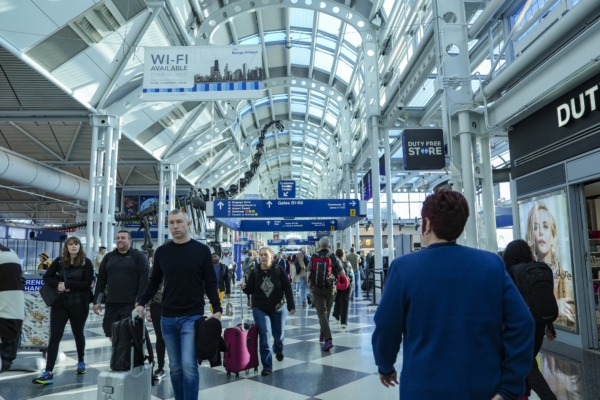
Chicago’s O’Hare International Airport is becoming a battleground for dominance between the two major US legacy airlines, United Airlines (commonly known as United) and American Airlines (commonly known as American).
For years, O’Hare International Airport has been a strategic hub for both airlines and a frontline of fierce competition. The competition has evolved into a comprehensive battle for boarding gates, routes, flight schedules, premium business passenger transport, and market share.
Analysts point out that the focus of the competition lies in the “boarding gates and time slots.” The airline that controls more and better boarding gates and more convenient flight schedules can attract more business travelers, who are often willing to pay higher fares.
In major US hub airports, usually only one airline dominates. Currently, Delta Air Lines dominates Atlanta, United controls Houston, and American Airlines has an advantage in Dallas. Chicago stands out as one of the few airports where the two traditional airlines can engage in large-scale competition.
United Airlines currently holds the upper hand, with its headquarters in Chicago and considering O’Hare as its “home turf.” The company is focused on consolidating and expanding its leading position here.
United Airlines plans to operate nearly 650 flights per day from O’Hare Airport this summer, serving around 200 destinations. The airport has expanded its boarding gates, widened the range of connecting flights, added thousands of local employees, and plans to hire thousands more by 2027.
Benefiting from ongoing investments, faster growth, and more reliable operations, United Airlines achieved a flight cancellation rate of only about 1% last year at O’Hare Airport, marking its best performance at the airport, and leading American Airlines by nearly 20 percentage points in the local passenger market share.
American Airlines, on the other hand, is working hard to catch up. Despite a slower recovery after the pandemic, it has recently seen significant expansion.
In late December last year, American Airlines announced its largest-ever spring flight schedule at O’Hare Airport, adding about 100 peak-day flights covering over 75 destinations. The daily flight volume for spring exceeds 500 flights, a 30% increase from the same period last year, and the seasonal transatlantic routes have been expanded to Paris and Dublin.
O’Hare Airport serves as the third-largest hub for American Airlines.
As the competition intensifies in boarding gates and flight schedules, the investment costs for both airlines are escalating.
Chicago, located in the Midwest of the US and connecting cities on the East and West coasts as well as serving as a gateway to Europe and Asia, has a concentration of large corporations fueling the demand for premium cabins, VIP lounges, and reliable operations.
Hence, both airlines are investing in high-end offerings.
United Airlines is expanding its premium seating and VIP lounge capacity and introducing high-speed “Starlink” Wi-Fi service.
American Airlines is upgrading its fleet and products, aiming to improve profit margins through high-end offerings. The airline has indicated that after completing the fleet upgrade, all flights departing from O’Hare Airport now offer premium seating, with its most profitable wide-body aircraft, the Boeing 787-9, serving as the core model on its Chicago to London route.
American Airlines also mentioned that the loyalty program enrollment in Chicago saw an increase of about 20% in the third quarter of 2025, almost twice the network average growth rate.
Data from Cirium shows that United Airlines operates around half of the scheduled flights at O’Hare Airport, while American Airlines operates about one-third.
At the end of 2025, in a reallocation led by the City of Chicago government, United Airlines gained five boarding gates while American Airlines lost four. American Airlines later challenged this allocation in court but ultimately lost. This widened the gap between United Airlines and American Airlines at the airport.
Steve Johnson, Chief Strategy Officer at American Airlines, told Reuters, “This is only a temporary setback for us.” He mentioned that their constantly expanding flight schedule should reinforce their position in future flight allocations.
To offset this operational setback, American Airlines recently spent $30 million to acquire two boarding gates from Spirit Airlines, stating that this deal would restore about half of the lost capacity.
Michael McMurray, Commissioner of the Chicago Department of Aviation, stated that the fierce competition between airlines showcases Chicago’s strength. O’Hare Airport has eight runways, and an $8.5 billion expansion plan over the next decade will increase terminal space, add boarding gates, resolve congestion issues, and bring more non-stop flights, optimized flight schedules, and lower fares for passengers.
Recent analysis by Joseph Schwieterman, a professor at DePaul University, shows that O’Hare Airport saw growth rates surpassing any other major US aviation hub in passenger numbers, flight departures, and boarding gate utilization in the past year.
He emphasized that this competition is “unprecedented” for the US aviation industry, stating that there are lucrative opportunities in Chicago, and both airlines need O’Hare Airport to thrive.
Former American Airlines upper management and current consultant Robert Mann expressed concerns about the risks of this competition. If American Airlines cannot secure equal boarding gate convenience, its business growth may face pressure, and United Airlines may need larger discounts to defend its market share.
He added, “In fiercely competitive hub airports, passengers often benefit, while monopolistic hubs tend to charge premium prices.”
In the short term, passengers may see more flights and lower fares, but in the long term, once the competition weakens, fares could rebound.
(This article referenced reporting from Reuters)