
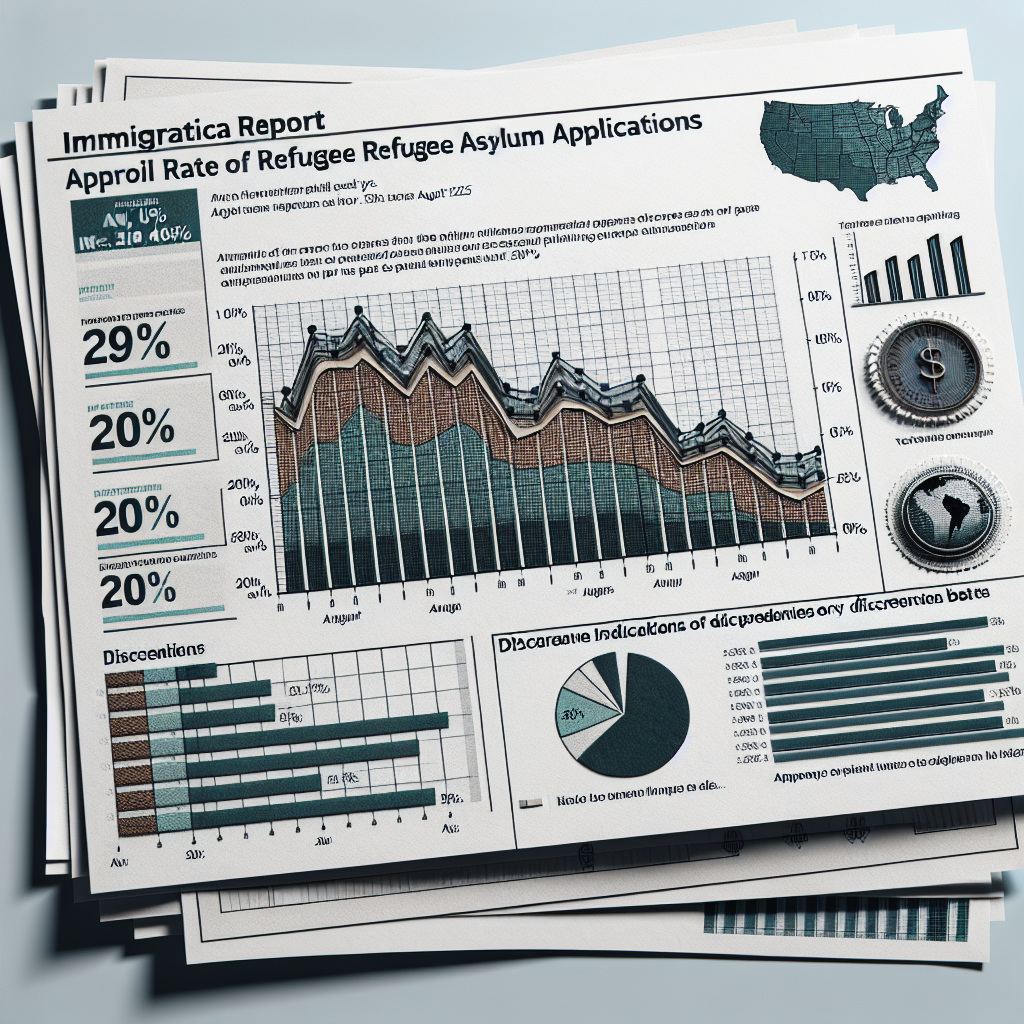
A recent report tracking government immigration data has revealed a sharp decline in the approval rate of asylum refugee applications by the United States government over the past two years, with the approval rate dropping to less than 20% as of August 2025. The report also indicates significant disparities in decisions made by immigration judges regarding the approval of cases.
The
TRAC report
released on November 18th stated that the approval rate for asylum cases in U.S. immigration courts has steadily decreased from 50% in August 2023 to only 19% in August 2025.
The report noted that the decline in approval rates for asylum cases began during President Biden’s tenure, with a 38% approval rate in August 2024, marking a 12% decrease from a year prior. This trend accelerated and continued further under the Trump administration, with a 19% decrease within a year.
According to the report, the Trump administration also “significantly expedited the pace of making asylum decisions.” The peak of asylum case hearings occurred in April and May 2025, with over 12,000 cases being closed. In contrast, during President Biden’s tenure, the monthly closure rate remained around 6,000 to 7,000 cases.
Following the peak in April and May, the closure rate of asylum cases per month dropped by approximately 25%. In August 2025, a total of 9,269 asylum cases were closed.
Despite the decrease in approval rates, the increase in the number of cases being processed means that the difference in the number of asylum applications approved monthly this year is not significantly different from the previous two years, with an estimated average of around 2,000 approvals per month.
According to
TRAC
, as of August 2025, there are over 3.43 million pending immigration cases in the United States, with over 2.27 million pending asylum applications. In 2024, the number of pending asylum cases was approximately 1.6 million.
The TRAC report also included an analysis of the approval outcomes of immigration judges over the past eleven months. The report highlighted significant discrepancies in the approval rates of asylum cases among different judges, although this has been observed previously.
The report stated: “In the latest release of TRAC’s ‘
Immigration Judges Report Series
,’ it is once again evident that there are significant disparities in asylum approval rates among many immigration judges.”
The report pointed out that immigration judges at the San Francisco immigration court showed the largest differences in asylum approval rates. While the judge with the highest approval rate granted 97% of asylum cases, the judge with the lowest approval rate only approved 4.8% of cases.
Among 80 judges in the New York immigration court, the highest denial rate was 97% from a judge who handled 1,125 asylum applications. Conversely, another judge who processed nearly 800 asylum cases had a denial rate of only 3.5%.
The report mentioned significant differences in approval rates among judges at the Boston immigration court, following closely behind San Francisco and New York. The variance in asylum approval rates among judges in Boston exceeded 85%. Similar disparities were observed in the Sacramento immigration court in California and the Arlington immigration court in Virginia, with variances exceeding 84%.
Established in 1989, TRAC, short for the Transactional Records Access Clearinghouse, primarily obtains and analyzes a vast amount of data from U.S. federal government agencies under the Freedom of Information Act (FOIA) for research purposes. Originally based at Syracuse University in New York, TRAC evolved into an independent non-profit organization. Its data analysis reports are frequently cited by the media.