
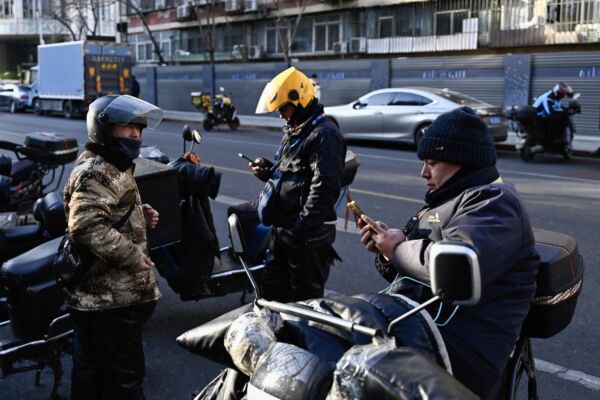
In recent years, with the Chinese economy entering a downturn, the consumer market has continued to decline. The army of food delivery drivers in China is expanding rapidly, with even former business owners and mothers of three forced to join the ranks of low-threshold food delivery workers. This phenomenon not only reflects the expansion of “flexible employment” but also serves as a microcosm of countless families struggling to survive under economic pressure.
The Epoch Times recently interviewed four mainland Chinese women with different backgrounds working as food delivery drivers, whose stories collectively depict the current employment landscape.
Ms. Chen, a mother of three born in the 1990s, used to operate her own clothing store in Shenzhen. However, as consumer demand decreased and offline retail shrunk, her store eventually closed down. For Ms. Chen, working in food delivery is not just a source of income but also a responsibility to her family. Transitioning from a small business owner to a full-time delivery driver, she represents many “small bosses” who, due to the impact of the pandemic and economic downturn, had to give up their entrepreneurial dreams and return to the harsh reality of the basic labor market. Her choice embodies the resilience and helplessness driven by family pressures.
Ms. Chen candidly admitted in the interview that the “flexible employment” model is essentially a highly intense survival competition. Her life is filled with fragmented delivery runs: “After lunch hour, I eat a few bites and then I run for tea orders; after the evening peak hours, I do late-night orders. Once I finish the late-night orders, I go back to sleep.”
She pointed out that the price per order depends on the distance. “Close distances pay around three yuan plus an additional subsidy of one yuan and five mao. For longer distances, it’s five to six yuan.” She frankly expressed, “It’s hard to make two hundred yuan running over forty orders. This week, I’m telling you, it’s difficult to even reach three hundred orders, let alone four hundred.”
Food delivery is a job that requires constant running, whether on the road, in residential areas, or climbing stairs. In the past, it was a low-security, high-risk profession. Even now, while the low-security status has been disrupted, the occupational risk remains high.
Ms. Chen mentioned that food delivery is a high-risk industry, as riders face real dangers on the road, but fortunately, she has the courage to handle it. Her job involves working continuously for over 12 hours, without breaks, neglecting family care. She emphasized, “I keep running every day, constantly, pushing myself to earn money for my future retirement.”
“We have kings in our team who complete three to three thousand five hundred orders per week.” They start running orders from 10:30 in the morning and finish around midnight, going back home too exhausted to move.
Ms. Chen mentioned that running deliveries incurs costs; recently, she replaced her car parts, spending over two hundred yuan (“I changed a brake pad… spent over two hundred yuan”).
Compared to the monthly rental of over three hundred yuan for batteries, she believed that “if I buy a battery, I can use it for at least four to five years,” showcasing her meticulous budgeting for long-term costs.
Additionally, Ms. Chen purchased necessary equipment such as boxes and helmets for her food delivery work.
In Anhui and Hubei, the stories of Ms. Zhao and Ms. Ma represent ordinary Chinese families relying on “flexible income” due to limited spousal earnings.
Ms. Zhao, a 30-year-old mother from Suzhou, Anhui, with a 7-year-old son, explained that she got married young and had children early. With a mortgage to pay and to supplement household expenses, she started delivering food in August. During the summer vacation when students were off, the weather was hot. Currently, amidst a slow season and colder weather, she’s unwilling to run deliveries too far and spends only four to five hours a day on deliveries. Ms. Zhao expressed, “It’s hard to earn a living when I can’t complete more than a dozen orders in a day, earning only fifty to sixty yuan. Lack of orders leaves me with no work to do.”
She noted that some food delivery drivers work for ten hours a day, while some female drivers work on deliveries after their regular jobs, sometimes until three or four in the morning.
She shared her experience of losing weight due to her hard work, having dropped from 124 to 117 pounds post food delivery.
Ms. Ma, a 39-year-old college graduate in Guangshui, Hubei, mentioned that her husband’s low income is insufficient for the family’s expenses. With a toddler to care for during the day, she is a full-time mother and does food deliveries at night. However, the income from deliveries does not cover costs; it simply adds to her experience.
Ms. Ma lamented, “This year is too difficult, life is so hard!” She described how food delivery often involves climbing many stairs and facing numerous difficulties. During deliveries, she often “drives into dead-end alleys and struggles to find a way out for a long time.”
Food delivery work is arduous, but it offers relatively “flexible” hours, allowing mothers to balance work and family, making them essential in preserving the family’s economic stability. This highlights how women often become the last line of defense for cash flow in families during an economic crisis.
“Can’t find a job? Go do food delivery.” This is the safety net for many citizens in mainland China; for them, food delivery is a profession they rely on for survival.
Nineteen-year-old Ms. Huang from Guangzhou represents the challenges faced by the younger generation when entering the workforce. With traditional factory or office job opportunities diminishing and graduates facing unemployment, many young people with high education or skill requirements are excluded from the job market.
She stated that being a food delivery rider has become an “available at your convenience” option. It provides immediate income without the need for academic qualifications or professional backgrounds. Ms. Huang moved to downtown Guangzhou, rented a room, and purchased a delivery vehicle to start working as a food delivery driver.
She shared that there are several girls working as food delivery riders at their stations.
Ms. Huang revealed that she works for over eight hours a day, delivering around thirty orders. She feels physically exhausted but noted that delivering in downtown Guangzhou pays more than in the suburbs and has higher order volumes.
When asked about her future plans, she asserted that she won’t work in food delivery for long since the age limit for delivery riders is between 18 and 45. Beyond that age, riders aren’t hired, and personal safety while riding is also a concern.
As of 2025, there are over 14 million food delivery riders in China. In 2024, the total number of food delivery orders was approximately 21.9 billion, with this year’s projection exceeding 90 billion orders.
To earn higher income, riders of all types on platforms must compress delivery times according to the platform algorithms. The system dispatches deliveries to riders based on data and algorithms in the most optimal way, setting delivery deadlines. Any delays due to various reasons result in fines for the rider.
Time is always a pressing factor for riders. To avoid delays, riders must be extremely sensitive to meal preparation times. While some platforms have modified penalty methods, from fines to deduction of points or performance targets, timely deliveries continue to be a critical factor for food delivery drivers. Customer complaints and negative ratings are the biggest challenges for riders, impacting their performance directly. Complaints often lead to incidents of retaliation from customers.
According to the “2024 China Blue-collar Employment Survey Report,” food delivery drivers earned an average of 7,496 yuan per month, as indicated by Meituan data. High-frequency riders earn between 7,230 and 10,100 yuan, while part-time riders generally earn between 3,000 and 5,000 yuan.