
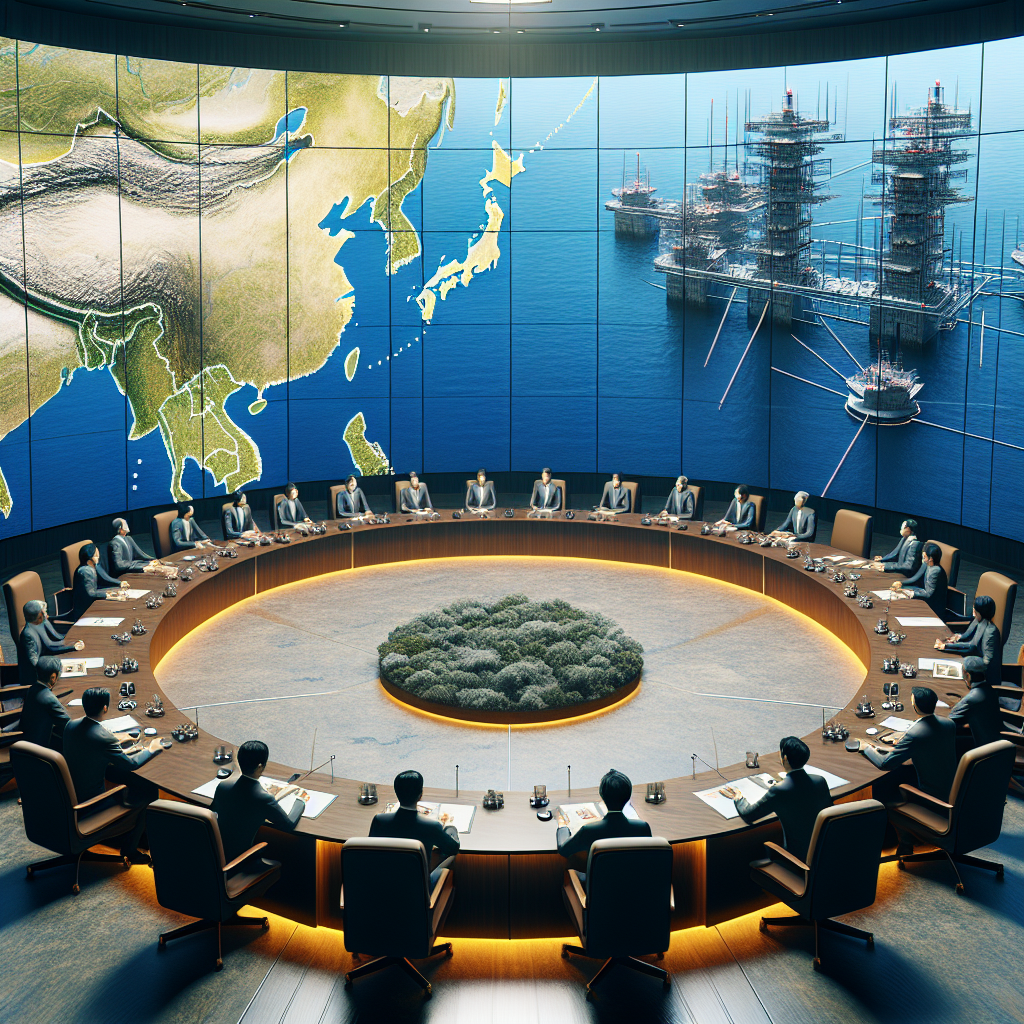
On Wednesday (April 23), the South Korean Ministry of Foreign Affairs stated during the “Maritime Cooperation Dialogue” with China that they would officially raise concerns about the construction of steel facilities by the Chinese Communist Party in the disputed waters of the Yellow Sea. This area overlaps the exclusive economic zones (EEZ) of both South Korea and China, with no clear boundary defined between them.
Recently, China’s construction of offshore steel facilities within the Provisional Measures Zone (PMZ) in the Yellow Sea (referred to as the West Sea by South Korea) has raised concerns in South Korea.
According to reports from the Yonhap News Agency, in February of this year, the South Korean government dispatched a research vessel from the Ministry of Oceans and Fisheries to conduct a survey in the area of the Chinese facilities. There was a prolonged standoff between South Korean and Chinese personnel, and ultimately, the South Korean team was unable to approach the facilities.
Last month, the South Korean National Assembly held a rare bipartisan hearing condemning China’s establishment of steel structures in the Yellow Sea, located between China and the Korean Peninsula.
According to Reuters, South Korean Foreign Minister Cho Tae-yul expressed to the National Assembly on Wednesday that South Korea would emphasize during the talks that they are considering setting up aquaculture facilities in the area based on principles of reciprocity to counter China’s actions. Cho Tae-yul also noted that officials from both sides have begun discussions on technical issues.
While Beijing claims these facilities are “fish farming equipment” and a reasonable use of near-shore resources that do not violate the China-South Korea Fisheries Agreement, critics, as cited by the Financial Times, argue that these facilities are part of China’s implementation of “gray zone tactics.” Critics point out that China has previously used similar means to apply pressure on countries including the Philippines, Vietnam, and Taiwan.
Jaewoo Choo, a China expert at the National Security Research Institute in Seoul, stated that China’s actions are aimed at “gradually occupying our maritime territory and restricting U.S.-South Korea alliance activities.”
Na Kyung-won, a lawmaker from the ruling party, the People Power Party, criticized China for using “gangster-style tactics” to prevent other countries from entering the disputed waters and called for a “firm and stern response” to this behavior.
Professor Nam Sung-wook from Korea University pointed out that if China constructs a series of facilities in the Yellow Sea, it could hinder South Korea or the U.S. Navy fleet stationed in South Korea from entering the East Sea in the event of a conflict in the Taiwan Strait in the future.