
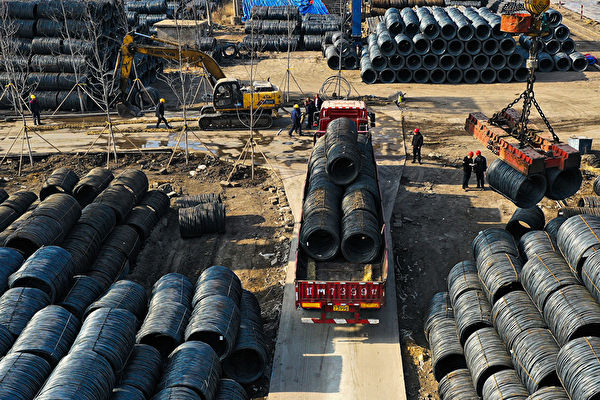
In December of this year, the steel market in Beijing experienced a brief surge, but soon began to decline.
According to the “Huaxia Times” on December 28th, in the second half of this year, the price of steel in China plummeted to a seven-year low. Recently, there have been unexpected reports of price increases in the Beijing steel market. Some industry insiders indicated that due to lack of demand support, the steel prices “didn’t really rise even though they were said to.”
At the steel market on Tianhe North Road in Daxing District, Beijing, the number of private cars parked inside the market far outnumbered the freight trucks. In the vast market, there were only three or four freight vehicles present, with few personnel in activity. Most store fronts had only one staff member sitting quietly in front of a computer, with hardly any business negotiations taking place. The steel products displayed in the market were covered in yellowish rust, surrounded by weeds, indicating they had been stored for a long time.
A steel structure professional mentioned that there is an overall surplus of steel, but due to international situations and futures’ behavior, steel prices have seen some increase. However, after a brief rebound in steel prices, they quickly fell again.
According to Lange Steel’s monitoring data, the market price of grade 3 rebar (Φ25mm) dropped to 3,174 yuan/ton on August 15 this year, lower than the lowest price in 2017. Stimulated by a package of favorable policies, on September 30 this year, the price of grade 3 rebar (Φ25mm) rose to 3,922 yuan/ton, stayed briefly, and then slid all the way down to around 3,400 yuan/ton by the end of November.
The recent price hike in Beijing’s steel market in December was also very short-lived, and prices have now fallen back. Steel trader Zhang Xing (pseudonym) said: “It wasn’t a real rise as the market lacks genuine demand. Now steel prices have dropped to around 3,300 yuan/ton. Looking back at previous years, the current period is the traditional off-season for the steel market, which is very sluggish at the moment and may see even lower market prices in the future.”
The market’s sluggishness is primarily reflected in demand, especially due to the weak investment demand for steel from real estate-related enterprises. According to Lange Steel Research Center’s calculations, from January to November 2024, China’s crude steel apparent consumption was 830.273 million tons, a decrease of 5.5% year-on-year; it is estimated that the domestic crude steel apparent consumption for the whole year of 2024 will be around 9.0 billion tons, a decrease of about 5% year-on-year.
Facing a persistently weak market, steel companies continue to reduce steel production. According to data from the National Bureau of Statistics of the People’s Republic of China, from January to November 2024, the country’s cumulative production of crude steel was 929 million tons, a decrease of 2.7% year-on-year; pig iron production was 783 million tons, a decrease of 3.5% year-on-year; and steel production was 1.283 billion tons, an increase of 0.9% year-on-year.
The soft market supply and demand directly led to the performance of companies in the steel industry remaining at a low level. According to the data from the National Bureau of Statistics of the People’s Republic of China, from January to November 2024, the ferrous metal smelting and rolling processing industry achieved operating income of 7.3919 trillion yuan, a decrease of 6.8% year-on-year; operating costs were 7.0919 trillion yuan, a decrease of 6.4% year-on-year; and the total profit was 78.6 billion yuan, a decrease of 83.7% year-on-year.
Ge Xin from the Lange Steel Research Center stated that the external environment is becoming more complex, domestic demand is insufficient, and some companies are facing difficulties in production and operation.