
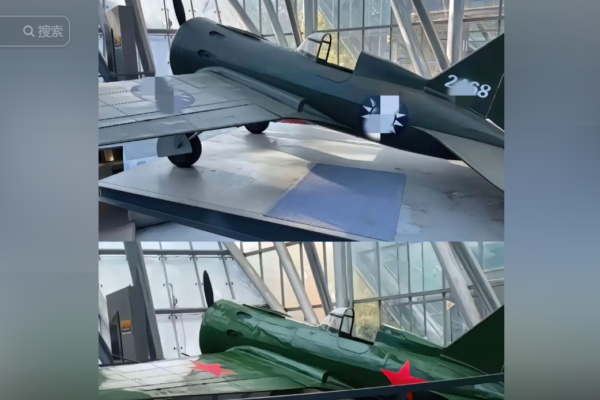
On December 27, 2024, reports emerged from Nanjing that the Republic of China Air Force fighter plane on display at the Memorial Hall for Anti-Japanese Aviation Martyrs had its blue sky, white sun insignia and serial number erased from the fuselage, replaced by a red star insignia. Internet users criticized this move as catering to “political correctness” and called for respect for history.
According to a military information blogger named “Eagle Over Jinling” on the mainland social platform Weibo, on December 23, it was revealed that the Nanjing Aviation Museum had removed the blue sky, white sun insignia and serial number from the I-16 aircraft, replacing them with a “red star” paint scheme.
The post included a set of before and after comparison photos of the I-16 fighter plane displayed at the museum. It pointed out that during the wartime resistance against Japan, both the Chinese Communist Air Force and the Soviet air units flying I-16 planes used the standard Chinese Communist Air Force paint scheme, never displaying any insignia of the Soviet Air Force. The post criticized the museum, stating that as a professional exhibition hall dedicated to the heroic aviators of the Chinese Air Force during the anti-Japanese war, such a mistake should not have been made.
“Eagle Over Jinling” also shared another photo of an I-16 fighter plane displayed at the China Aviation Museum, which bore the paint scheme of the Republic of China Air Force during World War II, not the “red star” paint scheme.
Some military history enthusiasts referenced books to point out that during the time, the Soviet Union supported the war effort in China discreetly, with all Soviet volunteer unit aircraft painted according to the Chinese Communist Air Force paint scheme rules including logos, badges, colors, etc., even being painted at the factory before arriving in China.
In a commentary on December 26 on Taiwan Central Broadcasting Corporation, commentator Dai Liwen expressed that the blue sky, white sun paint and serial number 2468 on the Republic of China Air Force I-16 fighter plane from World War II displayed at the Nanjing Memorial Hall for Anti-Japanese Aviation Martyrs were iconic exhibits. The serial number 2468 held two meanings, one being the 2,468 aircraft lost by the Republic of China Air Force during the eight-year war of resistance, and the other representing aircraft numbered 68 of the 24th Squadron of the 4th Group of the Republic of China Air Force. The I-16 plane had been displayed in this manner at the museum for nearly 30 years.
The article also emphasized that during the war, the communist forces only had guerrilla units on the ground, which is why they never dared to openly distort the history of the air force’s operations. The recent historical revisionism at the Nanjing Aviation Museum is not due to the staff’s ignorance of history or unintended actions, but rather part of mainland China’s recent systematic efforts to distort the history of the war of resistance and destroy the historical sites of the national army under the pretext of “continuing the red gene.” This once again confirms that history in mainland China is only a tool for united front work and diplomacy, and not the true history itself.
Dai Liwen criticized this behavior as an insult and desecration to the numerous land, sea, and air force martyrs of the Republic of China at that time, as well as an affront to all Chinese people seeking the truth of history today. The actions of the Nanjing Aviation Museum serve as a warning not to harbor naive and unrealistic illusions about the Chinese Communist Party, nor to underestimate the shameless and unscrupulous behavior of certain individuals. Scholars at home and abroad should strongly condemn the museum’s revisionist and insulting behavior towards the history of the war of resistance and the martyrs of the national army.
He further stated, “When the lies of history are exposed, they will not be able to stand in reality.”
Regarding the repainting of the fighter plane, many internet users expressed their opinions, stating, “The blue sky and white sun, in line with history, why change it to a new version? The authorities are creating historical nihilism themselves, hehe.” “They are too afraid.” “Blatant.” “Red redesign.” “Politically correct.” “This is really unnecessary.” “In any case, history should be respected.”