
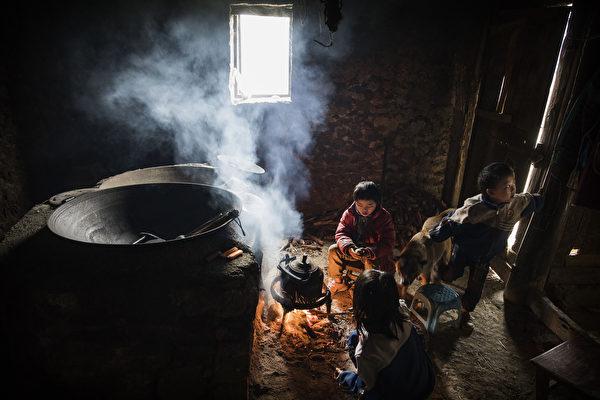
In the past, rural families in China used to have relatively large sizes with more children. To address the fertility issue, the Chinese Communist Party leaders had hoped to rely on the young people in rural areas, but this time it seems they may have miscalculated.
According to a report by The Wall Street Journal on Tuesday (December 24), studies have shown that young people in rural areas have significantly reduced their willingness to have children. One reason is that the household registration system forces rural couples to leave their children behind to work in the cities; another reason is that the second generation of migrant workers does not want their own offspring to repeat their own life experiences, becoming a new generation of left-behind children.
The household registration system, originally used to control urban population growth, has now become an invisible barrier hindering the establishment of families and childbirth.
Since the 1950s, the household registration system has artificially divided the Chinese population into rural and urban categories. This policy makes it difficult for rural residents to buy houses in cities and restricts their access to social welfare benefits such as medical insurance and education enjoyed by urban residents.
Since China’s opening up in the 1990s, the economic development opportunities in cities have attracted millions of migrant workers to urban areas. Due to residency restrictions, the children of migrant workers often stay in rural areas, living with their grandparents, becoming “left-behind children.”
China has the highest number of left-behind children in the world, reaching 67 million by 2020. Many reports and surveys have revealed the dire situations faced by these children.
The left-behind children of that era have grown up to become a new generation of migrant workers, and they generally do not want their next generation to go through the same hardships and lifestyles they experienced in their childhood.
27-year-old Zhao, who grew up living with her grandparents, says she is not in a rush to get married or have children. “I deeply understand the sense of inferiority and timidity as a left-behind child. I do not want the next generation to go through the same situation,” she told Huari Journal.
Zhao’s grandparents spent their lives farming in rural Guizhou. Zhao and her sister managed to complete vocational school without the presence of their parents.
A study by the non-profit organization “On the Way to School” in Beijing in 2020 found that out of 3,501 surveyed left-behind children in Chinese rural areas, more than one-tenth of the children stated they had not seen their parents in the past year, and a quarter of them only received a call from their parents once every three months.
A report released by the Population and Health Research Center at the Zhongnan University of Economics and Law in October indicated that even if the household registration system is relaxed, there will still be a large number of left-behind children due to external conditions such as limited family resources.
The report stated, “In addition to external conditions such as macro policies, one of the main barriers to children following their parents’ relocation is the lack of family resources. Minor children who do not have labor capacity need to spend a lot of time, effort, and financial resources to live and study in the receiving place.”
Even the official Communist Party media outlet, “People’s Forum,” under the People’s Daily, acknowledged in a survey report published in the January 2024 issue that the new generation of migrant workers have a low fertility rate and weaker willingness to have a second child.
The 2021 survey revealed that 21.8% of married new-generation migrant workers have temporarily postponed having children, and among respondents who already have one child, 34.4% expressed unwillingness to have a second child.
The pressure of raising children is the biggest livelihood issue faced by migrant workers. 86.2% of migrant workers reported difficulties in nurturing their children, including issues such as “limited time, inability to be around” (60.6%), “lack of capability to guide academic studies” (31.4%), and “high education costs, unable to afford” (28.6%).
According to official data from the Chinese Communist Party in 2023, the disposable income of rural families is less than half that of urban families, averaging around $3,000 compared to over $7,000 for urban families.
While the population challenges in China are becoming increasingly apparent, the top leadership of the Chinese Communist Party has yet to lift all constraints on childbirth. One reason is that the leadership believes that if restrictions are lifted, rural families might have too many children, leading to continued poverty.
Martin Whyte, a China expert at Harvard University and honorary sociology professor, bluntly pointed out this fallacy. He stated that the reluctance of migrant workers to have children is a major reason for the declining fertility rate in China, but this is because migrant workers still cannot equally access urban resources.
Currently, two-thirds of China’s population resides in urban areas, yet less than half (48%) hold urban hukou (residency permits). This means that approximately 250 million people are unable to enjoy multiple benefits at their workplace.
According to data from the Ministry of Human Resources and Social Security of the Communist Party, in 2017, only about 22% of migrant workers participated in urban work pension programs or medical insurance. Since then, the department has not disclosed any updated information.