
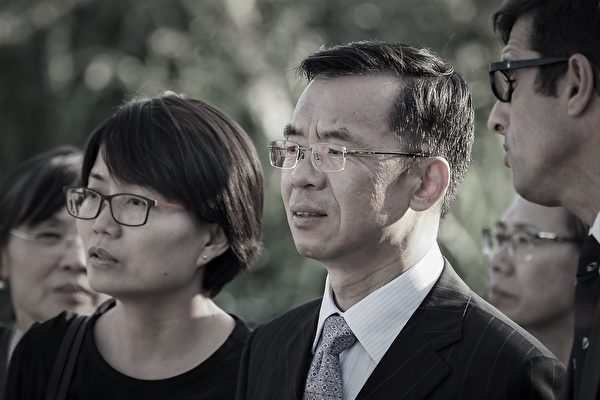
The Chinese ambassador to France, Lu Shaye, who has been known as the “wolf warrior ambassador” by the public, is about to leave his position and return to China. His wolf warrior rhetoric during his tenure in France has once again sparked attention.
According to a report by the Hong Kong media, Sing Tao Daily, the Chinese Embassy in France held a reception on December 9 for Lu Shaye, who is about to leave his post. Lu Shaye confirmed that he will return to China after completing his term following the end of the 60th anniversary of the establishment of diplomatic relations between China and France.
At the age of 60, Lu Shaye is proficient in French and has previously served as the Director-General of the African Department of the Ministry of Foreign Affairs and the Chinese Ambassador to Canada before taking up the position of Ambassador to France in 2019. During his more than five years as Ambassador to France, some of Lu Shaye’s remarks have repeatedly sparked controversy and led to summons from the French Ministry of Foreign Affairs, making him a symbol of China’s “wolf warrior diplomacy.”
Recently, the French newspaper, Le Figaro, reported on Lu Shaye’s impending departure and listed various “inappropriate” behaviors exhibited during his tenure.
For instance, he once criticized a French scholar as a “rogue” and referred to him as an “ideological devil” on the embassy’s website, leading to a summons from the French Ministry of Foreign Affairs.
In March 2021, following the global outbreak of the COVID-19 pandemic, Lu Shaye accused nursing staff in French nursing homes of “abandoning their posts overnight, allowing the elderly to die of hunger and disease.” This led to another summons from the French Ministry of Foreign Affairs.
Most recently, in April 2023, during an interview with a French television channel, Lu Shaye questioned the sovereignty of former Soviet countries such as Ukraine, claiming that Crimea, which has been occupied by Russia since 2014, “originally belonged to Russia,” drawing criticism from Baltic States, Ukraine, France, and the European Union.
The report also quoted sinologist Emmanuel Lincot’s perspective, pointing out that Xi Jinping’s aggressive foreign policy, characterized by aggressive and unyielding rhetoric and complete adherence to the party’s ideology and its new imperial vision, has fundamentally changed the attitudes of Chinese diplomats. This policy has led to a shift towards a more assertive stance among Chinese foreign officials.
This shift in diplomatic approach under Lu Shaye’s tenure as the Ambassador to France reflects broader changes in China’s foreign policy strategy under Xi Jinping’s leadership, which emphasizes a more assertive and confrontational stance on international issues.