
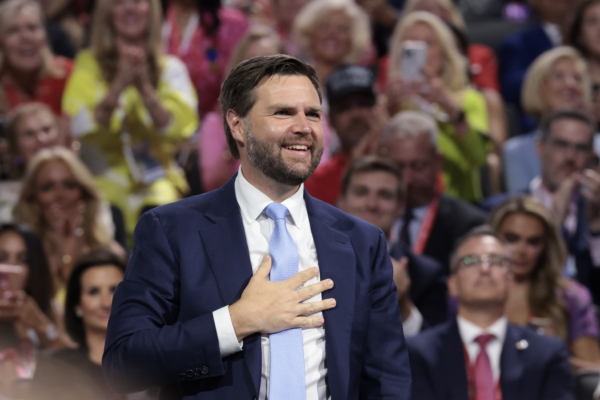
The Chinese Communist Party held the postponed 20th Third Plenary Session from July 15th to 18th in Beijing. During this time, J.D. Vance, the vice presidential running mate of the United States Republican presidential candidate Trump (Trump), was interviewed for the first time after being nominated, pointing out that the Chinese Communist regime is the “biggest threat” to the United States. Experts believe that Vance’s latest remarks have made an impact on the Chinese Communist Party’s Third Plenum, which is troubled by economic difficulties and personnel reshuffles. Regardless of whether Biden or Trump is elected, taking a tough stance against the Chinese Communist Party is a common trend for both parties.
The Republican National Convention officially nominated Trump as the presidential candidate on July 15th. On the same day, Trump announced that J.D. Vance, a 39-year-old Ohio senator, would be his running mate.
In an interview with Fox News on the day of his nomination, Vance said that if Trump is elected president, he will negotiate with Moscow and Kiev to “quickly end the Russia-Ukraine war, allowing the United States to focus on the real issue, which is China.” Vance stated, “That (the Chinese Communist Party) is the biggest threat facing our country, and we are not giving this issue the attention it deserves.”
Many observers pointed out that Vance’s remarks also represent Trump’s stance.
Chinese Foreign Ministry spokesperson Lin Jian responded to Vance’s remarks at a routine press conference on the 16th by saying, “We have always been opposed to bringing up China’s issues in the US election.”
Lai Rongwei, executive director of the Taiwan Inspirational Association (TIA), told Epoch Times that the biggest threat to US economic development and even the international order established after World War II is the Chinese Communist Party. Therefore, it is foreseeable that the United States will take a tough stance against the Chinese Communist Party in the future.
He believes that Vance’s statement on taking a tough stance against the Chinese Communist Party is another form of communication, signaling to China, “Come negotiate with us – do you need to change your ways?” This is a form of realism that adapts flexibly to real needs without being constrained by ideology, prioritizing American interests.
Lai Rongwei stated that Vance’s remarks represent the Trump team’s early release of a pressure message to the Chinese Communist Party.
“The pressure is definitely there. If you don’t treat the United States well, and China cannot be self-sufficient economically, and you are in international tension, how can you maintain the status of the ‘second largest economy’? If the Chinese economy collapses, the communist regime is ready to collapse.”
Regarding the Taiwan issue, when interviewed, Vance believed that the United States’ policy is “actually a strategic ambiguity,” stating, “I think we should first make it as difficult as possible for China to occupy Taiwan. The honest answer is, we need to figure out what exactly we will do if China attacks Taiwan.”
Vance said, “What we can control now is to make them (Chinese Communist Party) pay a high price for invading Taiwan.”
Su Ziyun, Director of the Strategic and Resource Institute at the Taiwan Institute for National Defense and Security, told Epoch Times that the US government has long viewed the Chinese Communist Party as a threat, as demonstrated by military readiness, technological containment, and trade suppression. It can be seen from the Republican Party’s platform that the United States aims to adjust its foreign policy, reduce aid to Ukraine, and increase deployment in the Indo-Pacific region to focus on countering the Chinese Communist Party.
The Chinese Communist Party is holding its Third Plenum, which was originally scheduled to be held at the end of last year, believed to have been delayed due to economic and political challenges. The Chinese Communist Party claims that the meeting is related to the so-called “deepening reform” and “advancing China’s modernization,” but the meeting will also involve the handling of fallen Central Committee members such as former Defense Minister Li Shangfu.
Su Ziyun believes that US elections will impact the Chinese Communist Party’s Third Plenum, and Vance’s remarks may cast a shadow over the meeting, which claims to focus on “reform.”
“The Republican Party platform does not mention Taiwan this time, but it does not mention any other countries either, only named China, seeing China as a threat. If Trump is elected and fulfills his campaign promise to impose tariffs as high as 60% on China, the Chinese economy is likely to take another significant hit, possibly failing to achieve even a 4.99% GDP growth, which could strongly impact the Chinese Communist Party’s regime.”
He believes that it will be challenging for the Third Plenum to come up with any tactics to reverse the downward economic trend.
“Currently, China highly depends on the US and the EU, its two largest export markets, with surpluses of $400 billion and nearly $280 billion, respectively. China’s annual fiscal income of $680 billion comes from these major democratic countries. If the US and the EU continue to resist China’s unfair trade practices, China’s economy will greatly decline.”
As the increasingly fierce strategic competition between the US and China expands to all areas, in the first half of this year, there has been a resurgence in calls within the US to cancel China’s “permanent normal trade relations” (or “most favored nation treatment”).
Su Ziyun stated that if Trump is elected this time, he may revoke the “most favored nation treatment” given to Beijing by the US, putting pressure on Beijing’s expansion.
Weng Mingxian, Honorary Professor of the International Affairs and Strategic Studies Institute at Tamkang University, told Epoch Times that the 20th Third Plenum of the Chinese Communist Party once again emphasized the development of “new productive forces,” claiming that there must be reforms. The official media also portrays Xi Jinping as another very important “reformer” after Deng Xiaoping. In fact, it is to reaffirm Xi’s position. This meeting still aims to revitalize the Chinese economy from the domestic perspective, as a strength and capital for future confrontation with the United States.
Lai Rongwei stated that the problems at the current Third Plenum are substantial. Firstly, it involves personnel issues, with some individuals who were originally part of Xi Jinping’s faction being “purged,” casting doubt on the loyalty of officials in the political arena towards Xi.
“The second is that China’s economy has a significant gap from exports to consumption and investment. Not to mention the real estate sector, the financial reports of several industries that should perform well are not excellent. China’s economy has long-standing structural problems, with too many companies making repetitive investments, producing homogenous products, facing product backlogs, weak domestic consumption, and having to export worldwide. Now, the world questions China’s dumping issues. Many of China’s natural disasters are linked to man-made factors, reflecting excessive infrastructure development, corruption, poor quality, and other problems, causing the entire economy to go astray.”
He believes that the Trump team is indeed sending a message to the world, including Taiwan and mainland China, in advance. Under the internal crisis and pressure from the US, Xi Jinping’s more hawkish approach – the “wolf warrior diplomacy” may need adjustment. “For example, excessive advancement of nationalism, constantly provoking the United States, should there be adjustments?”
The US election is scheduled for November 5th. US President Biden and his challenger Trump meet again in the presidential election, both striving to demonstrate their tough stance against the Chinese Communist Party. Trump has promised that once he becomes US president again, he will raise import tariffs on Chinese goods to 60%. Biden’s administration has also announced an increase in import tariffs on Chinese electric cars to 100%.
Su Ziyun said that a tough stance against the Chinese Communist Party is a common trend for the two major US parties. Beijing’s actions in recent years have proven the practical implementation of the Chinese Communist Party’s threat. During Xi Jinping’s second term, coinciding with Trump’s presidency, there was the first confrontation, initiated by Trump, in terms of military containment, technological warfare, and trade conflicts against the Chinese Communist Party. Now, in 2024, with Trump and Biden continuing to vie for leadership in the White House, the focus naturally shifts to the Chinese Communist Party. Therefore, the Chinese Communist Party has created its own strategic dilemma, and “Xi Jinping has ruined the entire Chinese Communist Party, of course, he is ruining himself.”
Weng Mingxian told Epoch Times that the future relationship between China and the US should be a dual emphasis on competition and confrontation. Competition will be in high-tech, economic, and global influence, while confrontation will be in the military tensions between the US and China in the entire Indo-Pacific region. Whether Biden or Trump is elected, the US will treat China as a long-term strategic competitor, and this situation will not change.
“Because the US national security strategy is about identifying threats. The only source of threat that may affect the US’s global hegemony in the future is China.”
Weng Mingxian said that if a US presidential candidate has a weak stance against the Chinese Communist Party, US voters will believe that the candidate is not staunch enough to defend global freedom, democracy, and human rights. Because mainland China has many human rights issues, including the issue of Hong Kong and the strategic implications through unilateral military force on the strategic direction of the first island chain.
“As the hegemon of the world, leading international strategic actions worldwide, the US must establish such energy. The main axis of the US international strategic thinking is to identify the source of threats. If the source of threats is China, it must be addressed with full strength to ensure peace. This is a strategic axis regardless of whether Biden or Trump is in power.”
He believes that the current firm stance against the Chinese Communist Party is firm and has become a consensus in the US Congress, transcending party lines. “The Senate and the House of Representatives are also building anti-Chinese acts, and the US-China strategic competition will be a long-term confrontation process.”