
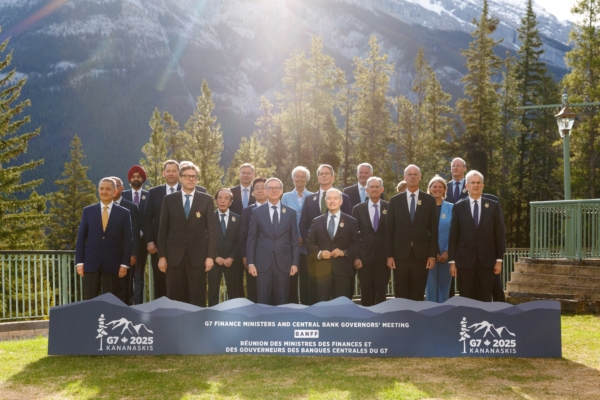
On May 18th and 19th, the finance ministers of the Group of Seven (G7) are set to convene in Paris to address the global economic tensions and coordinate on key raw material supplies. However, the severe geopolitical divisions worldwide are putting the cohesion among the group members to the test.
The core members of the G7 currently include the United States, United Kingdom, Canada, France, Germany, Italy, and Japan. It is expected that finance ministers from Brazil, India, South Korea, and Kenya will also participate in this meeting. Following this finance ministers’ meeting, the G7 Leaders Summit is scheduled to take place in Évian, France from June 15th to 17th.
Roland Lescure, the French Minister of Economy and Finance who is hosting the meeting, stated that the central issue at the Paris conference is the global economic imbalance. He pointed out, “It is evident that the development pattern of the global economy in the past decade or so is unsustainable.”
Lescure described this meeting as an opportunity for candid dialogue within the G7. He told reporters before the meeting, “These discussions are not easy. I wouldn’t say that we can reach a consensus on all matters, especially with our American friends.”
Post the conclusion of the Xi-Jinping summit, finance ministers from various countries will be focusing on the latest developments in U.S.-China relations. French officials involved in the preparations noted that as long as all parties agree to take responsibility for their own trade and capital flow imbalances, the meeting will be deemed successful.
G7 ministers are expected to discuss the economic ramifications of the conflicts in the Middle East, U.S. efforts to reopen the Strait of Hormuz, and the fluctuations in the global bond markets.
As a major energy importer, Japan is particularly sensitive to the inflation pressures brought about by the Middle East conflicts, with its bond yields having risen sharply recently. The United Kingdom is also facing concerns over political instability and rising inflation, leading to the country’s 30-year government bond yields reaching their highest levels since the late 1990s.
When bond yields and price trends move in opposite directions, it indicates wavering investor confidence in the governments issuing the bonds and can lead to traders demanding higher yields.
Furthermore, the international benchmark Brent crude oil futures prices have reached $109.26 per barrel. Although this price is lower than the peak of $118 per barrel reached in late April this year, it still represents a 74% surge compared to before the conflicts in the Middle East.
The International Energy Agency (IEA) warned in its May report last week that global energy demand will peak during the summer, and if the issues in the Hormuz Strait are not resolved, it is expected that oil and fuel prices will continue to rise.
The UK Treasury stated that British Chancellor of the Exchequer, Rachel Reeves, will urge all parties to take coordinated actions to limit inflation and supply chain pressures, restore freedom of navigation in the Strait of Hormuz, and reiterate the UK government’s desire to reduce trade barriers with the European Union.
Kyriakos Pierrakakis, the Greek Finance Minister representing the Eurogroup, stated in a statement on May 15th that reopening the strait and fully ending the conflicts in the Middle East are crucial in alleviating economic pressures. Even if the conflicts are resolved swiftly, the global economy is still likely to feel the strain due to the macroeconomic imbalances worldwide.
Lars Klingbeil, the German Finance Minister representing Germany, warned before the meeting, “We must make every effort to end the war thoroughly, stabilize the regional situation, and ensure freedom of navigation.” He added, “As Europeans, our direction is clear, that is, to rely on cooperation rather than confrontation.”
Another focal point is the G7’s efforts to coordinate forces to reduce dependency on critical minerals and rare earths from China. Lescure stated that the G7 hopes to strengthen coordination to monitor the market, anticipate supply disruptions, and develop alternative supply solutions. The main goal is to ensure that “no country can monopolize” such resources anymore.
The G7 is striving to reach a consensus on common measures to stabilize markets and encourage domestic investment, possibly by setting price floors for producers, joint procurement, and imposing tariffs.
However, Philip Luck, Director of the Economic Program at the Washington’s Center for Strategic and International Studies, believes that this initiative is a long-term project and may not yield significant results during the finance ministers’ meeting.
He stated, “We are still in the early stages of figuring out this issue. I don’t think this strategy has achieved consensus within the U.S. government, making it even more challenging to persuade our partners to sign similar cooperation agreements convincingly.”