
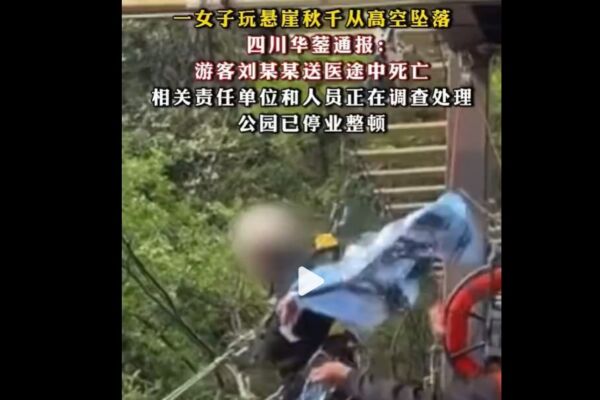
On May 3rd, a 16-year-old girl tragically fell to her death while participating in a swinging activity at the Maluyan Waterfall Scenic Area in Huaying City, Guang’an, Sichuan. The latest investigation indicates that the direct cause of the accident was the premature release of the safety lock.
According to a report by China’s state media CCTV’s program “Legal Online” on May 17th, Huaying City in Sichuan has released new findings regarding the tourist’s fatal fall at the swinging attraction. The investigation confirmed that the accident was caused by the premature loosening of the safety lock. Currently, the involved company has ceased operations for rectification, and the personnel responsible for the accident have been subjected to criminal measures.
Under normal circumstances, after tourists are properly equipped, they should slide along the track with the pulley to a safe position approximately 10 meters from the operating platform (directly above the suspended valley floor) before opening the release switch. However, due to the improper on-site handling by the staff involved, the release switch was prematurely unlocked before the pulley reached the safety point. This resulted in the girl falling vertically without sufficient cushioning space, leading to a fatal impact when her head violently struck the protruding rock wall below the platform.
On May 3rd around 4 p.m., a tourist named Liu, a female, was exploring the Maluyan Adventure Park in Huaying City and tragically fell to her death after colliding with the cliff wall while experiencing the waterfall swing activity and being taken to the hospital.
On May 5th, several netizens shared videos of the incident. One video showed a female tourist expressing multiple times, “It’s not tied tightly,” while being slowly guided out of the safe area with a safety harness before plummeting off the cliff right after sliding out of the safety platform. Another video depicted the injured woman lying in a pool of blood on the ground.
On May 17th, a blogger claiming to be a Physics Ph.D. from the Hong Kong University of Science and Technology, known as “Zhile,” posted an analysis on Zhihu focusing on several crucial details:
“Firstly, it wasn’t about the ‘rope not being tied properly,’ but rather, a mistimed release. In the standard process, after the tourist is suspended by the safety rope, they should be slid to a point approximately 10 meters from the operating platform for a proper release away from the rock wall beneath. However, on the day of the accident, the tourist unhooked right after leaving the platform with a protruding rock wall directly below, resulting in severe consequences.”
“Secondly, there was no monitoring facility at the scene. This implies that the accident reconstruction heavily relies on on-site staff statements, video clips, equipment analysis, and data retrieval. For such a high-risk activity, the lack of comprehensive monitoring in critical operation areas is a significant management flaw.”
“Thirdly, improper on-site personnel handling. The local emergency management official stated that the weight-bearing pulley structure didn’t reach a safe position, causing the premature loosening of the release switch. This indicates that the accident is not simply about a faulty part but rather possible issues in operation processes, confirmation mechanisms, and personnel training.”
“Fourthly, the awkward regulatory nature of the project. The report mentioned that ‘Swinging’ lacks national safety technical standards in China and, as it differs from regular cliff swings, is closer to a high-risk commercial adventure activity; if packaged as a scenic amusement project, the approval and supervision may fall into a gray area.”
The blogger further analyzed that the highlighted management loopholes mainly consist of inadequate training, a lack of ‘double verification’ mechanism, equipment lacking failsafe designs, and insufficient risk communication and emergency systems.
In conclusion, the blogger remarked, “Overall, the lesson from this accident isn’t about ‘tourists being reckless, but rather: once high-risk activities become commercialized, merely selling excitement without corresponding standards, training, monitoring, redundancy, and regulation is dangerous. The true danger lies not in the swinging activity itself but in operating extreme sports as if they were ordinary influencer-related projects.”