
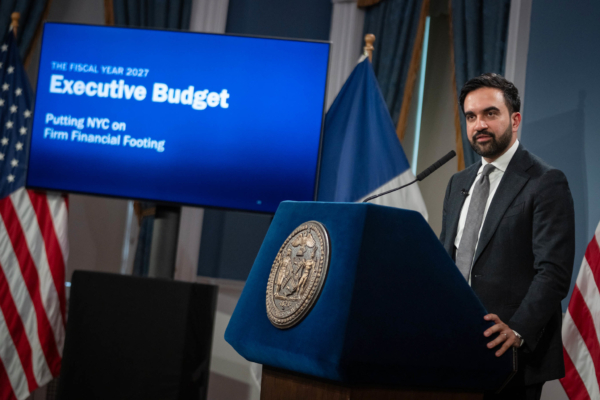
New York Mayor Mamdani announced the administrative budget for the fiscal year 2027 totaling $124.7 billion on Tuesday, with additional assistance of $4 billion from Governor Hochu and various cost-saving measures to fill a $5.4 billion budget deficit. The Mayor highlighted that he achieved budget balance without raising property taxes or significantly cutting municipal services.
One of the key factors in balancing the budget this time is the new round of assistance provided by Governor Hochu and the State Senate and Assembly. Hochu and Mamdani jointly announced on Tuesday that the state government would provide an additional $4 billion to help New York City fill the deficit, bringing the total new state aid in two years to nearly $8 billion.
Hochu stated that the state government would collaborate with the city government to promote free universal childcare, public safety, education, and infrastructure investment to “protect the public services that New Yorkers rely on every day.”
Previously, Mamdani had proposed a 9.5% increase in New York City property taxes as one of the deficit-filling measures, but the idea was strongly opposed by the business and real estate sectors as soon as it was announced. The City Council also made it clear that they do not support a comprehensive increase in property taxes as a means to balance the budget. The budget proposal released on Tuesday no longer includes a comprehensive property tax increase plan and does not incorporate the personal income tax and corporate tax increase plans proposed during the election campaign.
In addition to Hochu’s substantial assistance of $4 billion, Mamdani introduced additional tax revenues and cost-saving measures across all city departments.
One measure is the establishment of a “Cost-Saving Officer” in all municipal agencies, requiring each department to propose plans to reduce administrative costs and increase efficiency. Approximately $1.77 billion in savings have been identified over two fiscal years, including canceling outsourcing consultant contracts, consolidating office space, reducing software licenses, and recovering receivables, among other measures.
Regarding new tax revenues, Mamdani is pushing for New York City’s first “Pied-à-Terre Tax,” targeting non-New York residents who own second homes valued at over $5 million, projected to generate $500 million in annual revenue. This is coupled with a collaboration with the City Council to reduce the “Unincorporated Business Tax Credit” (UBT credit for individuals with annual incomes over a million dollars), resulting in an additional $68 million.
Apart from financial restructuring, the budget includes multiple investments in social welfare. In the education sector, the Mayor announced an additional $122 million to hire 1,000 teachers and allocated $1.5 billion for school capital spending to facilitate the reduction of class sizes policy while seeking to postpone meeting compliance goals in this area to reduce short-term financial pressures.
Special education is also a focus of reform. Due to insufficient public school special education resources, more families are demanding that the city pay for private school costs through legal proceedings, with estimated litigation costs reaching $1.5 billion this year. The city plans to increase special education services and school resources to lower the demand for litigation in the future.
In terms of housing, the city will add $4 billion in affordable housing capital investment and provide additional funding to the New York City Housing Authority (NYCHA) for housing renovations and restoring vacant units.
For rental assistance programs like CityFHEPS vouchers, the Mayor acknowledged the significant increase in related expenditures in recent years but emphasized that the subsidies would not be canceled or halted. Instead, costs will be controlled through management reforms, reasonable rent reviews, and reducing brokerage fees.
Childcare policies are another core aspect of the budget. The city reiterated its commitment to promoting free childcare for toddlers, including 3-year-olds and, for the first time, 2-year-olds, along with additional increases in subsidies for childcare facilities.
In the public safety sector, the city announced an additional investment of over $40 million in community safety, mental health, and anti-violence programs. An additional $26 million was allocated to enhance hate crime prevention, with a shift towards preventive measures rather than retroactive prosecution. While the Mayor only mentioned anti-Semitic issues during the Q&A session, the funding will also cover the Asian community.
However, elected officials overseeing New York City finances expressed concerns regarding the long-term stability of the budget proposal. City Comptroller Mark Levine pointed out that the current budget still relies on various one-time financial measures and does not address the future structural deficit, stating that “we still face a shortfall of approximately $7 billion in the next fiscal year.”
The pension payment restructuring plan has raised questions from the public about whether it is simply “deferring the problem.” Mamdani responded that this is just adjusting the payment schedule, which will not affect retirement benefits or reduce the retirement system itself.