
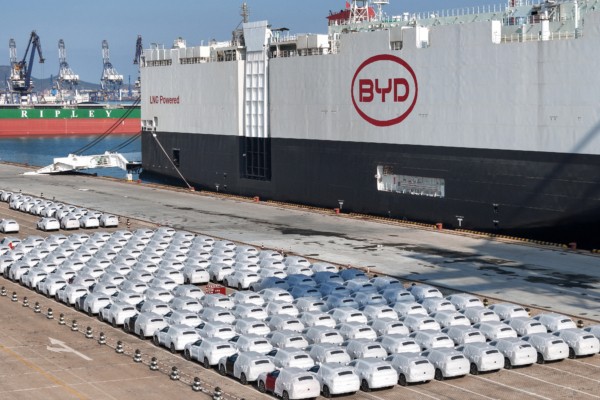
China’s automobile market continues to slump, with the latest data showing a sustained decline in domestic passenger car sales for seven consecutive months, with the traditional gasoline car market nearly collapsing. Faced with weak domestic consumption and overcapacity, the Chinese automobile market is experiencing a situation of “cold inside and hot outside” – car manufacturers are increasingly relying on exporting “low-cost” vehicles to overseas markets.
According to reports from mainland media such as Securities Times, the China Passenger Car Market Information Association (PCA) recently released data on automobile sales, indicating that in April 2026, domestic retail sales of conventional gasoline cars in China were only 530,000 units, a sharp drop of 37% year-on-year, further declining by 33% compared to March. The market for new energy vehicles is also showing signs of fatigue, with national retail sales of new energy passenger cars in April totaling 849,000 units, a decrease of 6.8% year-on-year and 0.3% from March, adding up to a 17.2% year-on-year decline from January to April.
In April, domestic passenger car (sedan) retail sales in China totaled 1.384 million units, down by 21.5% year-on-year, marking the seventh consecutive month of decline. Cumulative sales of domestic passenger cars in the first four months of this year reached 5.604 million units, a decrease of 18.5% year-on-year.
In contrast to the domestic market, China’s automobile exports continue to grow. Data shows that in April, exports of passenger cars in China increased by 80.7% year-on-year. Exports of new energy passenger cars in April reached 406,000 units, up by 111.8% year-on-year and 18.3% from March, with exports totaling 1.306 million units from January to April, an increase of 118.7% year-on-year. Gasoline passenger car exports reached 360,000 units in April, up by 55% compared to the previous year, a 5% increase from March.
According to a report by Reuters on May 11th, the Chinese automobile market is showing a situation of “cold inside and hot outside”, with continued weak domestic sales juxtaposed against rapid growth in exports, leading to an increasing gap between the two.
This trend is also reflected in Chinese electric vehicle leader BYD. Despite continued growth in overseas exports, BYD’s global sales have experienced a year-on-year decline for eight consecutive months as of April this year.
Analysts from PCA believe that the national passenger car market this year is influenced by a multitude of factors such as adjustments in new energy vehicle purchase tax policies, weak consumer confidence, and high oil prices, resulting in a trend of “domestic slowdown, high export growth, contraction in gasoline, and dominance of new energy”. High oil prices have dealt a heavy blow to domestic retail sales of gasoline cars.
Specifically, retail sales of gasoline cars in January and February saw a year-on-year decrease of 740,000 units, accounting for 40% of the decrease in passenger car retail sales. In March, gasoline car sales saw a decline of 345,000 units year-on-year, making up 52% of the retail decrease, and in April, gasoline car sales declined by 365,000 units year-on-year, further expanding its share of the decrease to 84%. Amid cost concerns, domestic consumer demand is accelerating its shift from gasoline cars to new energy vehicles, making the “oil-electric differentiation” pattern in the market increasingly prominent.
Behind the slump in the Chinese car market lies a close relationship with the overall economic downturn. In recent years, the continuous stagnation of the Chinese real estate market, decreasing expectations of household income, and weak consumer confidence have significantly impacted major consumer demands such as automobiles.
For years, government subsidies and related policies have sought to turn China into a global automotive powerhouse and a leader in electric vehicles. However, car companies have been striving to meet government-set production targets rather than consumer demand.
A survey by Reuters found that the number of cars produced by domestic Chinese brands far exceeds the absorption capacity of the already largest automotive market in the world. Most Chinese dealers are also struggling to make profits, with car lots overflowing with inventory. Dealers can only respond by significantly reducing prices.
To alleviate pressure in the domestic market, Chinese car companies are actively expanding into overseas markets. In recent years, Chinese new energy vehicles have rapidly entered the European, Southeast Asian, Middle Eastern, and Latin American markets with price advantages, driving high-speed export growth. However, at the same time, Chinese new energy vehicles are facing increasing tariffs from Europe, the United States, and Japan, as well as controversies over “overcapacity”.
Industry insiders believe that the current dilemma in the Chinese automobile market is not just a matter of sales volume but a reflection of multiple pressures such as the slowdown in economic growth, downgrading of consumption, and overcapacity.