
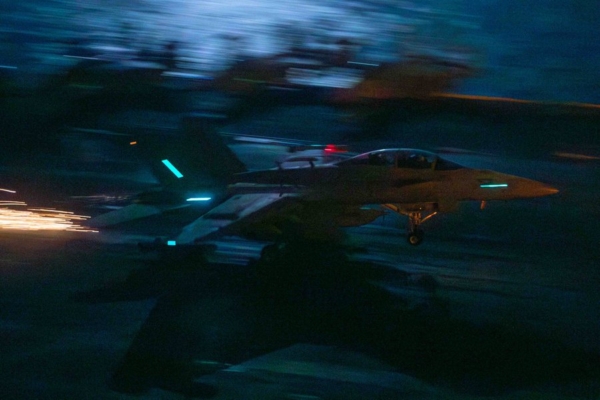
On Friday, May 8th, the U.S. military revealed that a U.S. fighter jet used precision-guided bombs to strike two oil tankers flying the Iranian flag, causing the tankers to lose their operational capabilities, showcasing the precision of American weapon strikes.
The United States Central Command (CENTCOM), responsible for Middle East military operations, released a video on Friday showing a U.S. Navy F/A-18 fighter jet hitting the chimneys of the “Sea Star III” and “Sevda” tankers. CENTCOM stated that these two tankers violated the U.S. blockade of Iranian ports.
The video shows smoke initially rising from the chimney of the “Sea Star III” tanker, followed by thicker black smoke after being hit.
In the video of the “Sevda” tanker, flames erupted instantly, followed by billowing thick smoke.
The footage provided by CENTCOM shows no damage to areas outside the chimneys. The press release did not mention any casualties among the personnel on the tankers.
Military experts told CNN that Navy planes likely used 500-pound laser-guided bombs to effectively strike the tankers with precision.
Peter Layton, a researcher at the Griffith Asia Institute and former Australian Air Force officer, described the possible scenarios for how the F/A-18 fighter jets executed these two attacks.
“If you fly straight towards the target at about 5,000 feet, using the aircraft’s infrared imaging targeting pod, aligning the laser beam on the chimney, and then releasing the bomb as you get closer, it should work,” he told CNN.
He suggested that the American jets likely targeted the entire chimney rather than directly dropping the bomb into the exhaust outlet.
“This is a laser spot, and the bomb needs to lock onto this spot in the final 10 seconds. If the laser point disappears beneath the chimney while you fly over the target, the accuracy of the bomb will be affected,” Layton explained.
Sal Mercogliano, a maritime expert and professor at Campbell University in North Carolina, told CNN that his analysis of the U.S. military video indicated that the ammunition hit the lower or bottom part of the chimneys of the tankers.
Retired U.S. Air Force Colonel Cedric Leighton, a military analyst for CNN, suggested that Navy aircraft likely fired inert rounds at the tankers, enough to immobilize them but not sink them.
Analysts stated that using inert or smaller explosive rounds could explain why there were no explosions on the tankers or secondary explosions that could have resulted from explosive warheads.
In a statement on Friday, CENTCOM detailed the events. The U.S. military implemented a blockade on these two cargo-less tankers when they were trying to enter an Iranian port in the Gulf of Oman. An F/A-18 “Super Hornet” fighter jet from the USS Bush aircraft carrier launched precision ammo at the chimneys of the tankers, rendering them “paralyzed,” thus preventing these non-compliant vessels from entering Iran.
On May 6th, U.S. forces also fired at the airborne Iranian oil tanker “M/T Hasna,” immobilizing it. This tanker also violated the U.S. blockade order, attempting to sail to an Iranian port. A Navy fighter jet fired several rounds from a 20mm cannon, hitting the tanker’s engine.
CENTCOM stated that these three tankers were no longer able to travel to Iran.
The command said on Saturday, May 9th, that the U.S. naval blockade on Iran’s waters remains in full effect. Since April 13th up to that day, CENTCOM had intercepted 58 commercial ships, causing 4 of them to lose power and be unable to navigate, to prevent these vessels from entering Iranian ports.