
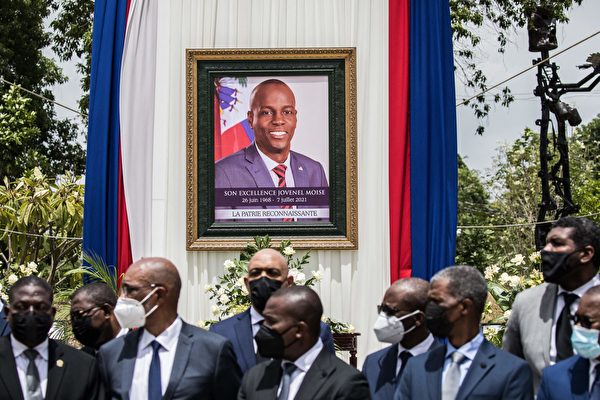
On Friday, May 8th, a federal jury in Florida ruled that four men involved in the 2021 assassination plot of Haitian President Jovenel Moise were found guilty on multiple charges. Moise’s death plunged the Caribbean nation into severe turmoil, with the U.S. Justice Department stating that the case demonstrates the firm stance of the U.S. in not allowing its territory to be used as a base for planning overseas violent actions.
The four men are Arcangel Pretel Ortiz, Antonio Intriago, Walter Veintemilla, and James Solages. After a 9-week trial at the Federal Court in Miami, the defendants were convicted of conspiring to commit murder or kidnapping outside the U.S., providing material support to the conspiracy, and violating the U.S. Neutrality Act, all of which could lead to life imprisonment.
According to the prosecution’s charges and court evidence, South Florida was the central location for planning and fundraising for the conspiracy. The defendants recruited around 22 retired Colombian soldiers as mercenaries, providing weapons, ammunition, and tactical vests, with the aim of overthrowing Moise and installing their preferred candidate in power to secure lucrative government contracts in the future.
Moise’s widow, Martine Moïse, testified as the first witness in the case, detailing the harrowing events of the attack on their home in the early hours of July 7, 2021.
Through an interpreter, she described hearing gunfire at the residence and asking her husband what was happening. Martine recounted Moise’s final words in pain, “My dear, we are dead.”
Communication records presented by the prosecution further revealed the brutality of the attackers. One of the defendants, Solages, accompanied the Colombian mercenaries into the presidential residence on the day of the attack, ordering the killing of everyone inside, including “cats, dogs, and parrots.”
Investigations showed that the conspiracy involved intricate planning and illegally diverted funds. The defendants had devised various plans, including kidnapping, drugging, and forcing the President to resign. After multiple failed attempts, they ultimately resorted to a violent assassination.
Of note, defendant Veintemilla is accused of misappropriating funds from the U.S. government’s Paycheck Protection Program (PPP), intended for COVID-19 relief, to finance the assassination plot.
Upon learning of the successful assassination, Veintemilla reportedly called his accomplices and said, “The rat (referring to President Moise) is in the box.”
Defense lawyers argued in court that the defendants were misled into believing they were participating in a lawful “arrest operation.” They emphasized that the defendants held legitimate arrest warrants issued by Haitian judges, with the intention of “liberating” the President deemed to have overstayed his term.
In his closing statement, defense lawyer Emmanuel Perez stated, “This was an internal conspiracy in Haiti,” asserting that the defendants were made scapegoats in an imperfect investigation.
The defendants also claimed that by the time the Colombian mercenaries arrived to “arrest” Moise, he had already been killed by his security team and government officials.
However, the jury ultimately rejected the defense arguments and found all four guilty.
Jason A. Reding Quiñones, the South Florida federal prosecutor, said in a statement, “This verdict serves justice for the assassination of President Moise and holds accountable those who turned South Florida into a staging ground for a deadly foreign conspiracy.”
“These defendants sought power, influence, and profits through violence. They supported a plot that transcended borders, disrupted the stability of a friendly nation, and ultimately led to the murder of a sitting president,” Quiñones stated.
Assistant Attorney General for National Security, John A. Eisenberg, remarked, “These defendants conspired to replace and ultimately assassinate Haitian President Jovenel Moïse, using U.S. territory as a planning ground for overseas violent conspiracies, a serious violation of our laws and fundamentally an affront to our sovereignty.”
The fifth key defendant in the case is Haitian-born doctor Christian Emmanuel Sanon. Due to health reasons, the 63-year-old dual citizen of Haiti and the U.S. did not participate in the trial and will face separate proceedings in the future.
Court documents reveal that he was not only one of the main conspirators initially considered as a successor to Moise but also had strong political ambitions to take over the presidency after the successful assassination. Investigations indicate that other defendants provided financial and military support in hopes of securing profitable government contracts under Sanon’s rule.
While the Miami court’s verdict marks a legal milestone in the case, Jake Johnston, a researcher at the Center for Economic and Policy Research, cautioned against expecting it to resolve all the questions surrounding the murder.
He told Reuters, “The people in Miami are just a tiny part of it; there are so many more who have been implicated. In the grand scheme, we’re not going to get the full story here.”
Currently, internal investigations in Haiti remain stalled due to gang violence, death threats, and a crumbling judicial system; the political vacuum created by the assassination continues to keep the country in a state of turmoil.