
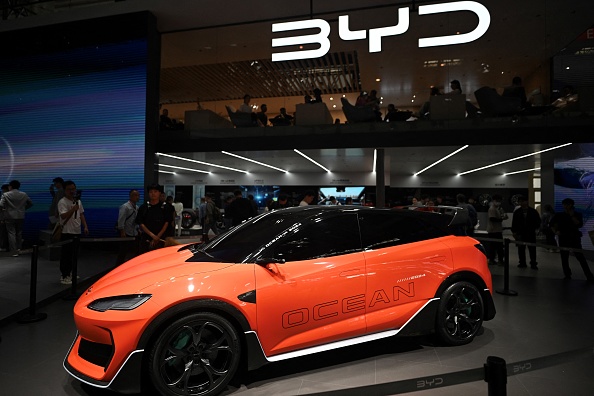
In the first quarter of this year, Chinese new energy vehicle giant BYD saw its revenue drop by 11.8% compared to the same period last year, marking its worst quarterly performance since the second quarter of 2024. Its net profit also plunged by over 55%, the largest drop since 2020.
On April 28, BYD announced that its first-quarter operating income was 150.225 billion yuan, down 11.82% year-on-year, with car sales revenue at 112 billion yuan, a decrease of 16.1%. The net profit attributable to shareholders of the listed company was 4.085 billion yuan, a steep drop of 55.38% year-on-year, further widening from the 38.2% decline in the fourth quarter of last year. Non-GAAP net profit was 4.148 billion yuan, down 49.24% year-on-year.
During the first quarter, BYD’s cumulative sales volume was 700,463 vehicles, a decrease of 30.01% year-on-year. The net cash flow generated from operating activities was 2.79 billion yuan, a decrease of 67.48% year-on-year. BYD stated that this was mainly due to a decrease in cash received from selling goods and services.
With the domestic market in China showing signs of weakness, BYD, as well as other Chinese car manufacturers like Geely, have been forced to seek growth in overseas markets. From Brazil and the UK to Australia and Canada, these countries have become dumping grounds for Chinese vehicles. In the first quarter, out of the total of 700,463 cars sold by BYD, exports surged by 56% year-on-year to 319,751 vehicles, accounting for 45.6% of total sales.
According to Reuters, as China gradually phases out subsidies for entry-level electric vehicles and plug-in hybrids, BYD is facing increasing pressure. Despite continuous growth in overseas shipments, BYD saw a seventh consecutive monthly decline in overall sales in March.
Over the past three years, the Chinese new energy vehicle industry has been fiercely competitive, with every company resorting to the same tactic: launching new models at reduced prices, rapidly clearing out old models, and using features and pricing to compete aggressively, leading to a heated price war.
In a report by “Sina News” on April 24, nearly 70 models across the industry underwent price reductions in the first quarter of this year, with the average price of new energy vehicles dropping by 38,000 yuan (a decrease of 13.7%), and fuel vehicles decreasing by 37,000 yuan (a decrease of 14.3%). Even luxury brands and joint venture models joined the price-cutting trend.
The price war has squeezed research and development investment, leaving car companies stuck in a situation where they are increasing production but not revenue, leading to a lack of technological iteration. Ouyang Ming, an automotive engineering expert and professor at Tsinghua University, emphasized that the industry needs to shift from focusing on price to focusing on value, concentrating on the overall lifecycle experience and emotional value.
François Roudier, Secretary-General of the International Automobile Manufacturers Association, remarked that while the price war may seem advantageous to consumers, it is detrimental as manufacturers are facing losses. One of the major problems lies in the uncertainty of the used car market, affecting buyer behavior and financing methods, thus harming the entire system.
The prolonged price war is primarily due to overcapacity. The China Automotive Technology Research Center predicted that China’s annual vehicle production capacity is 55.5 million vehicles, but last year’s domestic sales were only around 23 million vehicles, resulting in an average capacity utilization rate of about 50% for Chinese automakers, which is unsustainable in the long run.
In China, large automotive manufacturers are striving to maintain market share by accelerating product cycles and swiftly introducing innovative products. For instance, during the 2026 Beijing Auto Show (April 24 to May 3), there were a total of 219 press conferences, showcasing 1,451 vehicles, including 181 new models. According to public data, in March this year, the automotive industry hosted nearly 80 launch events, unveiling over 60 new vehicles.
Currently, surplus electric vehicles are increasingly being exported to overseas markets. In March alone, China’s electric vehicle exports more than doubled, reaching a historic high. However, this trend has sparked backlash in some markets, such as the European Union and certain Latin American countries, leading to tariff increases to protect their domestic automotive industries.
During the Beijing Auto Show, William Li, the Chairman of NIO, stated in an interview with “Daily Economic News” that the industry has entered its final phase. He mentioned, “In the five years before the final phase, the direction of the industry will become clearer. We hope to stay in this playing field by enhancing our system capabilities, which NIO has been focusing on over the past two years.”
BYD’s CEO Wang Chuanfu has lamented that China’s automotive industry has entered a ruthless phase of elimination. Zeng Qinghong, Chairman of GAC Group, also pointed out that the automotive industry has bid farewell to the golden era of high growth and the elimination process is accelerating.