
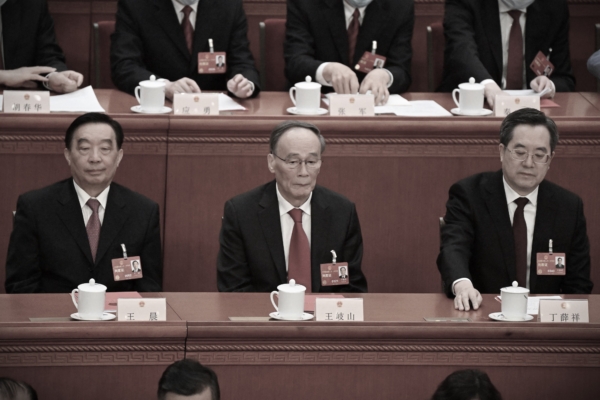
Last month, Zhou Liang, the deputy director of the China Banking and Insurance Regulatory Commission (CBIRC), who fell from grace, was announced to be removed from his position on the 21st. Chinese media reported that Zhou Liang may be involved in a corruption case in Hunan’s officialdom. The Hunan faction in the Chinese Communist Party (CCP) has seen a wave of falls from grace in the past year, with Zhou likely having ties to his former leader, the former Central Commission for Discipline Inspection Secretary Wang Qishan.
According to news released on April 21st on the website of the Ministry of Human Resources and Social Security of the CCP, Zhou Liang was relieved of his position as deputy director of the CBIRC by the State Council of China.
Prior to his investigation for alleged “serious violations of discipline and law” on March 24th, Zhou Liang was the top-ranked deputy director at the CBIRC. It was reported that he appeared at the funeral of the former deputy chairman of the China Banking Regulatory Commission, Wang Zhaoxing, held at Babaoshan on March 17, only to be taken away the next day.
Born in October 1971 in Yongzhou, Hunan, the 54-year-old Zhou Liang gained attention for being a long-time associate of the former CCP Central Commission for Discipline Inspection Secretary Wang Qishan.
Zhou Liang served as Wang Qishan’s secretary since 1997, with the duo working together for 20 years. Zhou Liang followed Wang as he held positions in Guangdong Province, the State Council Reform Office, Hainan Province, Beijing Municipality, the State Council, and the Central Commission for Discipline Inspection. During Wang Qishan’s tenure as a member of the Politburo Standing Committee and Secretary of the Central Commission for Discipline Inspection, Zhou Liang served as the Deputy Secretary of the Central Commission for Discipline Inspection from 2013, became the Executive Deputy Minister of the Organizational Department of the Central Commission for Discipline Inspection in April 2015, was promoted to Minister of the Organizational Department of the Central Commission for Discipline Inspection in September, becoming Wang Qishan’s personnel steward during his time at the commission.
In November 2017, Zhou Liang was appointed as the Deputy Chairman and Party Committee Member of the Banking Regulatory Commission; in March 2018, he became the Deputy Chairman and Party Committee Member of the Banking and Insurance Regulatory Commission; in August of the same year, he also served as the Vice Chairman of the China Banking Association; in May 2023, he became a Party Committee Member and Deputy Director of the CBIRC. Zhou Liang was in charge of supervisory work related to state-owned banks, policy research, finance, accounting, statistics, and other areas.
Reports from Caijing.com indicate that there are indications that Zhou Liang’s investigation may be related to the ongoing corruption case in Hunan’s officialdom.
Hunan-born high-ranking officials have been falling from grace in recent times.
On February 10, 2026, Ei Lianhong, Deputy Director of the Financial and Economic Committee of the Fourteenth National People’s Congress of the CCP, was investigated. Ei Lianhong, born in September 1959 in Liuyuan, Hunan, now 66 years old, has had a varied career spanning Hunan, Liaoning, Jiangxi, and Zhejiang provinces, having served as the head of both Changsha and Shenyang, the provincial capitals, as well as holding positions as the Secretaries of the Jiangxi and Zhejiang Provincial Committees. It was reported that when Ei Lianhong was investigated, family members were also taken away.
The media delved into the corruption of Ei Lianhong’s family, pointing out that his son Ei Shiwei was known for his extravagant and ostentatious behavior, being considered one of the “Seven Young Masters of Hunan’s officialdom.” Rumors had already connected the “Seven Young Masters of Hunan” to the case of Liu Wenjie, the former Director of the Finance Department of Hunan Province, who fell from a building on September 19, 2024, along with two businessmen (the Jiang brothers) from the thirteenth floor. Official reports described it as a “homicide,” but there were widespread doubts among the public that it was due to economic disputes. It was revealed that Liu Wenjie had guaranteed hundreds of millions of yuan for private loans, with a large sum of money flowing to the “Seven Young Masters of Hunan.”
According to a circulated list within the public, the named “Young Masters” and their parents include: Ei Shiwei, the son of Ei Lianhong (former Secretary of the Zhejiang Provincial Party Committee, fallen from grace in February 2026); Ei Pengfei, the son of Ei Huanhong (former Deputy Chairman of the Hunan Provincial Committee, sentenced to life imprisonment in 2024); Li Weiwei, son of Li Lanxiang (former Deputy Chairman of the Hunan Provincial Committee); Meikebao, son of Meikebao (former Deputy Director of the National Bureau of Quality Inspection, former Deputy Secretary of the Hunan Provincial Party Committee); Huhenghua, son of Hu Henghua (former Mayor of Chongqing, former Secretary of the Changsha Municipal Party Committee).
Senior commentator Cai Shenkun expressed on X platform that when Zhou Qiang, the former President of the Supreme People’s Court, served as Secretary of the Hunan Provincial Committee, Ei Lianhong was appointed as the Secretary-General of the Provincial Committee, serving as Zhou Qiang’s chief steward. After the 18th National Congress, he was transferred to Zhejiang as the Secretary of the Provincial Party Committee, and it was widely believed that his career would reach new heights. His crisis emerged after the “Seven Young Masters of Hunan” incident: the parents of the Seven Young Masters were all high-ranking Hunan officials at the provincial ministry level. They interfered in major projects and operated important personnel matters in Hunan, even establishing a covert “high-level think tank,” with connections to hundreds of provincial and department-level officials. Nearly a hundred of these officials have become targets of the anti-corruption campaign.
In addition to Zhou Liang and Ei Lianhong, among the high-ranking CCP officials who have fallen from grace since January 2025, at least ten are high-ranking officials in provincial ministry level positions from Hunan.
Jiang Chaoliang, the former Secretary of the Hubei Provincial Committee who was investigated on February 21, 2025, is from Miluo, Hunan. He was a former associate of Wang Qishan during his tenure as a member of the Standing Committee of the Guangdong Provincial Party Committee and Deputy Governor.
Hu Henghua, Deputy Secretary of the Chongqing Municipal Party Committee and Mayor, fell from grace on March 20, 2026. He was from Hengyang County in Hunan and had previously served as the Mayor, Secretary of the Municipal Party Committee, and member of the Standing Committee of the Hunan Provincial Party Committee in Changsha. Hu Henghua’s son is also rumored to be one of the “Seven Young Masters of Hunan.”
Moreover, among the central officials who have fallen from grace since last year, there are also Hunan-born individuals such as Guo Xueyi, former standing member of the Party Committee and Vice President of Central South University; Ye Hongzhuan, former Deputy Director of the Hunan Provincial People’s Congress Standing Committee; Zhang Yaoxue, former standing member of the Party Committee and President of Central South University; Jin Xiangjun, former Deputy Secretary of the Shanxi Provincial Party Committee and Governor of the Province; Xu Xianping, former Deputy Director of the National Development and Reform Commission; Zhou Derui, former standing member of the Tianjin Municipal Party Committee and Organization Minister; Xu Dazhe, former Secretary of the Hunan Provincial Party Committee; and Ulan, former Deputy Director of the Hunan Provincial People’s Congress.
Zhou Liang and Jiang Chaoliang’s former leader, Wang Qishan, himself has ties to the officialdom in Hunan. On May 16, 2017, the Hunan Provincial Party Congress decided on the list of 64 delegates to attend the 19th National Congress of the CCP, which included Wang Qishan. Wang Qishan later attended discussions with the Hunan Provincial delegation during the 19th National Congress in October 2017.
Wang Qishan also served as a National People’s Congress delegate for the thirteenth term in Hunan, with a term from March 2018 to March 2023. During the CCP’s two sessions from 2018 to 2023, Wang Qishan appeared with the Hunan delegation for deliberation.
Political commentator Li Linyi stated that the CCP officialdom has always formed factions based on native origins, such as the powerful factions of Fujian and Zhejiang under Xi Jinping’s leadership. According to Caijing’s statement, Zhou Liang seems to have become entangled in issues related to the Hunan faction, which appears to have Wang Qishan as its backer.