
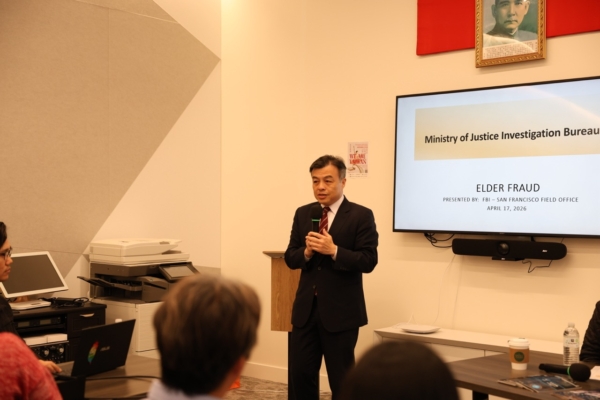
In recent years, a new type of crime model that combines “transnational repression” and “telecom fraud” has been quietly spreading within overseas Chinese communities. At a special seminar in San Francisco on April 17th, FBI agents revealed that this type of crime targets not only individuals’ properties but also exerts long-term control over victims through psychological manipulation and political intimidation, displaying unprecedented complexity and secrecy.
Miss Li from Taiwan shared with reporters her months-long experience of being deceived, revealing a typical “cross-border impersonation of law enforcement agencies” telecom fraud scheme.
Studying at UC Berkeley in California, Li said the incident began in September last year when she received a call from a supposed customer service representative of the delivery company UPS, claiming that there was a suspicious package sent from New York to Hainan, China under her name. The call was then “transferred” to the so-called “Hainan Public Security Bureau,” which accused someone of using her identity to open an account at the Industrial and Commercial Bank of China in China, involving a fraud case of 3 million RMB.
Under the pressure and gaining trust from the fraudsters, Li was asked to cooperate with the “investigation” through communication apps, including long video calls, daily reports of her whereabouts, and real-time selfies to prove she had not fled. The scammers even demanded strict confidentiality, instructing her not to disclose the “progress of the case” to anyone.
Subsequently, the fraudsters even demanded an $80,000 security deposit, claiming it would allow her to stay in the US to cooperate with the investigation and avoid deportation. Li, who could only come up with around $14,000 at the time, was promised help in overcoming the difficulty by the fraudsters, who then transferred about $110,000 into her account and required her to transfer the money in installments to the so-called “Vietnamese commissioner” instead of directly to the Chinese court.
In confusion, Li followed the instructions and transferred the funds in batches. Later, the scammers transferred approximately $80,000 again, falsely alleging the need to track down “moles” through “capital flows,” prompting her to continue the transfers.
By the end of last year, Li received a notification from Bank of America stating that her account was involved in fraudulent fund flows and was reported, leading to the freezing and closure of her account. It was then that she realized she had been used as a “money laundering channel,” transferring her personal savings and facing disruptions in her daily life due to the abnormal account status.
Li expressed that from initially receiving the call to realizing she was being scammed took about seven months. The fraudsters utilized Chinese communication, forged calls from the Chinese public security, and had detailed personal information about her and her family, gradually earning her trust and leading her into the trap.
It wasn’t until April this year when the perpetrators suddenly went silent that she fully acknowledged falling into the scam. She ultimately lost around $16,000 and endured the troubles caused by the freezing of her account.
Li also mentioned that her mother, a mainland Chinese, had her passport stolen before coming to the US.
Reflecting on the situation, she believed she trusted the scammers because her mother was from the mainland and had her passport stolen before coming to the US. The fraudsters not only had information on her and her family’s household registration but also details of her deceased grandmother, continuously sending her this information.
FBI agents stated that this type of new scam typically begins with victims receiving messages or calls claiming to represent Chinese law enforcement agencies (such as the Ministry of Public Security or local police stations). These supposed police inform the victims that they are suspected of criminal activities and explain that if they do not cooperate with the investigation, they will be handed over to US law enforcement agencies like the FBI and possibly deported or sent back to China.
The scammers often tell victims that to expedite the investigation and close the case quickly, they can first pay a sum for examination. They claim this is to ensure that the funds are not illegally obtained and do not involve tax evasion issues with the Chinese government.
The victims of such scams are often Chinese residents in the US who easily believe the scammers due to their previous interactions with Chinese law enforcement agencies. Hence, when they receive fraudulent calls, their initial reaction is to comply.
The scammers emphasize confidentiality and warn victims that if they mention this confidential investigation to anyone in the US, they will send people to arrest them and immediately deport them back to China.
From the victims’ perspective, such threats are more credible under the background of the implementation of “Transnational Repression” (TNR) by the Chinese Communist Party.
“Transnational Repression” is a concept introduced by the US Department of Justice in recent years, specifically describing how foreign governments extend beyond borders to intimidate, silence, coerce, harass, or harm their overseas nationals and exile community members, including those residing in the US.
The agents stressed that the essence of “Transnational Repression” is when foreign governments extend law enforcement or political oppression to other countries, including within the US, performing surveillance, harassment, intimidation, and even attempting to kidnap or forcibly repatriate the targeted individuals. The targeted individuals often include political dissidents, human rights activists, journalists, and religious or ethnic minority groups.
The agents emphasized that the persecution of religious and ethnic minority groups by the Chinese Communist government makes these groups targets of transnational repression, especially those considered threats such as Uighurs, Tibetans, and democracy activists.
In related cases, victims not only faced harassment overseas but also their relatives in China may be threatened or detained, becoming tools to pressure the victims.
The agents mentioned that the FBI has noticed several cases of transnational repression occurring in the Bay Area, which have not been disclosed yet.
During the seminar, an FBI forensic accountant delved into preventive strategies against common fraud tactics. He emphasized the importance of “delayed response” and “multi-verification.” People should avoid clicking on unfamiliar links and emails, not answer unknown calls, refrain from downloading apps from unknown websites, and avoid letting untrustworthy individuals use their computers or phones.
Furthermore, preserving scammers’ phone numbers, emails, and account information is crucial for law enforcement tracking cases.
The event was organized by the Taipei Economic and Cultural Office in San Francisco. Director Wu Chih-hsiang, in his opening speech, thanked the FBI agents and analysts for bringing this special seminar on anti-fraud awareness and transnational combat.
Wu also mentioned that through this seminar, attendees could understand how foreign forces use transnational intimidation, coercion, and surveillance methods and why this is more important than ever before.