
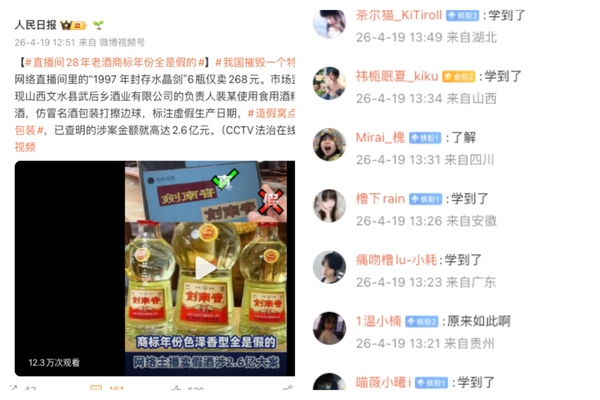
Due to the inadequate supervision by the Chinese Communist authorities, counterfeit products are rampant in China. Recently, the official Chinese state media “People’s Daily” reported a major fake liquor case in Shanxi, involving counterfeit liquor made by blending edible alcohol and food additives, falsely labeled as famous brands such as Wuliangye and Jiannanchun, with a total amount involved reaching 260 million yuan (RMB). Internet users, accustomed to such counterfeiting incidents, flooded the comments section on Weibo, sarcastically saying, “Understood.”
On April 19th, the State Administration for Market Regulation of the Chinese government announced that a large illegal network involved in trademark infringement and selling counterfeit liquor has been uncovered recently. The incident occurred in Shanxi, involving nearly 20,000 cases of counterfeit white liquor, over 700,000 pieces of counterfeit packaging materials, 14 manufacturing machines, 41 large liquor storage tanks, and one online live broadcasting sales point. The counterfeit liquors include “Jiannanchun,” “Wuliangye,” “Wuliang Original Liquor,” “Wuliang Liquor,” “Wuliang Qu,” “Wuliang Tribute Liquor,” “Luzhou Laojiao Special Qu,” “Sichuan Luzhou Laojiao Special Qu,” among others. Some of the products were packaged as “aged liquor” stored for decades and sold online.
According to the announcement, the total amount involved was 260 million yuan. 22 individuals were summoned for questioning, 11 of whom were subjected to coercive measures, with 2 individuals being prosecuted.
This news immediately sparked heated discussions online. Financial blogger and social media influencer “Zhou Si CIO” remarked, “Over 200 million worth of fake liquor sold through live streaming, how many people fell for it?”
Some netizens questioned, “Which online platforms and stores were involved, and which companies were responsible for the fakes? Why are they not being disclosed?” “Why is it that every time such news breaks, the platforms are able to escape unscathed?” “Shouldn’t the platforms be fined?” “Only two people prosecuted?”
The Chinese Communist state media has heavily promoted this anti-counterfeiting achievement, with “People’s Daily” reposting the report on its official Weibo account. However, the comment section was flooded with sarcastic remarks from netizens like, “Learned something new,” “Got it,” “So that’s how it is,” “Learned something new, thanks for sharing.”
Public reports indicate that the Shanxi major fake liquor case is not an isolated incident; counterfeit liquor has long been widespread in the Chinese market, with even fake “specially supplied Maotai” becoming a lucrative business in liquor stores. According to a report by the mainland media JiMu News on May 18, 2025, a counterfeit and distribution chain of “special supply liquor” spanning two provinces, Shandong and Guizhou, was exposed, using cheap bulk liquor priced at 5 yuan per kilogram, repackaged as “special supply Maotai” and sold for 120 yuan per box in the market.
Regarding the intermittent “anti-counterfeiting” campaigns by the Chinese government, former Shenzhen entrepreneur Wang Yingguo once told Epoch Times that the purpose is simply to provide a means for various levels of officials to “pluck leeks,” to catch a group of people to fine them and generate revenue for the officials.