
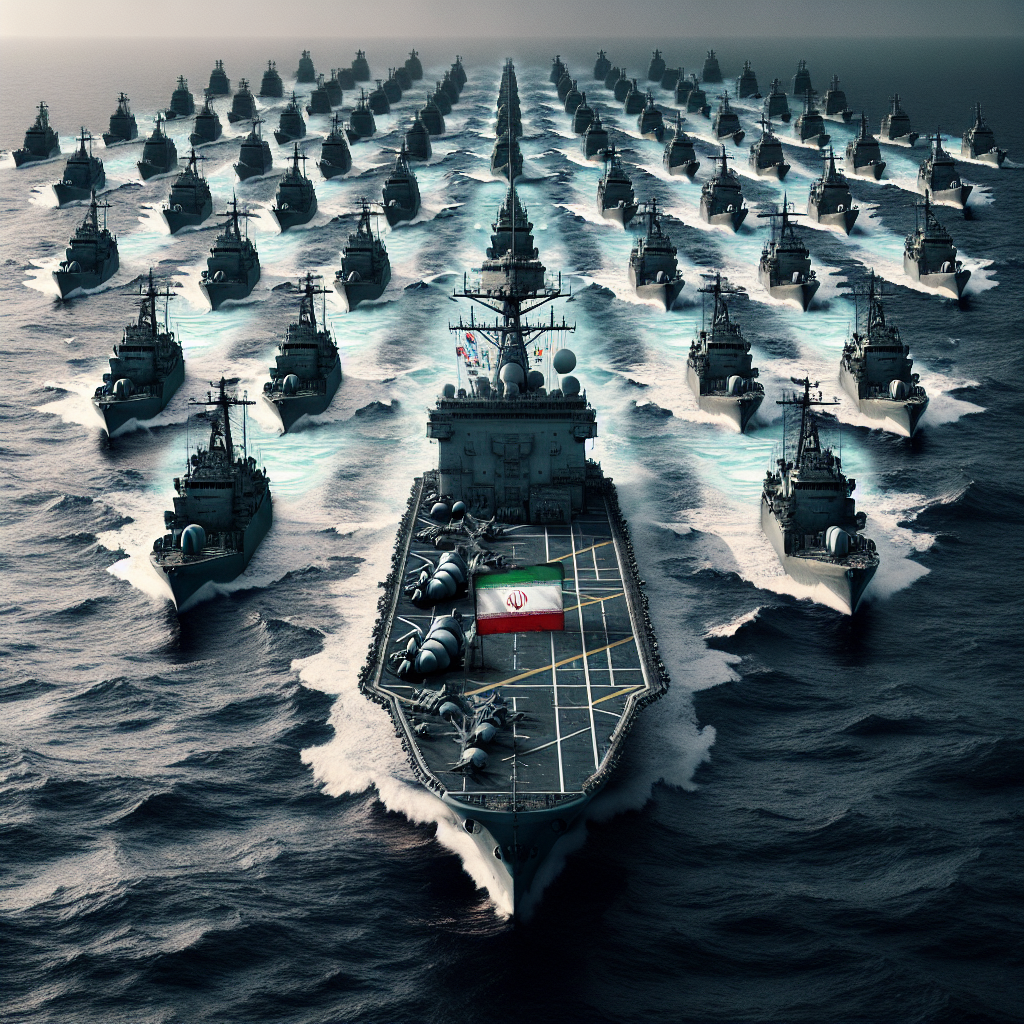
Since April 13, the US military has begun a comprehensive blockade of ships entering and exiting Iranian ports. National security analysts say the move showcases America’s formidable naval power, serving not only to block Iran but also to send a warning to the Chinese Communist Party.
Following the breakdown of negotiations between the US and Iran in Pakistan over the weekend, President Trump announced a comprehensive blockade on Iran aimed at cutting off the current regime’s financial resources, pressuring Iranian leaders to abandon their nuclear program, and reaching an agreement with the US. However, Trump’s blockade on Iran also presents significant geopolitical implications for China.
“If any ship dares to approach our blockade line, we will immediately destroy it, using the same methods used to combat drug traffickers at sea,” Trump wrote on the “Truth Social” platform.
On Saturday, April 18, the US Central Command shared photos on X platform showing the littoral combat ship USS Canberra (LCS-30) patrolling the Arabian Sea. “Since the blockade began, 23 ships have turned back in accordance with US military instructions,” the Central Command wrote. “The US military is implementing a maritime blockade on ships entering and exiting Iranian ports and coastal areas.”
The blockade only affects ships entering and exiting Iranian ports, while other ships remain unaffected.
On April 15, the US Embassy in X platform posted a Chinese chart displaying US military assets involved in the blockade of Iran.
The embassy stated: more than 10,000 US Navy, Marine Corps, and Air Force personnel, along with over a dozen warships and tens of aircraft, are jointly executing the mission of blocking ships entering and exiting Iranian ports. In the initial 24 hours, no ships crossed the US blockade, and six commercial vessels followed US military orders to turn back to an Iranian port in the Gulf of Oman.
The blockade targets all ships entering and leaving Iranian ports and coastal regions, including all Iranian ports in the Persian Gulf and Gulf of Oman. The US military is providing freedom of navigation support for ships traveling to and from non-Iranian ports through the Strait of Hormuz.
Rebecca Grant, Vice President of the Lexington Institute and national security analyst, stated in an article for Fox News that China imports about 11 million barrels of oil daily, with 90% transported via sea routes controlled by the US Navy. Currently, the transportation of oil and petroleum products can only pass through the waterway under US Navy command. Beijing can only watch helplessly.
She mentioned that the US military operation mirrors actions taken against drug trafficking in the Caribbean. Military maritime target tracking systems, even have the ability to “trace back” and track a ship’s movement from its departure point. No ship can approach Iranian ports undetected.
Grant further listed the military assets deployed by the Central Command for the blockade mission:
– Carrier-based naval aircraft:
In the strait’s airspace, land-based P-8 “Poseidon” anti-submarine patrol aircraft and the Navy’s 130-foot wingspan (about 40 meters) MQ-4 “Triton” high-altitude unmanned aircraft are building a continuous maritime situation picture for General Cooper, the commander of the Central Command. Their radar, specially tuned for tracking maritime targets.
– E-2D “Hawkeye” Early Warning Aircraft:
These aircraft, taking off from the USS Abraham Lincoln aircraft carrier, with a giant radar antenna on top that can track 3000 airborne, ground, and maritime targets simultaneously, with a 360-degree field of view. Real-time surveillance is the cornerstone of modern warfare.
– USS Tripoli (LHA-7) Amphibious Assault Ship:
This amphibious vessel carries 2200 Navy Marines and is equipped with its own carrier air wing. It’s certain that the ship’s F-35B fighter jets, MV-22 “Osprey” tilt-rotor aircraft, and the MH-60S “Seahawk” helicopters nicknamed “Sierra” are on standby. The MH-60S helicopters can locate and neutralize mines, and pursue any reckless actions by Iranian Islamic Revolutionary Guard small boats. Of course, US personnel on board USS Tripoli can board and detain ships as needed.
– Aegis Missile Destroyers:
The US Navy has deployed around a dozen destroyers near the Strait of Hormuz, equipped with Aegis combat systems. Together, they form the world’s most powerful missile defense system with formidable firepower.
Independent analyst Shanaka Anslem Perera also commented on the US military’s military assets for the blockade in Iran on X platform. He stated, the list explains the force structure of the US military for implementing the blockade: aircraft carriers, amphibious assault ships, dock landing ships, landing dock ships, missile destroyers, littoral combat ships, unmanned aerial systems, intelligence, surveillance, and reconnaissance equipment, and aerial refueling aircraft.
“This is not a mere patrol; it is a comprehensive blockade: carrier air wing strikes, Marines boarding checks on amphibious ships, littoral combat ship mine-clearing actions, continuous surveillance by unmanned platforms, and aerial refueling by tankers. Every layer of maritime blockade is present in this picture,” he said.
In her article on Fox News, Grant mentioned that Iran is nearly powerless to break the US blockade. The US joint air raids have destroyed Iran’s underground anti-ship cruise missile shelters. If Iranian Revolutionary Guard fast boats attempt an attack, it will be suicidal. The drone defense system is already deployed. US warplanes remain active during the ceasefire, ready to respond quickly once Iran launches an attack.
Grant further explained that Trump’s blockade on Iranian ports demonstrates the US military’s absolute superiority in the air and at sea, also sending a clear warning to Chinese leader Xi Jinping that China itself faces threats. Trump’s ultimate goal is freedom of navigation in the Strait of Hormuz, but at the same time, he is also signaling to China that the US Navy can manipulate the critical oil transport routes vital for Beijing’s survival.
“This is undoubtedly a heavy blow to the China-Russia bloc,” concluded Grant.
Furthermore, Chairman of the Joint Chiefs of Staff General Dan Kane stated on Thursday (April 16) that the US military will pursue ships associated with Iran far beyond the Middle East in the Indo-Pacific region.
The Strait of Malacca and its surrounding waters have long been a transit point for Iran’s “shadow fleet” to transfer oil to cover its shipments to Asian countries, mainly China.
Kane said, “We are also in the Indo-Pacific area of responsibility, conducting similar maritime interception operations against ships that left the region before we initiated the blockade.”
Charlie Brown, a senior advisor tracking the shadow fleet for the nonprofit “United Against Nuclear Iran,” and a former US Navy officer, told CNN that Kane’s remarks and some US warship movements monitored through ship tracking platforms and satellite imagery indicate that Washington might be considering actions similar to those taken earlier this year against oil tankers linked to Venezuela during a blockade operation.
“I expect similar actions to take place in international waters: the US has more operational freedom there and fewer restrictions,” he said.
Satellite images show that as of Thursday local time, the US Seventh Fleet destroyer USS Miguel Keith (ESB-5) is headed towards the Strait of Malacca.
The USS Miguel Keith is a large vessel, nearly as big as a Nimitz-class aircraft carrier, which departed from Sasebo, Japan on April 8.
The warship briefly stopped in Singapore waters on Friday and continued its passage through the Strait of Malacca that evening.
According to information released by the US Marine Corps, the vessel is an expeditionary sea base tasked with supporting air mine sweeping and special operations.