
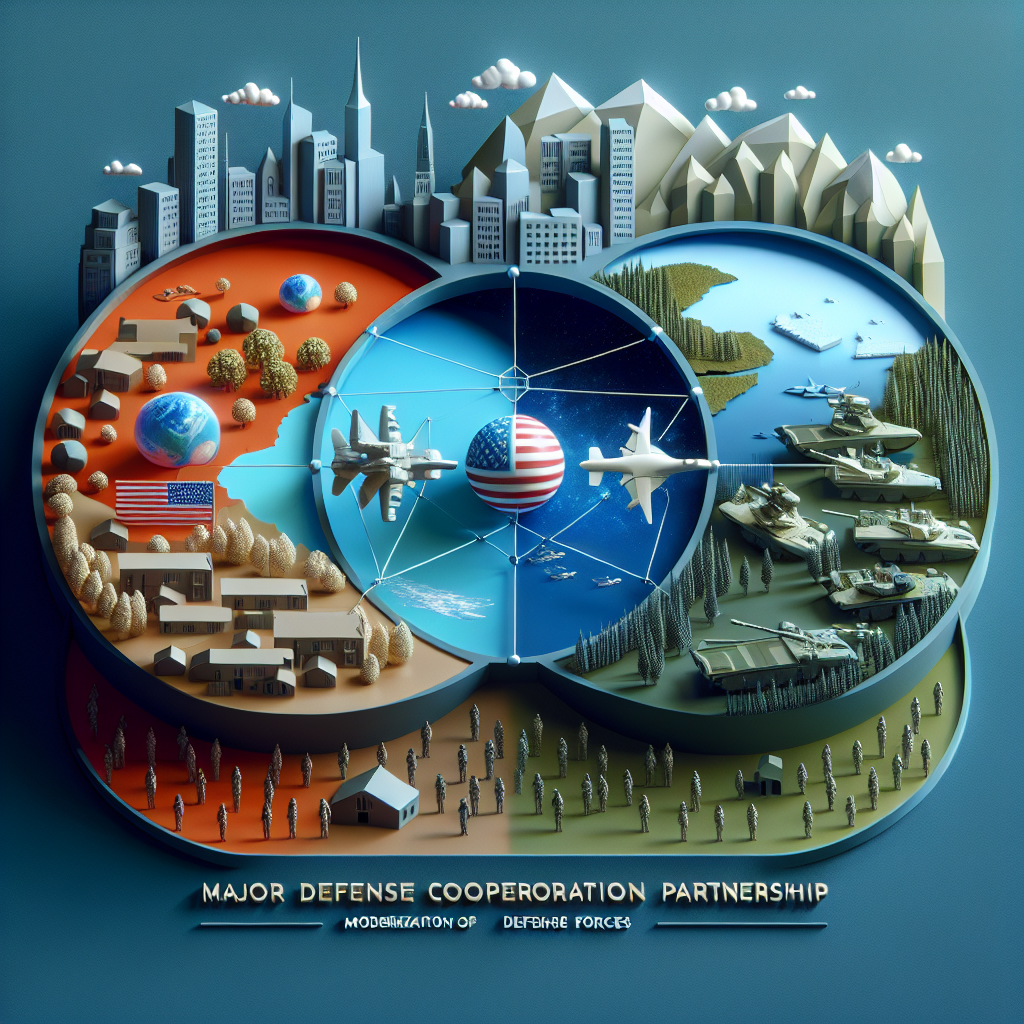
The United States and Indonesia recently announced the establishment of a “Major Defense Cooperation Partnership,” with three main areas of cooperation covering military modernization, joint training, and exercise collaboration. This move has sparked close attention from the Chinese Communist Party to the strategic position of the Malacca Strait. Experts point out that Indonesia is a key node in the first island chain, and the deep logic behind US-Indonesia cooperation lies in controlling China’s energy throat and building a Indo-Pacific deterrence and containment system.
US Defense Secretary Pete Hegseth welcomed Indonesian Defense Minister Sjafrie Sjamsoeddin at the Pentagon on April 13. During this meeting, both sides jointly announced the formal establishment of the “Major Defense Cooperation Partnership.”
This partnership aims to build a framework to deepen bilateral defense cooperation between the United States and Indonesia to maintain peace and stability in the Indo-Pacific region.
According to the joint statement, this new cooperation agreement includes three main “cornerstone pillars”: military organization and capability building, training and professional military education, and exercise and operational cooperation. This includes “joint development of advanced asymmetric warfare capabilities, exploring next-generation defense technologies in maritime, underwater, and unmanned systems, and cooperating on maintenance, repair, and overhaul (MRO) support to enhance operational readiness.”
Hegseth stated during the meeting that the two countries conduct over 170 joint military exercises annually, showcasing the dynamic and growing relationship. Indonesian Defense Minister Sjamsoeddin also remarked that they are working to enhance each country’s national interests based on mutual respect and win-win cooperation, describing this agreement as a new starting point for their defense relationship.
Since establishing diplomatic relations in 1949, the United States and Indonesia have maintained formal diplomatic ties for 75 years. This agreement elevates the military ties between the two countries to a new level, shining a spotlight on Indonesia, an archipelagic country with strategic international waterways, in the Indo-Pacific strategic landscape.
The upgraded defense cooperation between the US and Indonesia has drawn widespread attention from mainland media. “Wall Street Insights” stated that the US is strengthening its military presence in the Malacca Strait through the agreement with Indonesia, raising concerns in the market about the stability of this key global shipping route. Caixin cited analysis from Luo Chuanyu, Vice President of the China-ASEAN Institute at Guangxi University, stating that this move “may have a greater impact on the situation in the South China Sea.”
On April 17, Chinese Foreign Ministry spokesperson Guo Jiakun stated during a press conference that “military security cooperation between countries should not be aimed at third parties or harm the interests of third parties.”
Researcher Shen Mingshi from the Taiwan Institute of National Defense Security told Epoch Times that the United States’ strengthening of defense cooperation with Indonesia is directly related to the long-standing Chinese concern about the “Malacca Dilemma.”
The concept of the “Malacca Dilemma” was proposed by former Chinese leader Hu Jintao in 2003, referring to China’s high dependence on the Malacca Strait for oil imports, which would deal a fatal blow to the Chinese economy if this passage were blocked.
The Malacca Strait, approximately 900 kilometers long, is a strategic “chokepoint” connecting the Pacific and Indian Oceans, serving as a lifeline for East Asian countries. According to data from the US Energy Information Administration (EIA) in 2025, the Malacca Strait accounts for nearly one-third of global maritime oil trade on a daily basis. Its importance, whether economically or militarily, can be compared to the Suez Canal or the Panama Canal.
Shen Mingshi pointed out, “Over the years, China has continued to advance alternative solutions, including pipelines from Gwadar Port in Pakistan to Xinjiang, and from Kyaukphyu Port in Myanmar to Kunming, trying to bypass the Malacca Strait.” However, he believes that these efforts can only partially alleviate the situation, as China’s main source of oil still comes from the Middle East and cannot completely bypass the Malacca Strait.
Around the time of the signing of the defense agreement between the US and Indonesia, tensions in the South China Sea also intensified, with Southeast Asian countries facing increasing pressure from China.
According to Indonesia’s national news agency Antara News, the Indonesian government reported on April 7 that a device suspected to be an underwater drone with the inscription “CSIC” (China Shipbuilding Industry Corporation) and simplified Chinese characters was found in waters near the strategic Lombok Strait. The preliminary identification of the device raised strong international suspicions about China’s intelligence reconnaissance activities.
The Lombok Strait is one of the few deep-water passages suitable for submarines during operations, drawing high attention from the US and Australia. This incident has sparked international scrutiny of China’s intelligence and reconnaissance activities.
In the maritime areas around the Philippines, China’s expansion activities have been more intense. Satellite images cited by Reuters showed that China installed a 352-meter floating barrier at the entrance to Scarborough Shoal on April 10-11 and deployed multiple maritime militia ships to block the entrance.
Furthermore, the Philippines accused China of “fishermen” dumping cyanide near Ren’ai Reef. The Philippine National Security Council stated that China’s poisoning activities began in 2025.
Facing continued pressure from China, the Philippines officially established a new coast guard base on Thitu Island in the Spratly Islands on April 9. On the same day, a Philippine coast guard plane was attacked with illuminating flares by Chinese military forces during a routine patrol.
The developments in the Strait of Hormuz provide the latest real-life example for the Malacca Strait issue. After weeks of tension between the US and Iran, Iranian Foreign Minister Zarif announced on April 17 that the Hormuz Strait would be fully open to merchant ships during the Lebanon ceasefire.
US President Trump immediately stated on social media that the US’s maritime blockade against Iran would continue in full until the relevant agreements are fully completed. US Central Command Commander Brad Cooper also confirmed that over 10,000 US military personnel continue to carry out blockade missions, ensuring that “no vessel has escaped or will escape the US military blockade.”
The recent turmoil in the Hormuz Strait serves as a training ground for potential confrontations in the Malacca Strait in the future. Shen Mingshi stated, “So, if there is a conflict between the US and China, similar restrictions as in the Hormuz Strait, which limit strategic energy supplies, may occur.”
Shen Mingshi also highlighted Indonesia’s dilemma. Southeast Asian countries such as Indonesia have long followed a dual-track strategy of “economy relying on China, security relying on the US.” However, he cautioned that “China has historically been a disruptive force in the Southeast Asian region, and its expansion in the South China Sea also threatens Indonesia’s Natuna Islands interests.”
In conclusion, Shen Mingshi emphasized that the US aims to deter China’s expansion with a network that covers multiple countries, maintaining stability in the entire Indo-Pacific region. This stability, he believes, “is actually very helpful for Indonesia.”