
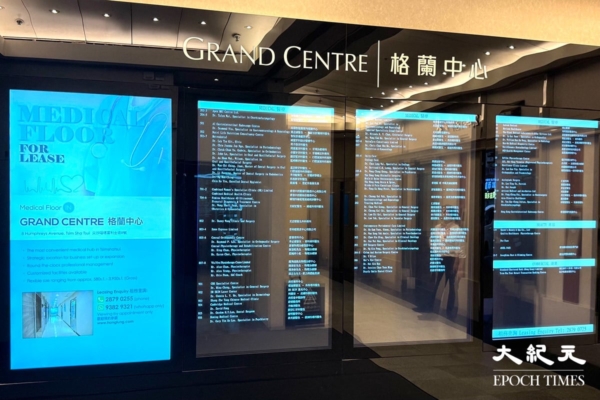
Recently, there have been reports of multiple clinics and medical institutions closing down in the Hong Kong market. Additionally, practicing traditional Chinese medicine doctors have revealed on social media platforms that they have been receiving real estate promotion flyers specifically targeting medical units for several months. These flyers are mainly concentrated in the central, Wan Chai, and Yau Tsim Mong districts, areas known for a high concentration of doctors. Among them, there are units boasting “beautifully renovated units for lease,” attracting new operators to take over.
At the end of March this year, a registered traditional Chinese medicine practitioner posted on the social media platform Threads, indicating that they had been receiving real estate promotion materials for medical units for several months, noticing that many units located in the traditional medical center hubs in Central, Wan Chai, and Yau Tsim Mong are up for takeover. The post mentioned that some units have a new and clean design, described as “beautifully renovated,” with an estimated cost savings of HK$200,000 to HK$400,000 in renovation expenses for potential new operators.
However, in the current economic environment, the process of leasing these units has not been smooth. Commentator Wong Ruiqiu analyzed on the program “Unfiltered News,” stating that many established Western doctors own their properties and operate relatively steadily. On the other hand, new operators running leased premises are facing significant pressure due to declining interest in medical consumption among Hong Kong residents and rising operational costs. She also mentioned that the medical market is not simply contracting but rather undergoing a major “reshuffling.”
Looking into the data, Rengui Medical Group suddenly closed down in May 2025, triggering widespread consumer complaints. A large number of parents who had pre-paid fees were unable to schedule their children for vaccinations. Customs, police, and consumer councils received over 2,530 complaints, involving a total amount of approximately HK$12 million. In 2025 alone, the consumer council recorded 1,299 complaints related to Rengui. Subsequently, creditors filed for liquidation of companies under the group.
Moreover, there are large medical groups expanding against the market trend. At 35 and 37 Kimberley Road in Tsim Sha Tsui, a medical group rented 14 entire floors of office space at a high price of HK$7.9 million per month last year. The total area covered approximately 94,400 square feet, with an average rent of HK$85 per square foot for a 5-year lease.
The property was jointly developed and acquired by consortiums like Kailongrui. The Central (commercial premises) office director Ma Weichang analyzed that post-pandemic, there is still a growing demand for specialized medical services. Consortia tend to develop “medical towers” with a single landlord to facilitate one-stop services.
Furthermore, citing Legislative Council documents, the number of private medical service points connected to the “Health and Care App” increased significantly from 359 in 2023 to 845 in 2025. This surge in numbers reflects an industry filtering process, with institutions possessing rich IT resources and systems continuing to grow, while small and medium-sized clinics are gradually marginalized due to the cost pressures stemming from digitization, transparency, and regulatory enhancements.
Regarding the trend of Hong Kong residents seeking medical treatment in mainland China, the Department of Health data shows that from early 2024 to January 2026, around 32,200 elderly people had used medical vouchers to seek treatment on the mainland. An additional 14,000 individuals had used the “cross-border health record” function.
Wong Ruiqiu mentioned that although the estimated number of people opting to pay for treatment or check-ups in mainland China reached 200,000, compared to the millions of patients treated annually in private clinics in Hong Kong, the influx to the mainland is not sufficient to explain the widespread closure trend in the city.
Wong Ruiqiu’s analysis points out that the real impact stems from local structural changes. Firstly, the mass emigration has led to a significant loss of stable consumer base from middle-class clients who prioritize regular check-ups and long-term follow-ups. Secondly, local residents are becoming more conservative in their medical consumption habits, reducing non-essential and preventive check-ups, coupled with soaring rents and wages, putting pressure on the survival space for small clinics.
The increased collaboration between insurance companies and large medical institutions is another significant factor. Large clinics being able to provide direct billing services divert patients systematically from small and medium-sized clinics to avoid upfront payments.
The Shenzhen Health Commission projects that by 2026, over 300,000 Hong Kong residents will seek medical treatment in Shenzhen, utilizing the cross-border health record channel. This figure is currently considered a policy goal or vision. The recently initiated “Shenzhen-Hong Kong Data Cross-border Secure and Convenient Channel” aims to achieve medical data interoperability, with Hong Kong University Shenzhen Hospital, Shenzhen Xinfeng Harmony Hospital, and Zhongshan Chenxinghai Chinese and Western Medicine Integrated Hospital designated as demonstration sites.
However, concerns have been raised regarding the quality and commercial logic of medical services in mainland China. In May 2025, Shanghai United Family Hospital was involved in a serious medical dispute when a patient surnamed Pan experienced dysfunction after multiple surgeries, discovering that the involved doctor held a false qualification.
Wong Ruiqiu cautioned that some high-end hospitals in mainland China are backed by investment firms, leading to instances of “over-medicalization” and unnecessary medical procedures for profit, where medical check-ups are merely used as a means to generate surgical fees.
Additionally, the “2026 Action Plan for Deep Integration Development Leadership Zone in Qianhai” reveals that the Qianhai Management Authority is directly responsible for constructing and managing the “Qianhai-Hong Kong Medical Data Cross-border Transmission Channel,” aiming to establish the area as the preferred and exemplary location for cross-border data flows. Data circulation will commence from the healthcare sector and gradually expand in a “safe and orderly” manner to other key sectors such as finance, commerce, education, and research. The ultimate goal is to construct this data expressway as the “digital backbone” supporting high-quality development in the Greater Bay Area.
Wong Ruiqiu emphasizes that this government-led data flow model aims to develop a “Chinese solution” that complies with national regulatory requirements and utilizes blockchain technology for recording and encryption. By refining large-scale data flow models in Qianhai, relevant departments hope to enhance their “bragging rights” in global data regulations and reduce dependence on Western technology norms.
She pointed out that the experiments in Qianhai essentially involve gradually integrating Hong Kong’s data into a management model prioritizing “national security.” Official documents repeatedly emphasize this policy vision, indicating that Qianhai is not only an experimental laboratory for institutional convergence but also a crucial springboard for achieving national data management goals.