
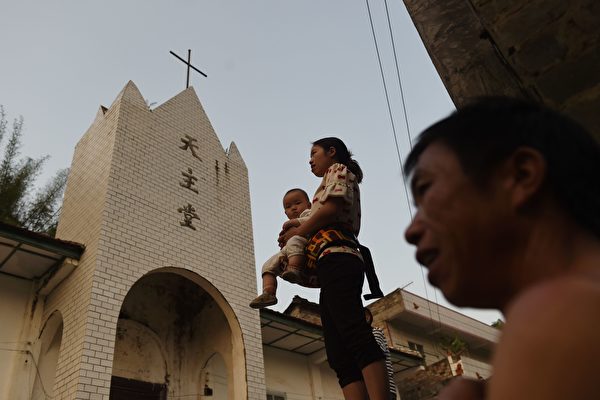
After Xi Jinping took office as the leader of the Chinese Communist Party, he has been implementing a so-called “Sinicization” campaign in the past decade, leading to intensified ideological control, strict surveillance, and travel restrictions for Catholics across China. A report released by Human Rights Watch on April 15, 2026, highlighted the Chinese government’s escalating control over religious groups, particularly targeting Catholics.
According to the report, there are about 12 million Catholics in China, who are only allowed to practice their religion within the official “Chinese Patriotic Catholic Association” system. Underground churches that refuse to join this system have increasingly become targets of suppression by the Chinese Communist Party in recent years.
Since the Chinese government introduced the policy of “Sinicization of Religion” in 2016, churches have been demolished nationwide, unofficial gatherings restricted, unauthorized religious publications and applications banned, and religious believers as well as clergy members threatened and constrained.
Under the Sino-Vatican Agreement of 2018, the Chinese government can nominate bishop candidates, with the Pope possessing veto power. However, the full text of the agreement has never been made public. The agreement has been renewed three times, extending its validity until October 2028, but both previous and current Popes have never exercised the veto power, even in cases where the Chinese government unilaterally appointed bishops in violation of the agreement. Since Pope Lianshi XIV took office in May 2025, he has accepted all five bishops appointed by the Chinese government without objection.
Underground bishops face suppression from Chinese authorities. For instance, 94-year-old Bishop Su Zhimin of the underground church in Baoding Diocese remains missing; Xing Wenzhi, former auxiliary bishop of Shanghai Diocese, has not made any public appearances; Guo Xijin, former auxiliary bishop of Fuzhou Diocese, and Shao Zhumin, bishop of Wenzhou Diocese, have been subject to long-term movement restrictions; Cui Tai, bishop of Xuanhua Diocese, and Mathan Chin, auxiliary bishop of Shanghai Diocese, have been detained and had their duties limited.
Clergy members lead restricted lives and are politically controlled. One priest was prohibited from opening a bank account, obtaining a mobile phone SIM card, and passport. The report highlights that clergy members in some regions of China are required to attend political training regularly, sometimes as frequently as once a week.
The report points out that the aforementioned measures violate the principles of religious freedom in the Universal Declaration of Human Rights, involving various fundamental human rights such as expression, association, and movement.
Furthermore, the Chinese authorities have increasingly restricted children from entering Catholic churches nationwide, which goes against China’s obligation as a signatory to the Convention on the Rights of the Child.
Recently, the Chinese government has imposed strict regulations on exchanges between clergy members and overseas individuals, including travel abroad or collaborations with foreign churches.
On December 16, 2025, the “Chinese Patriotic Catholic Association” and the “Chinese Catholic Bishops’ Conference” jointly passed an internal regulation requiring unified storage and strict approval of travel permits for all Catholic clergy members across the mainland.
Human Rights Watch calls on governments around the world to pay attention to these issues and urges the Chinese authorities to cease restrictions on religious groups.
It is noteworthy that while the Chinese Communist Party forcefully promotes religious “Sinicization,” in reality, since coming into power, the Party has vigorously propagated atheism, undermining traditional Chinese culture and implanting Communist agents within various religions, directly led by the CCP’s Religious Affairs Bureau. This essentially portrays religions that believe in a higher power under the leadership of the atheistic Communist Party.