
China’s economy continues to decline after the Chinese New Year, with various industries experiencing a new wave of strikes and salary disputes. The root causes behind these phenomena have raised concerns.
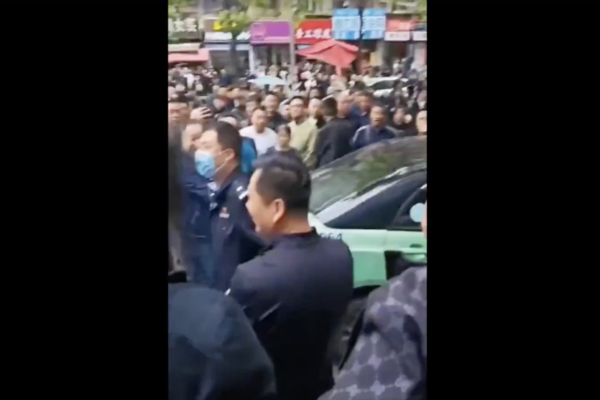
In Xi’an, Shaanxi Province, a large number of taxi drivers, facing dire living conditions, have been protesting outside local government offices to demand lower taxi contract fees.
On April 12th and 13th, hundreds of taxi drivers gathered for two consecutive days at the Xi’an Taxi Management Office to protest and demand a reduction in taxi contract fees.
In recent years, the traditional taxi market has been shrinking due to multiple impacts such as ride-hailing services and shared bicycles. Drivers’ incomes have plummeted, but the high taxi company contract fees they need to pay remain exorbitant, with most of their hard-earned money being taken by the authorities, making it difficult for them to make ends meet.
Videos from the protests show a large group of drivers blocking taxis on the road outside the management office, led by a spokesperson shouting slogans like “the government is heartless,” “down with the management office,” “we want to survive,” and “we want to eat.”
From April 9th to 10th, due to low income making survival impossible, taxi drivers in Fengjie, Chongqing, and Jinzhou, Liaoning, also went on strike.
Doctors and nurses in China have also joined the protests against wage disputes.
Online videos show that on April 8th to 9th, medical staff at Hedong District People’s Hospital in Linyi City, Shandong Province, went on strike demanding wages.
This hospital, previously publicly owned but now privatized, had hundreds of doctors and nurses striking for two days to demand their salaries. Reports indicate that the hospital had not paid its staff for two years, nor had it paid social security and medical insurance, despite multiple failed previous attempts by employees to seek justice.
On March 31, Tiantian Lake Hospital in Leping City, Jiangxi Province, announced the dismissal of all 315 employees, leaving them all jobless overnight.
Also, on March 31, Kangtai Hospital in Chaoyang City, Shantou, Guangdong Province, announced the dismissal of all employees starting April 1. Some staff members revealed that the hospital owed over five months’ worth of salaries to about 100 employees, totaling over four million yuan.
On March 20th, doctors and nurses at Shili Hospital in Lu’an, Anhui, went on strike to demand the unpaid wages and performance pay owed to them by the hospital.
The wave of hospital closures in China is expanding. According to statistics, the trend of hospital closures has been apparent since 2022 and is continuously growing. In 2025 alone, over 1362 private hospitals closed down. Data analysis suggests that this trend of closures is increasing, expanding from private to public hospitals. Many hospitals are facing wage arrears or operational difficulties, teetering on the brink of closure.
Wang Zhanxi, Associate Researcher at the Institute of National Security Studies of the Taiwan National Security Research Institute, told Taiwan Central Broadcasting Corporation that the core reason for the operational difficulties facing Chinese medical institutions lies mainly in the continuous deterioration of local finances. Hospitals heavily rely on “medical insurance” payments, which are primarily supported by local finances. Thus, when local government financial conditions worsen, their ability to pay medical insurance fees diminishes, leading local governments to “withhold” or delay medical insurance funds through various means, resulting in significant financial losses and operational pressures for hospitals, even pushing them toward closure.
In recent years, industries related to infrastructure and real estate in China have faced difficulties, with workers’ wage disputes becoming commonplace.
On April 12th, workers at the Smart Cold Chain Technology Industrial Park project of Shanghai Meixin Joint Construction Development Co., Ltd. blocked the entrance to demand unpaid wages. Some netizens questioned the effectiveness of such actions, wondering how many workers would actually receive their salaries in the end. In previous instances, such wage disputes in projects like the one in Shanghai are increasingly common, driven by local debt pressures.
Previously, on April 9th, workers at the Yalan Zhigu Industrial Complex project in Guangzhou, Guangdong Province, blocked the gate with vehicles to demand payment after three years of project completion with delayed wage payments.
On March 25, construction workers at Hanqing Huafu in Qingcheng District, Qingyuan, Guangdong, protested the closure, blocking the entrance to the site.
Wang Shoufeng, Vice Chairman of the Chinese Democratic Front in Germany, told NTD Television that the longstanding wage arrears issue for migrant workers in China is closely tied to large projects under central and state-owned enterprises, as well as local governments. These projects often become hotspots for wage arrears, as officials exploit them to embezzle funds, leaving workers continuously unpaid.
Over the past decade, the real estate industry in China has thrived, supporting countless individuals. Now, the industry has plunged into winter, with significant market demand contraction, leading major real estate companies to face financial difficulties, layoffs, and even bankruptcy.
The number of employees in Chinese real estate development enterprises has declined. From 293.7 thousand in 2019, the number dropped to 150.7 thousand in 2025, cumulatively reducing by 1.43 million, with a reduction rate as high as 48.69%.
Labor disputes have also emerged in the manufacturing industry.
According to self-media outlet “Yesterday,” on April 13th, hundreds of management personnel at the Foxconn factory in Taiyuan, Shanxi, went on strike protesting against the removal of managerial positions. This followed a similar strike on March 26, 2025, which had yielded no results.
From April 7th to 8th, in Zhenhai District, Ningbo, Zhejiang Province, hundreds of workers at Ningbo Ideal Auto Parts Co., Ltd. went on strike for two days protesting against the inadequate compensation for relocating the factory. The workers revealed that despite the equipment being close to being moved, there were no official notifications or relocation compensation or settlement plans in place.
Additionally, from March 27th to 30th, dozens of workers at Jiangsu Changshu Huaxin Auto Parts Co., Ltd. protested against the company’s indirect layoffs. Following a recent sharp decline in orders, the company shifted remaining work to temporary staff, forcing regular employees to take leaves, coercing them to resign to avoid compensation.
On April 2nd, the ” Pig Waist Family” restaurant in the Creative Industrial Park Noyecheng in Chancheng District, Foshan City, closed down, prompting employees to demand unpaid wages by blocking the entrance.
From March 31st to April 3rd, delivery riders in Fengjie County, Chongqing, went on a continuous strike protesting against platforms exploiting them by reducing delivery fees. By April 4th, the strike had been deemed unsuccessful.
On March 26th, an 80-year-old sanitation worker in Shaoyang, Hunan, tied himself to a sanitation vehicle protesting against withheld wages.
In recent years, wage disputes in mainland China have extended to various professions, including doctors, nurses, teachers, restaurant staff, sanitation workers, bus drivers, taxi drivers, delivery workers, tax bureau employees, bank workers, among others. The strikes and wage disputes from March to April this year mark the newest round following the traditional Chinese New Year.
China expert Li Lin told Epoch Times that the appearance of wage disputes and strikes in March and April, alongside the previously year-end occurrences, may signify severe economic deterioration in China, with no apparent solutions to the emerging problems.
Media chief editor and former founder of NPO in Shenzhen, Ai Shicheng, believes that the further spread of wage disputes signals an impending systemic collapse in society. Economic and social collapses can lead to political order upheaval, with a chain reaction starting to unfold.