
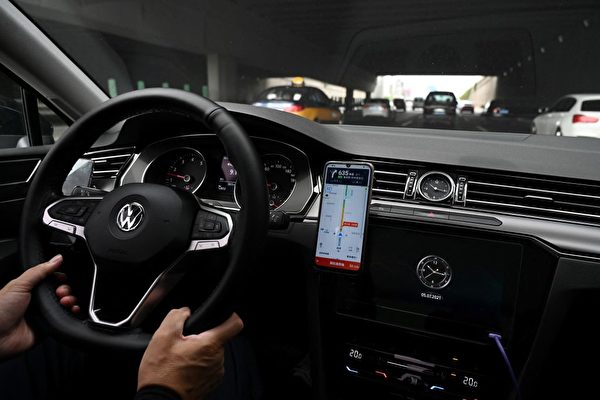
On April 17, 2026, the state security department of the Chinese Communist Party (CCP) released what they called “anti-spy case”, claiming that a ride-hailing driver assisted in the capture of two “foreign spies” in front of a military camp gate and was rewarded with a “special major contribution award”. The case was featured on CCTV news with a simulated screen, without disclosing specific time and location, sparking doubts about its authenticity among the public.
CCTV, a CCP mouthpiece, reported on the 16th that a ride-hailing driver recalled picking up two foreign passengers in the city, and when driving towards the gate of a military camp in a suburban area, the passenger in the front seat raised a phone to take pictures of the gate, while the passenger in the back whispered and pointed outside. The driver noted the characteristics of the two individuals and reported to the national security agency after reaching the destination.
According to the report, the two passengers ordered a ride again, this time heading towards another direction near a military training ground. The driver changed the route and drove the vehicle towards the camp gate. During the process, the passengers attempted to delete photos, prompting the driver to “turn around and grab the phone”. Subsequently, the sentries at the gate controlled the people inside the car, and the two passengers were handed over to the national security agency.
CCTV quoted the official conclusion stating that the two individuals were “instigated by foreign spy intelligence agencies” to conduct “reconnaissance” on Chinese military targets, with the driver being awarded the “special major contribution award”.
Regarding the ride-hailing driver espionage case disclosed by the Ministry of State Security, a former detective from Hunan, Tan Xiaoyang (pseudonym), in an interview with Epoch Times, said that the case process is illogical: “According to the news report, after the ride-hailing driver first found the two foreign individuals suspicious, he had already reported to the national security hotline. Why didn’t he wait for the police to handle it but instead took a second order and drove towards the military camp gate? This seems more like a pre-designed capturing scenario.”
Tan Xiaoyang believes that as an ordinary ride-hailing driver, why would he take on the role of luring and controlling suspects, “Isn’t he worried that the other party might carry dangerous items? Such as poison, sprays, or even a silenced pistol?”
Dong, a ride-hailing driver from Hubei, expressed his puzzlement after watching the CCTV news segment, saying, “CCTV news claimed that the ride-hailing driver judged that the other party would take a ride again, so he opened the platform and waited. Every ride-hailing driver knows that the platform randomly assigns orders, so the probability of the same driver getting the same passenger again is not high. CCTV said ‘sure enough, soon received the same order,’ haha, such a smooth occurrence, isn’t this just fabricating a story?”
Dong also mentioned that military camp gates and their surroundings usually have signs indicating “military restricted area”, where civilian vehicles without permits are not allowed entry. He questioned how the driver could drive the car to the gate. “Besides, the driver has not received professional training, how could he judge that the passengers are spies just from taking photos?”
Chinese scholar Zhao Fan (pseudonym) stated in an interview that the CCP’s security department throws out these seemingly cinematic cases during the so-called “National Security Day”, without providing basic information such as specific time, location, identity details of the cases. This vague description makes it impossible for outsiders to verify the authenticity of the cases: “In recent years, the Ministry of State Security has been releasing a series of spy-catching cases around this time but the plots often seem convoluted, leading people to doubt if they are true. I feel their main purpose is still propaganda for the common people, to tell you that foreign spies could appear in various identities, inciting you to be hostile towards foreigners, and guard against foreigners, including naturalized Chinese.”
Zhao Fan believes that the CCP’s narratives follow a clear standard communication model: first released by the security department, reported by CCTV, then amplified through self-media, ultimately leading to a public opinion atmosphere against foreign forces and foreigners.
In recent years, the CCP has widened the concept of “spy risks” from traditional intelligence areas to the social level. Activities such as photography, mapping, scientific exchanges, previously included in official propaganda, are now considered “potentially involving secrets”. This kind of propaganda shifts the “national security” responsibility to ordinary citizens and forms a monitoring mechanism involving society through reward systems and guiding public opinion.