
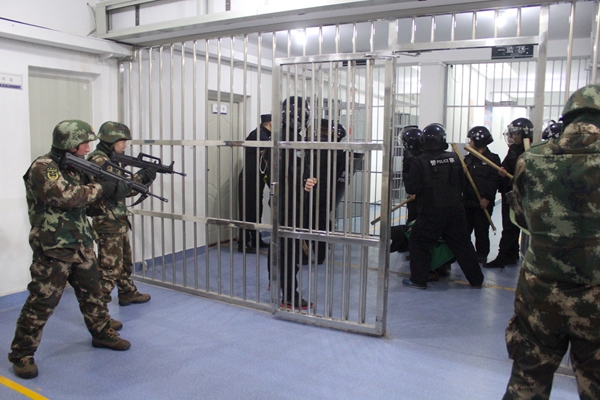
A Chinese police officer, Zhang Yabo, who last year broke away from his group while traveling in Germany, has recently publicly exposed the Chinese Communist authorities’ practice of imprisoning and torturing Uighur people in Xinjiang.
Zhang Yabo successfully left the group during a tour in Germany in August 2025 at Neuschwanstein Castle. Reported by Der Spiegel on April 16, Zhang Yabo fled with a inconspicuous gray backpack containing a laptop with evidence of the persecution of Uighur people during his tenure.
The report detailed Zhang Yabo’s successful escape, with him walking at the back of the group, rehearsing the moment of leaving the group countless times in his mind: in the hotel, on the bus, even in the restroom. Eventually, finding a moment when no one noticed him, he turned back, took a train to Munich.
Zhang Yabo then located the World Uyghur Congress in the Schwabing district of Munich.
In recent years, the Chinese authorities have been accused of establishing camps in Xinjiang that violate human rights, detaining Uighur minorities (also known as “re-education camps”), a claim that the authorities have consistently denied.
Zhang Yabo worked as a prison guard and police officer in northwestern Xinjiang for 9 years. There, a system established by the Chinese authorities, composed of camps, digital surveillance, and political indoctrination, primarily targets Uighur people.
Since 2017, many camps have been exposed in the region: surrounded by barbed wire, watchtowers, and checkpoints. It was reported that at one point, tens of thousands, nearly a million people, were detained there.
Zhang Yabo’s duty was to ensure that no one went to the mosque, search phones, establish records, and immediately report any findings.
The ID saved on his computer hard drive indicates that Zhang Yabo was born on October 15, 1986, in Henan Province, China. He worked as an elementary school teacher in Xinjiang starting in 2009, became a prison guard in 2014, and later worked as a police officer in a village.
He provided a photo of his police ID and a picture of himself in a black uniform standing in front of the prison.
He confirmed that in the camps, if there was disobedience, authorities would carry out torture on them as “so-called extremists.”
His task in the prison was to escort prisoners for interrogation. Most were Uighurs. Police beat the prisoners with batons until the wood broke. Zhang Yabo said he just watched without laying hands on anyone.
“One guard repeatedly kicked a young man’s testicles, and that man later died,” Zhang Yabo said. “I can still hear those screams to this day. I have nightmares about them.”
He mentioned that almost every week, someone died in the prison, with minimal medical care.
Once he guarded a prisoner whose arms were handcuffed for hours until he wet himself. Such punishment was common.
In 2016, he was transferred to a village with about 1,700 residents to serve as a police officer. He created files for suspects, recording their names, contacts, religious activities, even blood test results. He recorded messages in the village committee chat group, who got ill when, who didn’t attend mandatory Chinese classes, and reported information weekly to higher public security authorities.
He said anyone could be taken away at any time. Those who exercised suspiciously were suspects. Reporting suspects also had indicators: those who reported enough suspects could take a vacation, or else work overtime.
One of the documents he provided was an instruction issued in August 2022, related to how to handle so-called mental patients. The document required village administrative offices to conduct “screening and risk assessment.” As for who is considered mentally ill, Zhang Yabo said it’s those “unmarried” individuals, alongside “individuals who drink alcohol and roam the streets without following village instructions.”
Regarding forced marriages, Zhang Yabo said if Uighur and Han Chinese people marry, the couple would receive money. A colleague received 5,000 to 10,000 RMB for it.
In September 2023, Zhang Yabo resigned from his post officially due to “family and health reasons.” He later went to Guangzhou in the south.
Zhang Yabo joined a European tour, costing 35,600 RMB, approximately 4,500 euros. Before leaving, he broke up with his wife, sold furniture and household appliances. Additionally, he bribed officials to obtain an exit permit.
A screenshot showed that Zhang Yabo’s domestic bank account was frozen by the authorities for “legal reasons.”
He mentioned that his family cannot leave China now, his father was once detained overnight by the police, and a friend was taken away for questioning.
He also said his mother was coerced into calling him, begging him to return to China. Authorities threatened to imprison his mother.
When he left the job, Zhang Yabo signed a confidentiality agreement to remain silent about “classified state secrets.” But now he spoke out; he wants to tell the truth. He has applied for asylum in Germany.
When asked why he fled and spoke out, Zhang Yabo stated it was because he is a Christian and presented a baptism certificate.
Dr. Adrian Zenz, a senior researcher at the Victims of Communism Memorial Foundation, stated that Zhang Yabo’s testimony is one of the most detailed eyewitness testimonies obtained from within the Xinjiang security system to date.