
The US Navy has expanded its global blockade against Iran. According to the latest announcement, the US military can now board and detain Iranian vessels, vessels sanctioned by the US Department of the Treasury’s Office of Foreign Assets Control (OFAC), and vessels suspected of smuggling anywhere in the world, aiming to combat Iran’s “shadow fleet” of over 570 oil tankers.
On Thursday, based on the latest announcement from the US Naval Forces Central Command (USNAVCENT), the US military will now board, search, and detain sanctioned vessels regardless of their location in accordance with the US blockade of Iranian ports.
This means that the US Navy has expanded the scope of the blockade that came into effect on Monday at 14:00 UTC, extending beyond the Strait of Hormuz. The Seatrade Maritime News first reported this on Thursday.
The announcement stated, “In addition to enforcing the blockade, all Iranian vessels, vessels sanctioned by the US Department of Treasury’s Office of Foreign Assets Control (OFAC), and vessels suspected of carrying prohibited goods fall under belligerent rights and are subject to boarding and search operations by belligerent parties. These vessels can be boarded, inspected, searched, and detained regardless of their location.”
This announcement implies that vessels belonging to the US-sanctioned Iranian “shadow fleet” could be boarded and detained anywhere in the world. Prohibited goods include items destined for enemy entities potentially used in armed conflicts such as weapons, ammunition, explosives, military equipment and technology, as well as oil, lubricants, and nuclear materials.
Charlie Brown, senior advisor of the private organization United Against Nuclear Iran (UANI), stated that the latest US military actions serve as both a warning and a clear signal.
“The announcement should make all members of the ‘shadow fleet’ aware that they could face these actions wherever they are,” Brown said.
Brown added that these actions fully comply with the provisions of the Law of the Sea Convention.
This includes the “shadow fleet” operating in Southeast Asian waters, with the Eastern Outer Port Labuan (EOPL) in Malaysia identified as a hub for ship-to-ship transfers by these clandestine vessels, transporting oil from sanctioned Iran to China.
Iran relies on maritime trade for nearly 90% of its trade, generating over $400 million in daily oil revenue in the past. The expanded US sanctions on Iran’s shadow fleet will exacerbate the risk of economic collapse and currency crisis in Iran.
If oil shipments are disrupted, Iran’s oil trade with China settled in yuan will also be affected. Beijing faces the choice between continuing to purchase Iranian oil and avoiding direct confrontation with the US Navy.
UANI has identified a “shadow fleet” consisting of over 570 ships that have supported Iran’s oil exports.
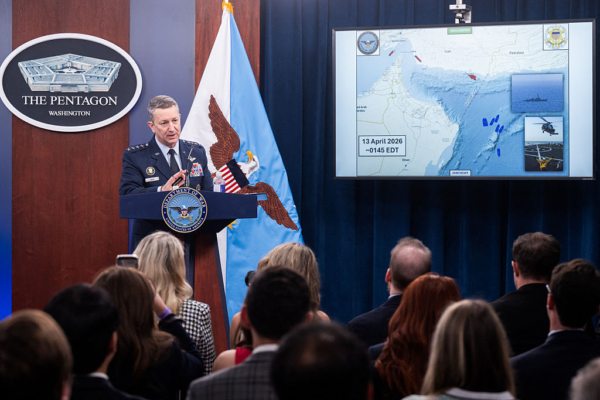
During a Pentagon press conference on Thursday, General Dan Caine, Chairman of the Joint Chiefs of Staff, emphasized that the US blockade on Iran applies to all vessels traveling to and from Iranian ports, regardless of their nationality.
Caine also stated that if vessels support Iran’s illegal activities, the US military will pursue them beyond the Strait of Hormuz.
“The joint forces… will actively pursue any vessels flying the Iranian flag or attempting to provide material support to Iran,” he said.
He further noted that the US military’s targets include vessels of the so-called “shadow fleet” used to transport Iran’s oil in violation of international rules.
Caine mentioned that the operation involves over 10,000 US military personnel, several ships, and dozens of aircraft.