
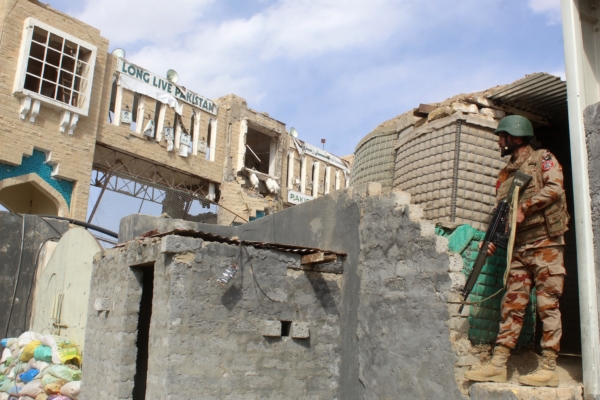
Pakistan and neighboring Afghanistan have been embroiled in conflict since last week, with the situation escalating in the past two days. Pakistan has declared the two countries to be in a state of “total war.” The official stance of the Chinese Communist Party (CCP) on this matter is one of deep concern. Both Pakistan and Afghanistan have close relations with China. Experts suggest that this sudden turn of events represents a setback in CCP’s foreign policy.
Pakistan’s Defense Minister, Khawaja Muhammad Asif, officially announced on Friday (February 27) that Pakistan and Afghanistan have entered a state of “open warfare.”
Prior to this announcement, intense armed clashes broke out between the two sides in the late night hours. Pakistan carried out airstrikes on multiple locations including the Afghan capital, Kabul, resulting in significant casualties on both sides.
Pakistan has long accused the Afghan Taliban government of supporting “anti-Pakistan terrorists” and launching suicide attacks in the country.
The “anti-Pakistan terrorists” referred to by Pakistan are associated with Tehrik-e-Taliban Pakistan (TTP). While ideologically aligned with the Afghan Taliban (both adhere to Sunni extremist Islamic beliefs), TTP operates independently with the goal of overthrowing the Pakistani government and establishing an Islamic Emirate within Pakistan.
The Afghan Taliban consistently denies sheltering “anti-Pakistan terrorists,” claiming that Pakistan’s security issues are internal affairs. In turn, they accuse Pakistan of harboring hostile organizations such as the Islamic State Khorasan branch (IS-K).
Following Pakistan’s declaration of “open war” with neighboring Afghanistan, a spokesperson from the United States State Department stated on the 27th in an email: “The U.S. supports Pakistan’s right to defend itself against the Taliban, designated as ‘Specially Designated Global Terrorist’.”
Pakistan is an important non-NATO ally to Washington, while the U.S. views the Taliban as a terrorist organization.
CCP spokesperson Mao Ning expressed deep concerns about the escalating conflict between Pakistan and Afghanistan on February 27 during a routine press conference. She called for dialogue and negotiation to resolve differences, achieve a ceasefire quickly, and ensure the safety of Chinese personnel and institutions in Pakistan and Afghanistan.
Chinese official media often refer to the China-Pakistan friendship as “ironclad.” President Xi Jinping has publicly described Pakistan as a “ironclad friend.” In recent years, Chinese engineers and technical personnel working on the China-Pakistan Economic Corridor (CPEC) projects have been targeted in attacks, largely attributed to TTP and Balochistan Liberation Army (BLA).
At the same time, China has not officially recognized the Afghan Taliban regime, but has become one of the Taliban’s most significant external contacts. In 2023, China became the first country globally to exchange ambassadors with the Taliban. Taliban officials have participated in the Belt and Road Forum multiple times. Despite being one of the few economic partners of the Taliban, CCP’s actual investment has been lower than expected, with many projects delayed or scaled down, such as the termination of the Amu River oil field contract in 2025 due to disputes.
Australian scholar Yuan Hongbing told Epoch Times that CCP has long been one of the main backers of international terrorism. The Afghan Taliban was supported by the CCP in the past, and after falling under CCP control, it became an ally. The situation in Pakistan is even more intertwined with the CCP. However, there have been recent changes. Due to internal conflicts among various factions of international terrorism and Pakistan’s strong relationship with the CCP, these terrorist organizations have begun taking revenge on the CCP in Pakistan, representing a major failure in Xi Jinping’s foreign policy.
“CCP has been supporting international terrorism and is now facing blowback. This will have negative repercussions on CCP’s strategy of using international terrorism to challenge the United States,” he said.
Yuan also mentioned that the turmoil in these regions is affecting CCP’s investments. The Belt and Road initiative has become a series of unfinished projects globally, largely due to Xi Jinping’s lack of foresight. As local political and economic conditions change after CCP invests funds, its investments suffer significant setbacks. Now, in Afghanistan, CCP faces a similar predicament.