
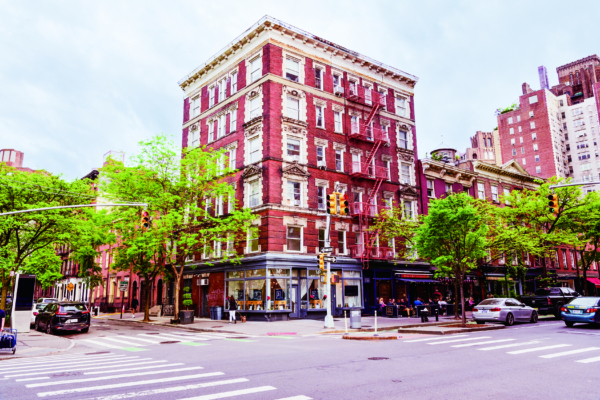
In the city of New York’s Lower East Side, feelings of nostalgia and pride are deeply rooted in the intricate history that encompasses the neighborhood’s buildings, streets, and alleyways. For American architectural historian Andrew S. Dolkart, his family’s connection to the Lower East Side dates back to a specific corner where an apartment building named Mayflower stands, unlike the legendary ship that carried the Puritans to the New World in 1620. His paternal lineage is intertwined with the stories of Jewish immigrants from Russia who settled in this vibrant neighborhood.
To Dolkart, these family narratives are not distant myths but rather a series of chapters hidden behind the doors, staircases, and narrow corridors of the tenement buildings in the city. The experiences of his father growing up in the apartment building became a symbol of the life journey shared by numerous immigrant children who grew up in Lower Manhattan over the past century.
For countless new immigrants, the story of the “American Dream” often begins at Ellis Island. From 1892 to 1954, Ellis Island served as the most significant federal immigration inspection station in the United States: only those who passed through health examinations and detailed inquiries, and were granted entry, truly stepped foot into “America.” However, the arrival was just the beginning; the real challenges lay ahead in finding a place to settle and survive in this new land.
At this juncture, the Lower East Side emerged as the most direct and practical choice for many immigrants. Proximity to the port and industrial areas offered concentrated job opportunities while the abundance of affordable tenement buildings made it an attractive residential option. The Lower East Side, roughly bounded by Houston Street to the north, Canal Street to the south, Bowery to the west, and adjacent to the East River, witnessed a significant influx of Ashkenazi Jewish immigrants, with nearly 75% of the 2.5 million impoverished newcomers settling in the area between 1880 and 1924. They brought with them Yiddish language, synagogues, mutual aid societies, as well as street vending carts and small shops that thrived in the neighborhood’s street economy.
By 1910, the population had exceeded half a million, with many squeezed into cramped rooms and spending their days working in garment factories, workshops, or docks, before retreating to the stuffy stairwells and corridors at night.
Many of New York’s earlier overseas Chinese migrants are familiar with the district of Wan Chai in Hong Kong. Wan Chai, like the Lower East Side, has a historical trajectory that echoes similarities between the two regions. Both areas served as initial reception points for new immigrants in the city: the Lower East Side welcomed waves of immigrants from Europe, the Caribbean, and Asia, while Wan Chai attracted mainland immigrants, boat people, workers, and small traders seeking a livelihood in Hong Kong. Positioned near ports with convenient transportation and relatively low rent, both neighborhoods became havens for the working class, nurturing tight-knit communities with dense living arrangements and close-knit neighborhood relationships.
Two main buildings of the Lower East Side tenement apartments were built around 1863, situated at 97 and 103 Orchard Street, witnessing the lives of immigrants from countless nations. On the other hand, the Blue House complex in Wan Chai, a rare urban heritage existing for nearly a century, reflects early working-class living conditions and the neighborhood culture of grassroots Hong Kong residents. These architectural structures are not merely buildings but rather vessels that housed laborers, small businesses, and families’ daily lives.
The creaking stairs, dimly lit slanted corridors, and weathered wallpapers have preserved the essence of that era. These tenement apartments carried the hardships of immigrant families as they first arrived in America, much like how the Blue House complex witnessed the daily lives of grassroots citizens in post-World War II Hong Kong. Initially deemed ‘backward’ due to their age and lack of amenities, both locations faced the threat of demolition but found renewed appreciation through community engagement and preservation efforts. The Lower East Side transformed its tenements into a museum, offering guided tours that transformed residents’ stories into tangible history; while the Blue House chose to “keep the house and keep the people,” allowing original residents to continue living there and introducing new tenants to foster a communal living environment, serving as the site of the “Hong Kong House of Stories.” These old buildings on opposite ends of the globe did not arise from grand construction plans but were built by the efforts of ordinary people striving to survive and support each other in confined spaces.
“I can see the departed people,” described Kevin Jennings, president of the Tenement Museum in the Lower East Side. This is not due to any supernatural ability he possesses but rather a testament to how the past and its inhabitants continue to linger in the museum.
The Lower East Side’s tenement buildings were once synonymous with poverty, overcrowding, and labor struggles. However, within the Lower East Side Tenement Museum, these apartments are being recontextualized: they represent not just ‘poverty’ but also serve as vessels for significant social change. When the museum was established in 1988, founders Ruth Abram and Anita Jacobsen made a bold decision to focus solely on the real people who once lived in these apartments, bringing their stories back to life even though many had long passed away, allowing visitors to imagine their lives in those hallways, kitchens, and bedrooms. This choice steered the narrative of history away from famous individuals, power dynamics, and major events, back to the most basic aspects of daily life.
For the tour guides and researchers working at the museum, these individuals come alive once again through census records, city directories, photographs, receipts, letters, oral histories, and the stories passed down through generations: detailing how they made a living, celebrated holidays, sent their children to school, arranged furniture in their homes, and managed to fit a bed and dining table into a cramped space. These intricate details breathe life into history and help readers understand that the foundation of America was laid not by a few heroes but by countless ordinary people who have been overlooked.
The interwoven tapestry of immigrant stories at the museum presents the Lower East Side not as a singular immigrant myth but as an ever-evolving river of narratives: German families in the 1860s operating small taverns, striving through wars, economic downturns, and legal changes; African American families seeking refuge in the city after the Civil War; Irish families arriving shadowed by famine, facing exclusion and discrimination but persevering; German Jewish immigrant mothers in the 1870s becoming household breadwinners amidst financial panics; Russian Jewish families moving garment workshops into their apartments in 1902, assimilating industrial revolution rhythms into their kitchen and bedrooms; Italian families navigating uncertainty and ensuring their children’s futures during the Great Depression in the 1930s; Jewish Holocaust survivors arriving as refugees in 1947, seeking the meaning of “home” anew; Puerto Rican mothers migrating with their children in the 1950s, integrating into the new wave of immigrants in the Lower East Side; Chinese families coming after the Immigration and Nationality Act reforms of 1965, toiling in the garment industry akin to their predecessors.
These fragmented episodes serve as snapshots, revealing how the same neighborhood accommodated different ethnic groups in various eras and showcasing the “similar fate” shared by immigrants: language barriers, low wages, limited housing, yet a shared desire for education and better livelihoods for their children. Therefore, the Lower East Side tenement buildings are not just structures; they act as historical magnifying glasses, illustrating how America was constructed through layers of labor and immigrant aspirations.
If the tenement buildings carry the weight of daily life, then Essex Market embodies the essence of everyday life in the Lower East Side. Its origins can be traced back to the bustling street stalls culture in the late 19th century Lower East Side, where Hester Street saw a plethora of vendors selling potatoes, herring, vegetables, and daily essentials. As European immigrants poured into the streets, the city became more congested, prompting the city authorities to establish an indoor public market on Essex Street in 1940, which then formalized the scattered street vendors into a managed space, giving rise to the establishment of Essex Market.
Initially, the market’s vendors and customers primarily came from the Jewish and Italian immigrant communities of the Lower East Side. The market was not just a place for purchasing groceries but also a social hub for exchanging news, building trust, and fostering community relationships. In the 1950s, with the influx of Puerto Rican immigrants, the market’s product offerings adjusted to meet new dietary demands and cultural backgrounds.
During World War II, Essex Market not only served as a place for residents to buy food but also doubled as an educational center. The market hosted regular cooking demonstrations and food preservation tutorials to educate families on making the most of limited rations, substituting ingredients, and simplifying cooking methods under rationing regulations to help residents maintain their diets with limited resources during wartime scarcity.
From the 1960s to the 1980s, economic downturns and the rise of large supermarket chains posed threats to the market, nearing the brink of closure. As local government planned to sell the land and introduce private developments, Lower East Side residents, public representatives, and scholars joined forces to prevent the market’s demise, successfully preserving this public space. In 1995, the New York City Economic Development Corporation invested in renovation funds, consolidating the dispersed vendors at 120 Essex Street, revitalizing the market’s popularity and vibrancy.
In 2019, Essex Market relocated to a new location within Essex Crossing, offering a more modern and illuminated space while retaining the core spirit of a public market. The original vendors were given priority to return, ensuring a mix of old and new merchants continue to supply fresh groceries and dining options at reasonable prices for the community. For the Lower East Side, the survival of Essex Market signifies a timeless testament to its history.
The Eldridge Street Synagogue on Eldridge Street, constructed in 1887, stands as the first synagogue in America built by Eastern European Jewish immigrants. Before its construction, many Eastern European Jewish immigrants gathered in makeshift spaces like meeting halls or old churches for worship. The synagogue, upon its erection, became a focal point for Jewish immigrant communities from Russia, Poland, Lithuania, and other Eastern European regions.
Amidst the narrow and bustling streets of the Lower East Side, the synagogue’s grand and symmetrical facade, constructed with solid brick structures and arched elements, exuded an air of dignity that communicated the community’s respect and pride in their faith. The Star of David atop the high roof symbolized the hard-earned religious freedom in the New World, while intricate carvings of the Ten Commandments adorned the thick wooden doors at the entrance. The congregation thrived for fifty years at the synagogue, attracting thousands during festivals, where lawyers, businessmen, craftsmen, clerks, vendors, and laborers congregated.
Following the implementation of the Immigration Act of 1924 and subsequent population shifts, the congregation declined, leading to the closure and abandonment of the main sanctuary. Only during the preservation movement in the 1980s was this architectural gem rediscovered and restored. Upon completion of its renovation in 2007, the synagogue transformed into a museum and community cultural center. In 2010, colorful stained glass windows created by artist Kiki Smith and architect Deborah Gans graced the eastern facade, symbolizing the continuity of faith through the blue starry sky and the Star of David, pointing towards the future.
Looking back at the century-long history of the Lower East Side, the tenement buildings, synagogues, and neighborhoods interweave with each other, creating a city map inscribed by ordinary people. Here, there are no grand narratives of a single ethnic group’s glory; instead, it is a tale of generation after generation striving to live, build families, and establish communities in confined spaces. Beyond language, festivals, and labor, they brought the flavors of their homelands into the streets, stalls at the market, counters at delicatessens, and corners of small shops, gradually transforming them into tangible and memorable cultural imprints of the Lower East Side.