
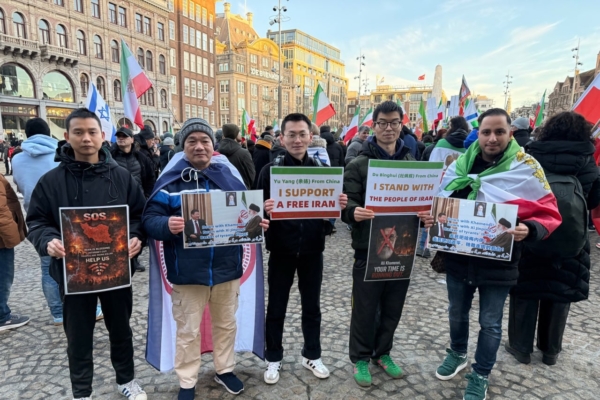
On January 14, 2026, in the capital of the Netherlands, Amsterdam, local residents held a march called “United for Freedom,” with hundreds of people participating. Among them were five activists from China who marched alongside Jewish and Iranian exiles to the US Consulate General in the Netherlands, holding signs in support of the Iranian people and burning a portrait of Iran’s Supreme Leader, Ayatollah Khamenei.
The march started at Dam Square in Amsterdam, with participants carrying flags of ancient Iran (green, white, and red with a lion, sword, and sun motif), flags of Israel, and flags symbolizing freedom, creating a solemn and intense atmosphere.
The five Chinese activists who participated in the event were Du Binghui from Luoyang, Henan, Wei Zhijian from Nanning, Guangxi, Yu Yang from Anhui, and Jiang Peikun and Liu Feilong from Guangdong. They held banners written in both English and Persian to express their support for the Iranian people. The banners included messages such as:
• Yu Yang (Anhui): “I Support a Free Iran”
• Wei Zhijian (Guangxi): “Woman, Life, Freedom”
• Jiang Peikun (Guangdong): “I Stand with the People of Iran”
• Liu Feilong (Guangdong): “I Support a Free Iran”
• Du Binghui (Henan): “I Stand with the People of Iran”
Additionally, these five activists also carried trilingual banners in Chinese, English, and Persian that read, “Down with Khamenei! Down with Xi Jinping! Backer of tyrants’ thugs!”
Upon arriving at the US Consulate General in the Netherlands, the participants burned the portrait of Ayatollah Khamenei on the lawn in front of the consulate, chanting “Free Iran.” They then observed a moment of silence for the victims in Iran, with hundreds of cell phone flashlights shining in the darkness.
Wei Zhijian, a pro-democracy activist from Guangxi, expressed deep empathy for the Iranian protests, stating that as someone who opposes the Chinese Communist regime, he strongly supports the Iranian people in their fight against authoritarian oppression.
Wei highlighted similarities between the two regimes, stating, “The Chinese Communist Party locks 1.4 billion Chinese people in a prison of lies and surveillance under the guise of ‘Chinese socialism with characteristics,’ while the Islamic regime in Iran locks generations of Iranians in another religious tyranny under ‘divine politics.’ The common denominator is not allowing you to be human, only demanding you be a tool, a believer, a slave.”
He also expressed admiration for the courage of the Iranian people, comparing their actions to the consequences faced by dissidents in China who spoke out in 1989. Despite the risks involved, Wei emphasized his solidarity with the Iranian people in their struggle for freedom.
Du Binghui, an activist from Luoyang, Henan, participated in the march to show solidarity with the Iranian people, stating that as someone who has faced oppression in China, he can relate to the struggles of the Iranian population.
Du pointed out the similar oppressive tactics used by the Iranian and Chinese regimes, noting their brutal crackdowns on dissent and information censorship. Despite the potential risks for his family in China, Du firmly stands with the Iranian people in their fight against all forms of tyranny.
Yu Yang, a pro-democracy activist from Anhui, chose to fully participate in the march to vocally oppose dictatorship and support the oppressed. He emphasized his universal stance against authoritarianism, stating that as someone from China, his anti-dictatorship sentiments have no boundaries.
When asked about the potential risks his actions may pose to his family in China by burning portraits of authoritarian leaders, Yu expressed concern for his relatives but asserted that he refused to be overwhelmed by fear and censorship when expressing his beliefs in a free and safe country.
Since 2022, Iran has witnessed massive protests against the Islamic regime. Official figures report over 2500 deaths from the crackdown, although the actual number is believed to be much higher. The Iranian authorities have resorted to internet shutdowns to continue suppressing protesters through information censorship.
According to Dutch media reports, the Iranian people are enduring extreme brutality under the regime. Arash Aria, an Iranian musician, shared a harrowing account of his father, who lost three fingers due to torture for producing anti-government flyers. Reports from Iran tell disturbing stories of authorities trapping protestors inside buildings and setting fires, causing numerous casualties.
Helen, another Iranian woman, expressed fear and anger, sharing her constant state of terror and distress. She mentioned the alleged deaths of 12,000 Iranians in the protests and voiced concerns for her family’s safety in Iran, wearing sunglasses during the march to avoid potential monitoring by embassy agents.
The Amsterdam march is just a small part of global support for the Iranian people. From Washington DC to various cities in Europe, Iranian exiles and international advocates for democracy are organizing similar protests to pressure the international community to act against the Iranian regime.
Yasmin Katibai, an organizer of the march from Hoofddorp, emphasized the need for external support, stating that the Iranian people cannot achieve their resistance alone and require assistance from outside forces.
Many Iranian exiles are hopeful for international intervention, especially from the United States and Israel, to bring about change in Iran’s political landscape.
Since its establishment in 1979, the Islamic Republic of Iran has been under the control of the Supreme Leader and the Islamic Revolutionary Guard Corps. Decades of authoritarian repression have included arbitrary arrests, torture, and fatal shootings of protestors by the Iranian regime.
In 2022, the death of a 22-year-old Iranian woman, Mahsa Amini, who was arrested for violating strict dress codes and subsequently died in police custody, sparked widespread protests in Iran. The momentum of these protests persists to this day.