
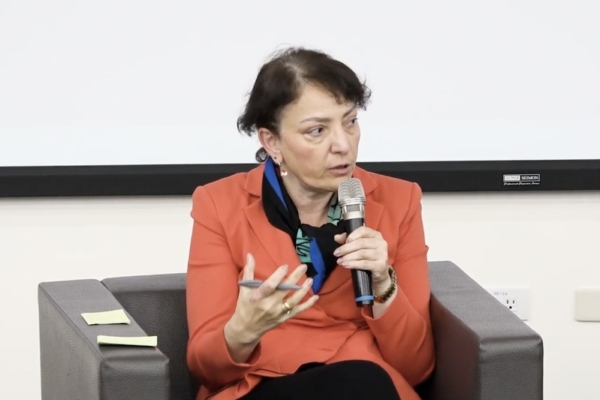
Taiwan Democracy Lab recently hosted a public lecture featuring former Georgian Defense Minister Tinatin Khidasheli, who discussed the structural infiltration of the Chinese Communist Party. Khidasheli pointed out that this infiltration not only weakens Georgia’s democracy and national security but also poses a long-term threat to European security.
On the evening of the 12th, Taiwan Democracy Lab organized a public lecture titled “Memo to Taiwan from Georgia and the Czech Republic before 2027” at the National Chengchi University’s Center for Public Enterprises. The event was moderated by Wu Ming-hsuan, the co-founder and CEO of Taiwan Democracy Lab, with Tinatin Khidasheli, Marek Gold and Executive Director of the Czech Think Tank, and Taiwanese legislator Shen Bo-yang in attendance to share their perspectives.
Khidasheli shared that in the late 1980s and early 1990s, the people of Georgia made a clear historical choice to seek equality, democracy, and full sovereignty as a nation, while distancing themselves from the past dominance of the Communist Party. After the end of the Cold War, Georgia made it clear that joining the European Union and NATO is at the core of its national development and security strategy, aiming to safeguard sovereignty through democratization and integration into Western systems, countering the long-term threat from Russia.
Since the 1990s, Georgia has been constantly under attack from neighboring countries, transitioning from past military conflicts to current cyber warfare and infiltration operations. Russia, through both soft and hard power, has been attempting to penetrate and influence Georgian society by integrating its defense system, academic institutions, and media. This experience is something that many countries can learn from.
Khidasheli emphasized the need to scrutinize and question information and cultural products from Russia as even films critical of communism could be aimed at promoting Russian interests rather than genuine democratic mechanisms. She highlighted the importance of being vigilant and not blindly accepting information from powerful neighboring countries.
As the narrative of anti-Western sentiment emerged in the 2010s, there has been a fundamental political shift in Georgia. The upper echelons of the Georgian government started to openly adopt anti-EU, anti-US, and anti-NATO stances and portrayed the EU bureaucratic system as Georgia’s main enemy. They believed that the EU was using Georgia as a geopolitical tool to contain Russia and prevent it from waging war against Ukraine.
Over the past decade, Georgian political elites gradually positioned the so-called “China model” as the sole viable alternative to the Western path, reshaping the country’s development direction through political narratives. The official promotion of China’s economic development experience as a successful civilization option aimed to prove that democratic processes and Western governance models are no longer suitable for Georgia’s current reality.
She pointed out that since the summer of 2023, Georgia has signed numerous partnership and strategic agreements with China, where the Chinese side openly claimed to invest up to $10 billion in Georgia and signed numerous cooperation memoranda. However, the reality shows that most of these investments remain on paper promises, with little actual direct funding from China flowing in.
Despite the appearance of Chinese-driven development in Georgia, most foreign investments actually come from the EU or international financial institutions, subcontracted to Chinese companies for execution, and packaged as achievements of a pro-China stance in domestic political operations. This development model exposes Georgia to high risks of being dominated by Chinese enterprises in the energy and logistics security systems in the Black Sea region and overall Europe.
The political elites in Georgia deliberately used the “China alternative” as a tool in the anti-Western narrative, enabling Chinese companies to effectively control key national assets and policy directions through corrupt systems, shadow companies, and political-business relationship networks. China’s influence in Georgia primarily stems from its political narrative operations and penetration of Georgian national decision-making and long-term strategic directions through enterprise networks, public procurement, scholarship programs, and key infrastructure construction contracts.
Regarding the revolving door between politics and business and shadow operations, she cited Hualing Energy as a key case of Chinese influence in Georgia. A former pro-China Georgian prime minister joined Hualing after resigning in 2015, followed by another former prime minister entering the company in 2017-2018. Even though Hualing declared bankruptcy in Hong Kong in 2020, the corruption within the judicial system during the pandemic allowed the company management to take over assets, making Hualing legally disappear while still operating in practice.
In the highly sensitive geopolitical region of the Black Sea, the structural infiltration of China not only weakens Georgia’s own democratic system and national security but also poses a long-term and far-reaching threat to Europe’s energy security and strategic stability.