
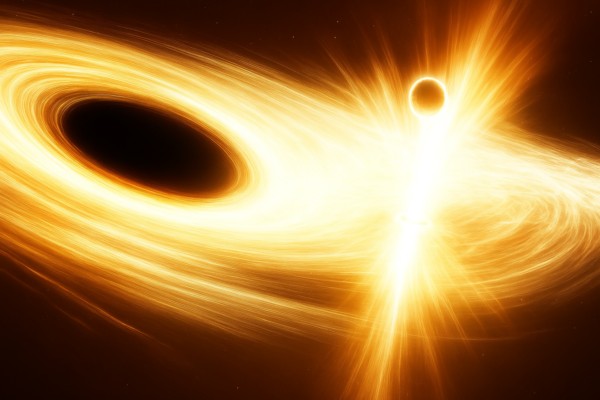
Recently, an international astronomy team has used the space telescope of the National Aeronautics and Space Administration (NASA) to confirm that a faint and elongated cosmic line observed in the past is actually a trace left by a black hole rapidly escaping its parent galaxy. Researchers believe that this study may help unravel the question of whether black holes can break free from the gravitational constraints of galaxies.
The team composed of institutions such as Yale University in the United States, the University of Toronto in Canada, and Tel Aviv University in Israel, has for the first time confirmed a supermassive black hole moving away from its original galaxy at an astonishing speed of 2 million miles per hour (approximately 3.6 million kilometers per hour).
The research findings have been posted on the preprint server arXiv and submitted to the Astrophysical Journal.
The black hole is officially named “RBH-1” and was initially discovered by Professor Pieter van Dokkum’s team at Yale University in 2023. They first noticed a peculiar faint line in an archived image from the Hubble Space Telescope (HST).
Subsequently, the team conducted observations at the Keck Observatory in Hawaii. The observations at that time revealed that the peculiar 200,000-light-year-long (about twice the diameter of the Milky Way) linear structure was actually a “trail” formed by a group of young stars, originating from a black hole with a mass equivalent to 20 million suns.
Although researchers at the time suspected this unusual object might be an “escaped” black hole, there was a lack of conclusive evidence. It was not until the team sought the assistance of the James Webb Space Telescope (JWST) with superior sensitivity and clarity that it was confirmed to be an “escaped” supermassive black hole.
The JWST space telescope’s mid-infrared instrument provided unprecedented clarity, observing the formation of a shock wave named “bow shock” at the front edge of the RBH-1 black hole as it moved rapidly.
Researchers likened the “bow shock” to the waves pushed by a ship sailing in water, with the “ship” being the black hole, which is challenging to observe directly, and the “waves” representing hydrogen and oxygen spectral signals emitted when the galaxy’s gas is heated and ionized by the shock wave.
The team stated that in addition to the remarkable resolution images provided by the JWST telescope, the observations also perfectly matched the previous observations at different wavelengths by the Hubble and Keck telescopes, confirming the predictions of the theoretical models.
They believe that studying this “escaped” RBH-1 black hole will allow scientists to gain deeper insights into the evolution of galaxies and black holes. The central regions of galaxies, including the Milky Way and most large galaxies, contain supermassive black holes, and whether these black holes can break free from the constraints of galaxies has long been a puzzle.
Researchers noted that confirming whether a black hole truly “escapes” is highly challenging, with the famous “Cosmic Owl” galaxy located approximately 11 billion light-years away serving as a classic case for comparison. This galaxy has two galactic cores and three active supermassive black holes, with the third black hole “embedded” in a gas cloud between the two galactic cores.
Scientists had previously suspected it was also an “escaped” black hole ejected through a three-body interaction. However, subsequent JWST observations indicated that this black hole likely formed in place through direct collapse in the gas cloud, rather than being ejected.
This contrast highlights the uniqueness of the discovered RBH-1 black hole. Unlike the ambiguity of the Cosmic Owl galaxy, RBH-1 exhibits distinct bow shock and velocity gradients, making it the first officially confirmed supermassive black hole to truly “escape.”
The current mainstream astronomical view suggests that supermassive black holes in the centers of galaxies are typically extremely difficult to dislodge. The only way for these black holes to detach would require two black holes to be extraordinarily close or for a third black hole to be involved in a three-body interaction, creating a complex gravitational field that could potentially “kick out” one of the black holes from its original position.
Researchers speculate that this escaped black hole, which may even be the result of interactions between three black holes each with a mass equivalent to 10 million suns, is a compelling outcome.
However, further research is needed on this phenomenon and other escaping celestial black holes, with hopes of finding more similar examples. Researchers stated that the current Euclid telescope and the upcoming Nancy Grace Roman Space Telescope are likely to unravel this mystery stemming from black holes.
Professor Pieter van Dokkum, the lead author and astronomer at Yale University, was the first to confirm the existence of an “escaped” supermassive black hole. He expressed astonishment at the clarity of the observation data, stating, “Everything about this object indicates its uniqueness. Being able to observe such clear evidential features is truly gratifying.”