
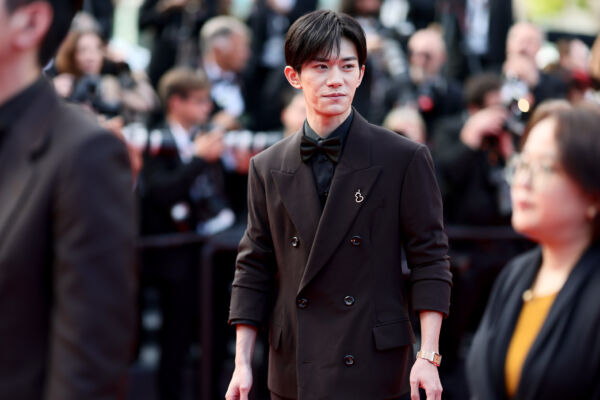
On December 21, 2025, the controversy surrounding the investigation of Haorong, the director of the Central Academy of Drama in China, has escalated. Known as the “star instructor,” Haorong has created the “Class of 1996 Star” and nurtured famous personalities like Zhang Ziyi, Liu Ye, Yuan Quan, Qin Hailu, and others. Recently, it was revealed that the art exam results of two batches of students were strikingly similar, implicating the 25-year-old rising star actor Yiyang Qianxi.
On December 19, the official statement from the Communist Party of China reported that Haorong, the Deputy Secretary of the Party Committee and Director of the Central Academy of Drama, is suspected of serious violations of discipline and laws, and has voluntarily surrendered for investigation.
Public records show that Haorong, born in 1971, is a member of the Communist Party of China, a professor, a doctoral supervisor, the director of the Central Academy of Drama, and the Deputy Secretary of the Party Committee. He also holds positions as a part-time member of the 14th National Committee of the Chinese People’s Political Consultative Conference, the Vice Chairman of the Education Department’s Higher Education Drama and Film Studies Teaching Instruction Committee, and Vice Chairman of the Beijing Film Artist Association, among other roles.
Haorong graduated from the Department of Performance at the Central Academy of Drama in 1995, and later became a faculty member before obtaining a master’s degree as a postgraduate student. Throughout his career, he held various positions within the academy until he was appointed director in November 2018.
Following Haorong’s arrest, netizens uncovered a series of controversies at the Central Academy of Drama involving many popular celebrities, notably regarding the art exams under scrutiny. Reports suggested that the entrance ratio for the Performance Department was 246:1, leading to fierce competition among aspiring actors for limited spots, raising questions about the fairness of the selection process. Apart from the rumored “backdoor entry fee” of 500,000, it was disclosed that the art exam scores of two consecutive batches of students were identical, both incidents occurring during Haorong’s tenure.
A leaked art exam scorecard indicated that in 2018, there was a cluster of celebrity applicants at the Central Academy of Drama, including Yiyang Qianxi, Li Landi, Hu Xianxu, Luo Yizhou, among others, with their ranking seemingly reflecting their respective fame. In 2019, the pattern continued with notable celebrity applicants. Upon closer inspection, it was found that the scores on both scorecards were exactly the same, including the decimal points, suggesting possible tampering by merely changing names, hometowns, and genders.
Traditionally, the art exam for the Performance Department evaluates “voice, stage, form, and performance,” the four fundamental aspects of performing arts that require actors to embody vivid characters through voice, language, physical movements, and overall presentation. Some netizens argued that based on genuine acting experience, the fairness of the art exam scores at the Central Academy of Drama remains questionable.
For instance, in the 2018 art exam at the Central Academy of Drama, Yiyang Qianxi, a member of the popular boy band TFBOYS, received the highest score of 94.85, surpassing actors with backgrounds in film and television like Li Landi and Hu Xianxu. However, in terms of actual performance skills and delivery of lines, Yiyang Qianxi arguably falls short compared to these actors, making the legitimacy of the scoring system dubious. Netizens raised concerns that Haorong’s preference for celebrity status may have influenced the preferential treatment given to well-known applicants in the exam scores.
Although it is currently unclear whether there was any collusion between the Central Academy of Drama, Haorong, and the candidates, Haorong’s position at the intersection of cultural arts, educational systems, and the world of literary fame has raised suspicions. Reports from the Financial Times citing insiders hinted at potential connections between Haorong’s case and the ongoing external expansion of Ma Xingrui’s case and the continuous scrutiny faced by Xi Jinping’s wife, Peng Liyuan. Against this backdrop, Haorong’s “voluntary surrender” is seen by some as a sign of escalating power struggles within the upper echelons of the Communist Party of China.