
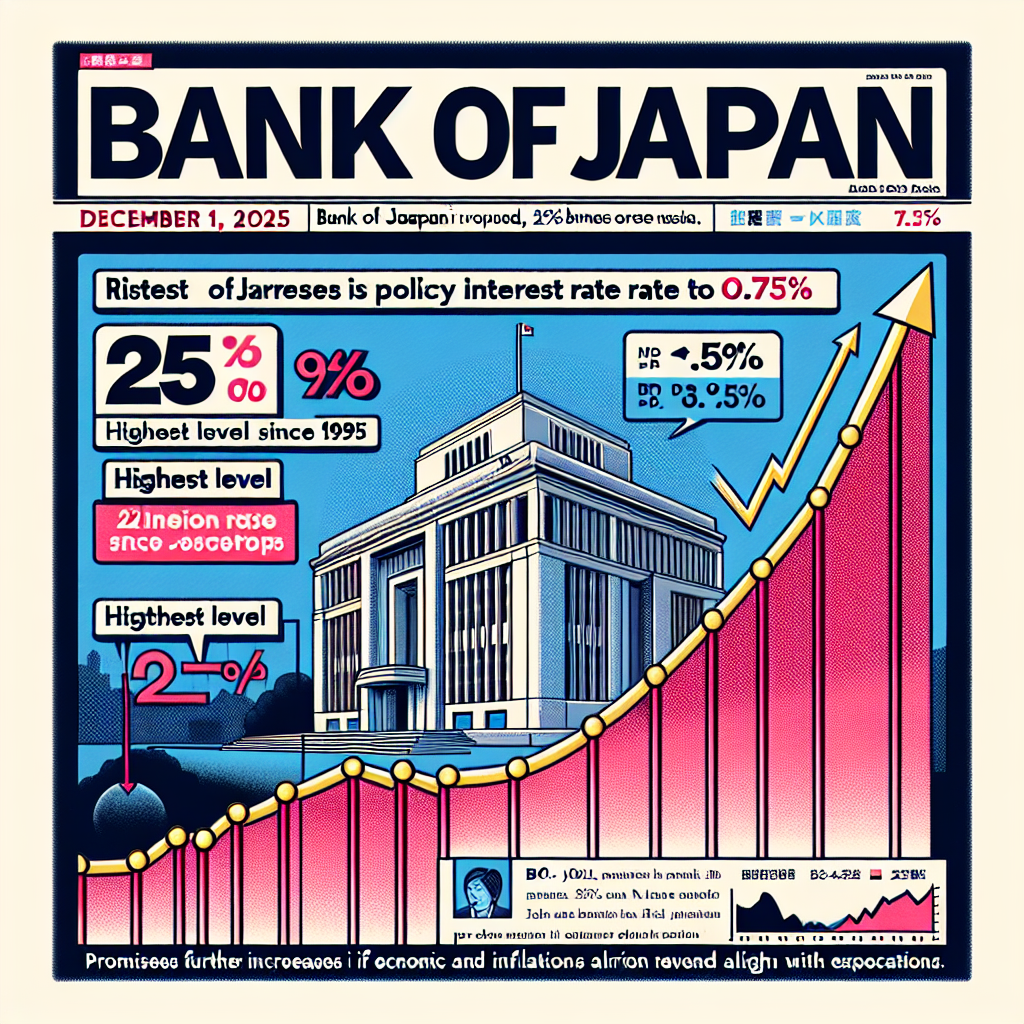
On December 19, 2025, the Bank of Japan (BOJ) raised its policy interest rate by 25 basis points to 0.75%, marking the highest level since 1995. The BOJ clearly stated that if the economic and inflation trends align with expectations, they will continue to raise interest rates, symbolizing an important step for Japan in officially ending decades of ultra-loose monetary policy.
According to the statement released by the Bank of Japan, recent data and surveys suggest that the mechanism of wages and prices modestly rising in tandem is likely to be sustained. The central bank emphasized that even after this rate hike, real interest rates remain at a “significantly low” level, and if economic and price forecasts are met, they will continue to push for further rate hikes.
The decision to raise rates was in line with market expectations and was approved unanimously. The Bank of Japan stated that inflation is expected to gradually converge to the 2% policy target by the end of the 2027 fiscal year.
Following the announcement, the financial markets reacted relatively mildly. The Japanese yen fell more than 0.3% against the US dollar to 156.02; the yield on Japan’s 10-year government bonds rose by about 5 basis points to 2.019%, while the yield on 20-year Japanese bonds increased by 3 basis points to 2.975%, both reaching new highs since 1999.
Analysts pointed out that the rate hike outcome has been largely absorbed by the market, and investors quickly turned their focus to the press conference by Bank of Japan Governor Haruhiko Ueda.
Analysts believe that if the Bank of Japan continues to normalize its policies, it may gradually alter the role of the yen as a global cheap funding currency, affecting foreign exchange and global fund flows.
At the same time, the Bank of Japan announced that companies are “highly likely to continue wage increases” next year, and indicated that uncertainties surrounding the US economy and tariff policies have decreased, providing support for further policy normalization.
It is worth noting that although the decision to raise rates was unanimously approved, two members of the Policy Board, Soichi Takada and Naoki Tamura, dissented on the outlook for prices. Takada believed that both inflation and core inflation had essentially reached a stable target, while Tamura thought that overall inflation could likely reach the target in the mid-term of the projection period. This contrasts with the generally cautious official outlook of the central bank and reinforces market attention on the future rate hike space.
On Friday, Japan’s Ministry of Internal Affairs and Communications released economic data indicating that due to the widening price increases of food items such as rice and energy prices, Japan’s core Consumer Price Index (CPI) excluding fresh food rose by 3.0% to 112.5 compared to the same month last year in November 2025, showing an increase for the 51st consecutive month, with the year-on-year growth rate exceeding the Bank of Japan’s 2% target for the 44th straight month.
Bank of Japan officials and market participants generally believe that persistently high food prices and the recent depreciation of the yen have pushed up import costs and overall inflation, which is one of the important backgrounds for the central bank to raise rates again. The Kaga administration, which previously had a loose stance, also accepted this rate hike due to price pressures.
At the same time, a survey by the central bank showed that business confidence in Japan has reached a four-year high, with many companies planning to provide significantly higher wage increases next year, indicating that the economy has a certain degree of resilience to rate hikes.
The Bank of Japan estimates that Japan’s neutral interest rate range is around 1% to 2.5%. The neutral interest rate refers to the level of interest rates that can balance inflation and economic growth – neither overheating the economy nor stifling growth.
This rate hike brings interest rates closer to that range, making the question of “what level will rates ultimately rise to” the core issue for the next stage in the market.
Investors generally expect that the Bank of Japan’s future rate hikes and the pace of rate hikes will depend on the momentum of wage growth and whether inflation shows persistence.