
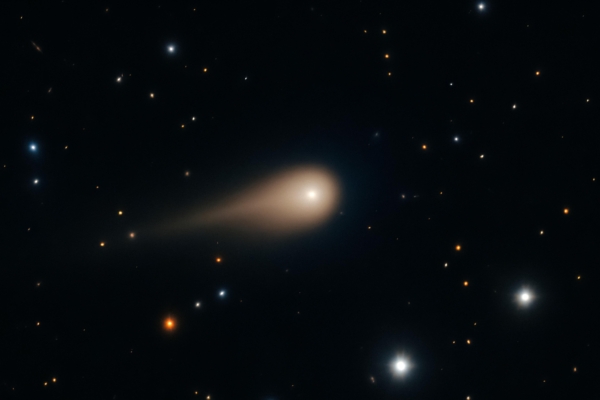
Latest observations show that the visitor from another star system, 3I/ATLAS, not only erupts “ice volcanoes” (cryovolcanoes), but also exhibits a regular “heartbeat” pulse, once again sparking controversy in the scientific community: Is this interstellar comet a “natural” object or the alien spacecraft proposed by Harvard scholars?
Harvard University scientist and astrophysicist Dr. Avi Loeb believes that 3I/ATLAS’s pulsing light, which repeats every 16.16 hours, could provide evidence of its artificial origin—perhaps pointing to the internal operations of an advanced spacecraft.
Loeb pointed out that the interstellar visitor’s light blinks in a regular cycle, like a “stellar lighthouse.” He said, “The pulses are periodic, just like the flow of blood in a heartbeat.”
He explained, “This could be periodic thrust used for orbital correction by 3I/ATLAS, or some kind of operational cycle within the spacecraft.”
Loeb analyzed that the comet’s brightness primarily comes from its coma, so the periodic modulation likely stems from pulsatile gas and dust emissions. He has speculated that the multiple jets of 3I/ATLAS could be part of an advanced artificial propulsion system.
In contrast to Dr. Loeb’s speculations, mainstream science, based on recent observations, once again offers explanations for 3I/ATLAS’s unusual characteristics rooted in natural phenomena.
A recent study posted on the preprint server arXiv on November 24 by a research team from the Spanish National Institute of Aerospace Science reported that when 3I/ATLAS approaches the Sun, clear spiral gas and dust jets erupt from its surface, indicating signs of cryovolcanic activity.
The study suggests that the ice volcano activity is driven by the sublimation of internal solid carbon dioxide (dry ice), leading to vigorous eruptions resulting from the reaction of gas with active metal particles. This periodic material release is the primary natural explanation for the comet’s periodic blinking.
Dr. Loeb also concurs that if the comet formed naturally, the pulses must be due to the periodic sublimation of “a large ice bag facing the Sun.”
This study has surprised scientists as the composition and behavior of 3I/ATLAS are remarkably similar to the cold, primordial Trans-Neptunian Objects (TNOs) in our solar system. Despite originating from another star system, the mixture of substances in 3I/ATLAS shows striking similarities to those found in materials formed in our solar system.
Since its discovery in July, there has been an abundance of online speculation regarding whether 3I/ATLAS is an alien spacecraft. However, NASA officials maintain that 3I/ATLAS is a comet.
3I/ATLAS is the third interstellar object documented by humans. Although its composition resembles solar system objects, its hyperbolic orbit and extremely fast velocity confirm that it is not within the gravitational range of the solar system.
Scientists emphasize that 3I/ATLAS could be billions of years older than our solar system. With it set to permanently leave the solar system next year, the scientific community is racing against time to study it.
(This article referenced reports from “Life Science” and “New York Post.”)