
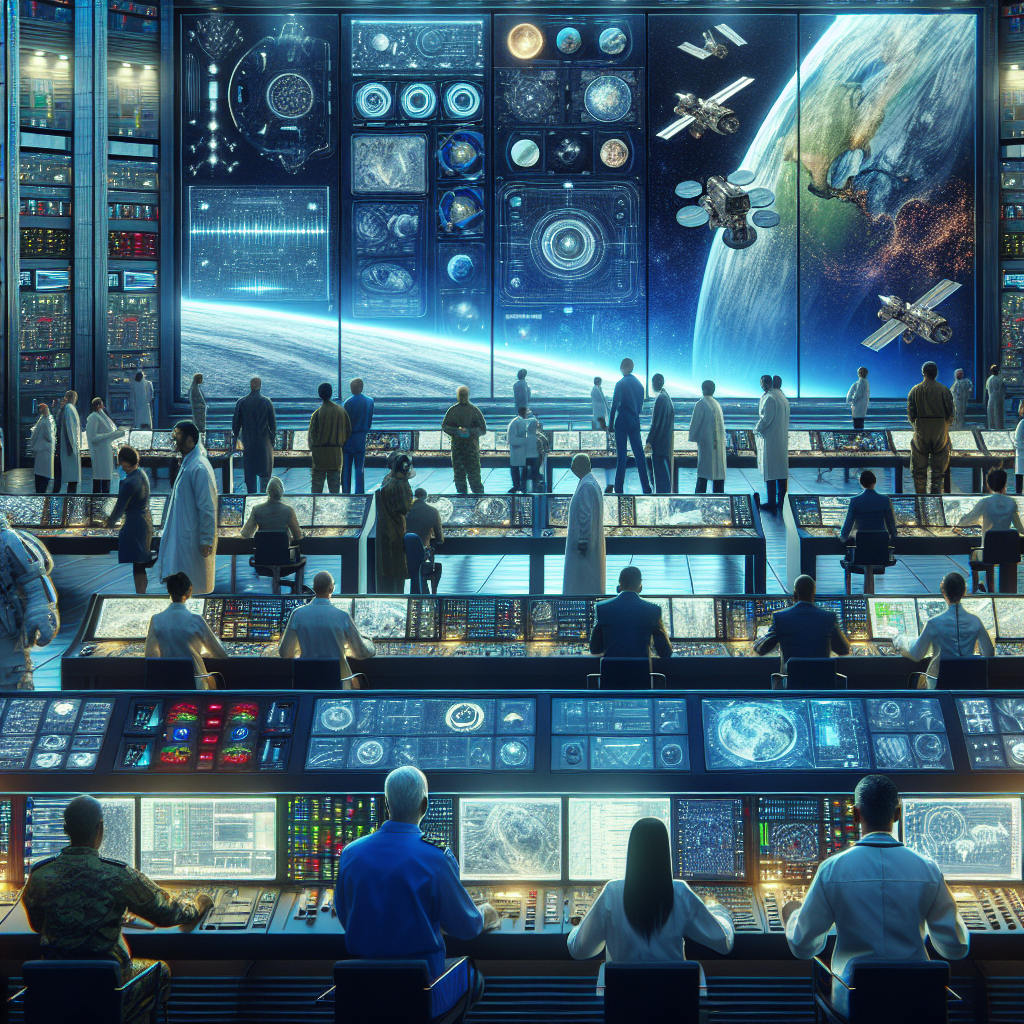
Space technology has become an indispensable field for the operation of countries and societies. Experts point out that in the face of space threats from the Chinese Communist Party, it is urgent and crucial to integrate cross-agency efforts to address the needs of space national security and resilience within the existing mechanism of the Taiwanese government.
Assistant researcher Hsu Chih-hsiang from the Institute for Political-Military and Operational Concept Studies of the Ministry of National Defense’s Institute for National Defense and Security Research stated in an article published on the official website that on July 28, the Japanese Ministry of Defense issued the “Space Domain Defense Guidelines,” emphasizing that countries like China and Russia have significantly strengthened their anti-space capabilities, posing a significant threat to space assets that are highly relied upon by the nation as a whole. Therefore, it is necessary to establish comprehensive capabilities across all domains to enable the Self-Defense Forces to respond to various situations and ensure the sustainable use of space capabilities, highlighting the crucial importance of incorporating private sector resources.
Hsu Chih-hsiang mentioned that on July 21, the American Institute in Taiwan (AIT) posted on Facebook, mentioning that if Taiwan and the United States could connect through a spaceport in the future, it would significantly reduce travel time through trans-orbital flights and also hold important implications for strategy and national security. This demonstrates the interdisciplinary and complex nature of current space security issues, requiring more than a single agency to effectively address them.
Recognizing the critical role of current space technology in national security and the stable operation of society, Hsu Chih-hsiang emphasized the necessity for countries to establish a cross-agency entity within government institutions for integration and planning to effectively respond.
Regarding space defense and security issues, Hsu Chih-hsiang pointed out the complexity of these key issues and highlighted that various countries are introducing measures such as rebuilding, establishing cross-agency entities, or creating horizontal coordination mechanisms between agencies to better address these challenges.
He further explained that aside from establishing the Space Operations Group in the Air Self-Defense Force in 2020, Japan also handles space-related complex affairs by establishing a horizontal cooperation mechanism between the Self-Defense Forces and the Japan Aerospace Exploration Agency (JAXA), where JAXA plays a crucial role in handling more complex functions compared to the military’s space operations group, with the Self-Defense Forces primarily focusing on operations, while other tasks are overseen primarily by JAXA.
Hsu Chih-hsiang elaborated on the various actions taken by countries in recent years, pointing out that besides establishing space operations forces or space forces, horizontal integration between governments is also an important direction. For instance, the United States reinstated the “National Space Council” in 2017, with the Vice President serving as the chairman to coordinate space affairs, including security. The practices of Germany and France are similar to those of Japan.
He noted that the French military uses the “Joint Forces Space Command” as a hub to coordinate armed forces, external collaboration with the National Centre for Space Studies (CNES), and cooperation with civilian sectors. On the other hand, Germany established a Space Operations Command within the Federal Armed Forces, closely collaborating with the German Aerospace Center (DLR) and coordinating with allied space operations forces.
As for the UK, they command the “National Space Council” and the Space Directorate of the Ministry of Defense to oversee the UK Space Command. South Korea has established the Presidential Advisory Unit, the “National Cosmic Committee,” consisting of national security units, government departments, and industry and academic experts.
Reflecting on the actions taken by these countries, Hsu Chih-hsiang emphasized the complexity of space security issues and the necessity of inter-agency cooperation, which Taiwan also faces in dealing with complex space security problems. This is evident in the recent mention by the AIT of the “Spaceport” issue.
On July 21, AIT posted on Facebook, stating that Taiwan and the United States are strengthening space cooperation, including negotiating potential spaceport collaborations. The post mentioned that in the future, inter-orbital flights could reduce the travel time from Houston to Taipei to 2.5 hours. While the technology for trans-orbital flights still lacks cost-effective transportation means, once developed, it could facilitate not only cargo and tourism but also rapid delivery of equipment and materials to Taiwan by the US military through the “Space Domain” (such as spaceplanes, rockets, etc.) during wartime, avoiding the time-consuming traditional transportation and reducing combat losses against China’s Anti-access/Area-Denial (A2/AD) military capabilities. This would significantly enhance strategic resupply capabilities, holding critical strategic significance.
Even if the technology matures, this issue would involve coordination across various government departments, including the National Applied Research Laboratories under the National Space Organization (TASA), civil aviation units, and the Ministry of National Defense, necessitating cross-agency entities for integration and coordination.
The National Space Organization released a press release on August 7, stating that the Low-Orbit Communication Satellite Plan is crucial for Taiwan’s communication resilience. In addition to collaborating with international communication satellite companies, the government is developing indigenous low-orbit communication satellites to enhance the development of related industries domestically and integrate into the international space industry chain.
Considering the criticality of space in national security, military, resilience, and societal operations, and the main threat to Taiwan coming from the Chinese (Communist) regime, Hsu Chih-hsiang emphasized the urgent and crucial importance of integrating cross-agency efforts to meet the demands of space national security and resilience within the existing mechanism of the Taiwanese government.