
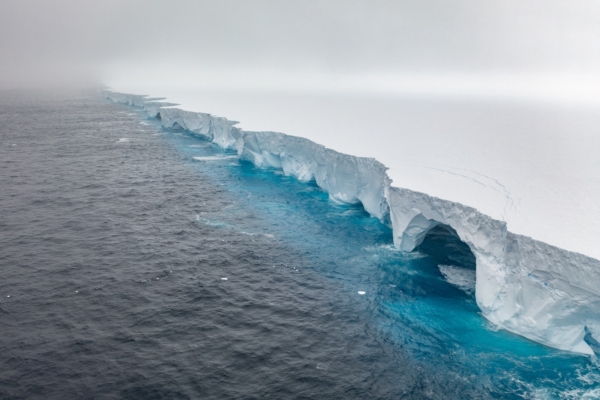
UK scientists have announced that the world’s largest iceberg has finally broken free from being stuck in one place for the past few months and has resumed drifting northward in the Southern Ocean. They believe it will eventually leave the Southern Ocean, entering the Atlantic Ocean where it will encounter warm seawater and melt.
The iceberg, named A23a, is reported by the BBC to cover an area of up to 3,800 square kilometers, equivalent to twice the size of Greater London. With a thickness of 400 meters, it weighs nearly 1 trillion tons.
A23a broke off from an ice shelf in Antarctica in 1986, stranded in the Weddell Sea, one of Antarctica’s marginal seas, for over thirty years. It began slowly moving northward in 2020 but got stuck near the South Orkney Islands in April this year due to encountering a whirlpool. It has now regained its freedom and continues its northward drift.
The British Antarctic Survey announced on December 13 that A23a is further drifting north. The agency has created a video showing the iceberg’s movement over the years and shared it on social media.
Oceanographer Andrew Meijers from the British Antarctic Survey stated in a press release, “Seeing A23a start moving again after being trapped for a period of time is truly exciting. We are interested to see if it will follow the path of other large icebergs breaking off from Antarctica. More importantly, what impact it will have on the local ecosystem.”
It is believed that A23a will ultimately leave the Southern Ocean and enter the Atlantic Ocean, where it will encounter warm seawater, break down into smaller icebergs, and then melt.
Meijers and researchers from the agency are studying the impact of A23a on the local ecosystem.
One year ago, researchers from the agency boarded a research vessel to study this iceberg. They captured photos of the Antarctic ecosystem and how sea ice affects global ocean carbon and nutrient cycles, collecting data on the iceberg.
Laura Taylor, a biogeochemist involved in the research, mentioned, “We know that these massive icebergs can provide nutrients to the waters they pass through, creating thriving ecosystems in areas with lower productivity. What we don’t know is how specific icebergs, their scale, and origins will impact this process.”
She added, “We collected surface seawater samples from behind, adjacent to, and in front of the path A23a traveled. They should help us determine what life might form around this iceberg and how it affects the carbon in the ocean and its balance with the atmosphere.”
Earlier reports by the BBC emphasized the importance of understanding seabed shapes.
Undersea mountains, valleys, and slopes have a profound influence on the direction and mixing of waters, as well as the distribution of nutrients needed by marine life. This influence extends to the climate system, as the large-scale movement of water helps disperse heat globally.
The behavior of A23a can be explained as scientists have thoroughly investigated the seabed north of the South Orkney Islands. However, this comprehensive understanding does not apply to most other parts of the world.
Currently, only a quarter of the Earth’s seabed has been mapped by scientists according to modern standards.