
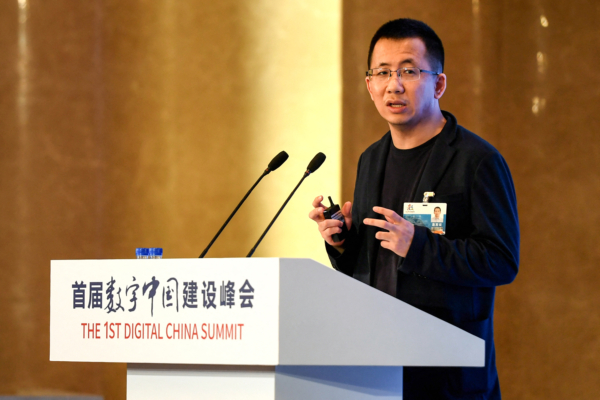
Recently released 2024 Hurun Rich List shows that the number of entrepreneurs in China with personal wealth exceeding 5 billion yuan (approximately 700 million US dollars) has decreased for three consecutive years, and the number of entrepreneurs in the 1 billion USD level has dropped by over 30% in the past three years. The list reveals that this year, Zhang Yiming, the founder of the tech company ByteDance, has become the richest person in China for the first time.
Hurun Research Institute released the “2024 Hurun Rich List” on October 29. The cut-off date for calculating the wealth of the listed entrepreneurs was August 30, 2024. The list indicates that this year, there are a total of 1094 entrepreneurs with personal wealth exceeding 5 billion yuan, a decrease of 12% (147 people) from last year and a 25% decrease (371 people) from the peak in 2021.
The total wealth of the listed entrepreneurs also shows a downward trend, decreasing by 10% from last year to 21 trillion yuan (approximately 2.94 trillion US dollars). This year, 331 entrepreneurs saw an increase in their wealth compared to last year, including 54 newcomers, but the number of new entrants is less than half of last year. Meanwhile, 964 entrepreneurs saw a decrease or no change in their wealth, with 201 people falling off the list this year.
Looking at the sources of wealth, industrial products, consumer goods, healthcare, real estate, and food and beverages are the top five sources of wealth for the listed entrepreneurs.
In terms of regional distribution, Beijing remains the city with the highest concentration of listed entrepreneurs, with 115 people despite a decrease of 24 from last year. Shanghai surpassed Shenzhen this year to rank second, followed by Hong Kong and Hangzhou.
Furthermore, the Lee Shau Kee family from Henderson Land Development made it into the top ten of the Rich List for the first time. The threshold for the top ten this year was 165 billion yuan, a reduction of 5 billion yuan from last year. The average age of the top ten entrepreneurs has increased to 65 years, up by 4 years from last year.
This year, the number of centi-billionaires decreased by 4 people compared to last year, reaching 26. At the same time, the number of billionaires in the 1 billion USD level decreased by 142 people from last year to 753. In 2021, this number was as high as 1185, showing a decrease of over 30% in three years.
According to the Hurun Rich List, the entrepreneurs who saw the most significant wealth decline in the past year mainly come from the new energy, real estate, software services, and healthcare industries, which were greatly affected by US policies and fluctuations in performance before and after the COVID-19 pandemic.
Hurun Rich Chairman and Chief Research Officer Rupert Hoogewerf stated that the number of entrepreneurs with wealth exceeding 5 billion yuan has decreased for three consecutive years, with nearly 400 fewer people from the peak in 2021 to approximately 1100 currently. He also mentioned that China’s wealth creation structure has undergone significant changes in the past five years. Half of the entrepreneurs on this year’s Rich List were not listed five years ago, and nearly 80% were not on the list ten years ago.
In terms of industry distribution, the newly listed entrepreneurs mainly come from the technology sector, especially in new energy, consumer electronics (such as smartphones), cross-border e-commerce, biotechnology, and other industries.
Hoogewerf pointed out that in the new energy sector, the wealth of Zhong Shiqing, the founder and chairman of CATL, has grown by over 100 billion yuan in the past five years, while he was not on the list ten years ago. Additionally, the wealth of Wang Chuanfu from China’s carmaker BYD and Li Shufu from Geely has increased by over 100 billion yuan compared to ten years ago.
There are 39 people from the new energy-related industries on the list this year, 26 fewer than the peak in 2021.
In the field of consumer electronics, the wealth of Lei Jun, the founder of Xiaomi, has tripled from ten years ago. The founders of OPPO, Chen Mingyong, Vivo founder Shen Wei, and DJI founder Wang Tao were not on the list ten years ago. In the e-commerce sector, the founder of Pinduoduo, Huang Zheng, was not on the list ten years ago, and the founder of Shein, Xu Yangtian, entered the list five years ago.
Chinese entrepreneur Zhao Haitao, who now resides in the United States, mentioned in an interview with the Epoch Times on October 31 that China’s new energy industry relied on policy incentives before the pandemic, experiencing explosive growth as major companies raced to seize policy advantages. However, after three years of epidemic control measures and the shift in policy focus by the CCP, the industry quickly cooled down, leading to a significant decrease in entrepreneurs’ wealth, with many facing survival challenges.
Zhao Haitao further explained that the real estate industry in China had shown a rocketing upward trend over the past two decades. However, with the combination of policy pressure, economic cyclical patterns, and factors like the pandemic, an industry collapse became almost inevitable. Real estate enterprises have been hit hard, with virtually no one spared. Therefore, the two fastest-accumulating industries suffered the biggest setbacks, which were actually within expectations.
Economist David Wong, currently in the United States, also mentioned to The Epoch Times that the consecutive decline in the number of 5 billion yuan-level Chinese billionaires for three years reflects the current structural “birth pangs” of the Chinese economy, and also indicates a shrinking trend among the high net worth population. The pressure faced by large enterprises in capital contraction and capital outflow further exacerbates this trend.
Wong noted that China’s economy is facing severe pressure in the innovation field, with diminishing space for survival and increasing difficulty for innovation to break free from policy influences. Faced with political and so-called “national security” challenges, corporate innovation becomes increasingly arduous. He mentioned that the so-called “innovation” in the past was often accompanied by collusion between officials and businessmen seeking rents, rather than genuine technological and market breakthroughs. Moreover, many billionaires saw their fortunes evaporate rapidly due to punishments and industry pressure.
The list shows that Zhang Yiming, the 41-year-old founder of the Chinese tech company ByteDance, saw his wealth increase by 105 billion yuan compared to last year, making him the richest person in China with a fortune of 350 billion yuan. ByteDance is the parent company of the short video platforms TikTok and Douyin. The company has close ties to the CCP. As early as 2017, the CCP government had a stake in ByteDance’s Chinese entities and held a board seat in its subsidiaries.
Zhang Shuhong, the 70-year-old founder of Nongfu Spring, experienced the largest decrease in wealth over the past year. Due to Nongfu Spring’s slower revenue growth in the second quarter of 2024, Zhang Shuhong’s wealth decreased by 110 billion yuan, dropping to 340 billion yuan, relinquishing his position as the richest person for three consecutive years, and now ranking second.
Ma Huateng, the co-founder of the Chinese tech company Tencent, saw his wealth increase by 35 billion yuan compared to last year, ranking third with 315 billion yuan.
Huang Zheng, the founder of the Chinese discount e-commerce platform Pinduoduo, saw his wealth decrease by 25 billion yuan compared to last year, ranking fourth with 245 billion yuan, down one position from last year. Moreover, the wealth of He Xiangjian, the founder of Midea Group, and his family increased by 35 billion yuan compared to last year, ranking fifth with 235 billion yuan.
Both Zeng Yuqun and Ding Lei, the founder of CATL and Netease, respectively, saw a slight shrink in their wealth from last year, both ranking sixth with 200 billion yuan. Similarly, the wealth of Li Ka-shing and his eldest son Victor Li also declined by 5%, ranking sixth with 200 billion yuan.
Jack Ma, the founder of the Chinese e-commerce giant Alibaba, saw a 3% decrease in his wealth compared to last year, ranking tenth with 165 billion yuan, maintaining the same position as last year.
On the 2024 Hurun Rich List, the percentage of female entrepreneurs decreased by 1.9 percentage points to 23.5%. Zong Fuli, the successor of the food and beverage production company Wahaha, became the new richest woman in China with a wealth of 81 billion yuan, overtaking Kuang Xiaoxing, the wife of the founder of New World Development in Hong Kong.
This year’s Hurun Rich List also reveals that Chinese liquor industry tycoons collectively experienced a decline in wealth.
For instance, Wang Junlin, the chairman of Langjiu Group, ranked 65th on the list with a wealth of 59 billion yuan, down 18 places from last year with a 17% decrease in wealth.
Wu Xiangdong, the chairman of Huazhi Liquor, ranked 157th on the list with a wealth of 29 billion yuan, down 17 places with a 16% decrease in wealth.
Wu Shaoxun, the chairman of Jingpai Liquor, ranked 306th on the list with a wealth of 16.5 billion yuan, down 38 places with an 18% decrease in wealth.
Liu Xiaodong, the chairman of Bairun Liquor, ranked 656th on the list with a wealth of 8 billion yuan, down 268 places with a 45% decrease in wealth.
Cai Kaiyun, the chairman of Daohuaxiang Liquor, ranked 875th on the list with a wealth of 6 billion yuan, down 120 places with a 25% decrease in wealth.
Xu Jintong, the chairman of Kouzi Jiao Liquor, also ranked 875th on the list with a wealth of 6 billion yuan, down 67 places with a 23% decrease in wealth.
Regarding this phenomenon, David Wong believes that the CCP’s policies restricting marketing and pricing of high-end liquor have squeezed the industry’s profit margins. Additionally, China imposes heavy taxes on alcohol. Challenges from emerging and international brands have intensified market competition, further lowering overall profit margins.
Zhao Haitao also stated that economic stagnation has led to weak consumer spending in Chinese society, directly impacting non-essential products such as liquor, which are among the first items consumers abandon. The widespread decrease in wealth of the liquor industry reflects this economic situation.
He further analyzed that China’s so-called socialist market economy is still mainly driven by government policies, which, despite quickly fostering emerging industries, lead to stronger backlashes the faster these industries develop. As the operation time of this economic system lengthens, accumulating risks grow, making self-rescue increasingly difficult.