
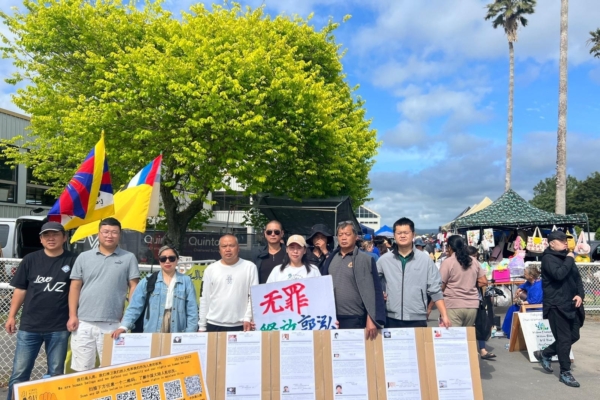
Yang Chunyan, who comes from Jiangsu, China, lived in a rural area in northern Jiangsu for 20 years before striving to become a private entrepreneur. During the epidemic, she strongly resisted the brutal lockdown policies of the Chinese Communist Party, and was arrested multiple times by the local police station. After the epidemic, she left the country in anger and continued to speak out against the CCP overseas, calling for recognition of the CCP’s true nature, hoping to awaken the Chinese people and bring a free democratic society to China.
“In the darkness and lack of rule of law and human rights in the CCP’s China, the sufferings seem endless…” Yang Chunyan recounted the atrocities of her childhood, where the one-child policy was being implemented, leading to the abandonment and drowning of female babies in her hometown.
As the first-born in her family, Yang Chunyan was spared from the fate that befell many female infants due to local customs that forbade harming the first-born, believing it would bring punishment from the heavens. However, in a patriarchal rural society where boys were favored over girls, females were seen as burdens to be married off.
Her mother endured four pregnancies, with Yang Chunyan’s first younger brother born two years after her through premature childbirth at seven months, resulting in a fine of 500 yuan in 1980. Subsequently, her mother was forced to undergo abortion and sterilization, which led to her suffering from schizophrenia and frequent mental breakdowns.
“How many fetuses did they (the CCP) exterminate back then? It’s really countless fetuses!” Yang Chunyan recalled a nightmare from her childhood when she saw the bodies of female infants floating in the river frequently. Even when she visited her mother at the hospital after undergoing abortion and sterilization, there were fetus corpses in the hospital’s cesspits.
“A few years before I left the country, the situation was still the same there. Some people had many pregnancies in the quest for a son, even if it meant facing hefty fines. My neighbor had more than ten pregnancies, starting from the age of nineteen, undergoing abortions every year…Jiangsu, Zhejiang, and Shanghai are considered relatively developed regions in China.”
In Yang Chunyan’s childhood memories, happiness was scarce, overshadowed by endless farm work. When she was seven or eight years old, there were groups of beggars from Shandong, Henan, and Anhui who traveled thousands of miles to Jiangsu seeking alms, as Jiangsu was known for its abundant rice production, comparatively better off than those regions.
“We rarely ate meat back then. How destitute were the common folks? Whenever my family cooked meat, others would smell it and show up at our place to get a bite or two. When we bought our first ’28 big pole’ (a type of bicycle with 28-inch wheels and a straight steel beam in the middle), there weren’t many bikes in the village.” Yang Chunyan reminisced.
Despite her academic excellence and love for reading, her father believed she should start working early to earn money. It was only after her mother invited the teacher to persuade her father that she continued her education. With her father engaging in business and selling goods through the streets, he managed to support her education through high school in town.
At the age of 20, she ventured out to work at hotels in Wuxi and Suzhou, later running a barbecue restaurant and stall over the following decade, eventually becoming a successful private business owner in the food industry.
According to her, most rural girls drop out of school early to earn money to support their families. While working at a five-star hotel in Suzhou in the early 2000s, she witnessed girls from Huai’an and Xuzhou quitting school at a young age to work and support their families.
“Underdeveloped regions rely on ‘selling girls’ for survival. In some county-level cities with an economic disparity of at least 20 years compared to developed regions, people with potential leave, and girls venture to Suzhou for prostitution. Parents use the money earned to build houses for their sons and get them married, a tragic reality for these young girls who are as beautiful as flowers.” Yang Chunyan believes that it’s not disgraceful for women to resort to prostitution for survival, but rather a consequence of a society and systemic oppression that leaves them no other choice.
“This is a distorted society, it’s abnormal. In our locality, there’s a village cadre who’s slept with half the women in the village. Few village officials don’t have illegitimate children. Not to mention the town mayors and city mayors, like the former mayor of Yancheng, Xu Qiyao, who had relations with many women, including mothers and daughters together. You can’t use common sense to understand the people in such places.”
In 2021, the CCP declared complete poverty alleviation in rural areas and lifted the poverty-stricken county designation. Yang Chunyan believes that this poverty alleviation is only partial, as achieving total poverty alleviation is a fallacy. “Go to the highly impoverished regions in the southwest, rural areas are extremely destitute. Many men who can’t find wives purchase brides from Yunnan, Guizhou, and Sichuan, paying tens of thousands for a wife. This is a widespread phenomenon.”
“Women have no social standing whatsoever, even with the current high bride prices. The claim of elevated status for Chinese women is not because their status has risen, but because there are fewer women. The destitute have no chance to reproduce, and it’s this system of bride prices that allows them to buy a woman to be a workhorse in the family.”
She recalls a visit to Anhui in 2002 for a construction project, where poverty was unimaginable. There were no decent toilets, excrement littered the ground, and children bathed once a month, their hands covered in thick dirt.
“Yet, the village cadres there were affluent. During our construction projects, we had to give them gifts. How destitute were the commoners? They let chickens and pigs roam freely in their yards without pens, living in squalor.”
During the epidemic, the CCP authorities used epidemic prevention as an excuse to force shops to close. Yang Chunyan, conducting food business, had to upload her travel code and nucleic acid test results daily; otherwise, she couldn’t enter her home, shop, shopping mall, or any other place. “Your life becomes a problem, let alone making money – basically, we couldn’t survive.”
She gradually found platforms to expose the truth behind the epidemic and expressed opposing views on epidemic control online, leading to her Weibo account being suspended and her QQ account frequently frozen.
At that time, all areas had checkpoints, and residential gates were locked. Schools required parents to upload nucleic acid test results before 9:30 a.m. daily, meaning they had to take their children for testing by 8 a.m. “In harsh weather conditions, some parents dragged their children to get tested. Those in charge of handling these matters showed no humanity, with no understanding of what it means to be human.”
She would sneak out over the residential walls to take solitary walks on the main road. Her business suffered during that time due to travel restrictions, and she frequently argued with and even fought with the residential security guards. She noticed that the guards at the entrance, who were usually deferential, became fierce and aggressive when wearing red armbands. Due to her resistance, she was reprimanded at the local police station three times.
“Back then, the severity of the epidemic was unimaginable. The ambulance sirens never seemed to stop on the streets. Hearing those sounds, I would break down emotionally and drive at 130 kilometers per hour on the highway.”
Once the lockdown measures were lifted in early 2023, she promptly applied for a visa and arrived in New Zealand.
Yang Chunyan has been aware of the darkness of the Communist Party since she was young, observing corruption in village cadres and government officials she encountered in adulthood. During the epidemic, she developed a deeper understanding of this evil party.
Back in the Republic of China era, the Yang family was well-off, with her grandfather owning a transport ship on the Yangtze River, living a good life. Even during the Japanese invasion period, the family did not suffer from hunger. However, under Mao Zedong’s rule, which enforced collectivism and required people to surrender their property and eat at communal canteens, millions of people starved to death, including her grandfather. At that time, her father was only 11 years old, frequently swelling from hunger and having to work.
She said, “After the CCP took complete power, China basically had no real human rights. When I went out to work, I needed temporary residence permits, costing several tens of yuan each. Since the CCP came to power, the overall civilization and integrity of the Chinese people have deteriorated significantly compared to before.
“It’s because of the CCP’s rule that people lack trust in each other, have no basic moral standards, and thus created a society of mutual harm.”
“My biggest wish in this lifetime is to witness the fall of the CCP and return China to a free democratic society. I will continue to voice my opinions. Even if I can awaken just one person, I’ll be content. If more people awaken, there will be hope for the downfall of this regime.”