
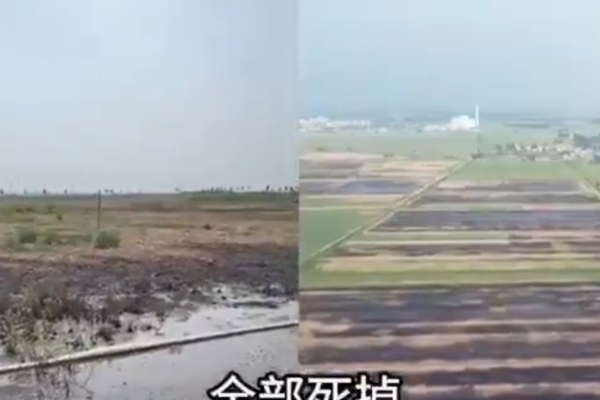
On May 12, several bloggers from mainland China posted videos revealing serious pollution in a large area of farmland in Rendian Village, Dongguantun Town, Juye County, Shandong Province. The pollution has led to a significant reduction in wheat production and even complete crop failure.
The videos show black polluted water flowing across the farmland, with the ditches on the edges filled with black water. The irrigation devices in the fields are continuously spraying black water out. According to the bloggers, this farmland is located in the Dongguantun Industrial Park in Juye County, with thousands of mu (Chinese unit of area) of farmland affected by pollution.
One of the bloggers told “Urban Scene” that he learned from local sources that the farmland has been polluted for over two years, resulting in large areas of wheat turning yellow and dying, causing severe yield reduction. Pipes buried in the fields continuously discharge foul-smelling sewage, with a stench similar to manure, and the surrounding area is filled with a strong odor and swarming with flies; “if you stay there for a long time, the smell will give you a headache.”
On May 12, Juye County, Heze City, Shandong Province issued a statement saying, “The area shown in the online video is a land area near Rendian Village of Dongguantun Town leased by a livestock manure treatment enterprise for returning biogas slurry to the fields. The enterprise mainly engages in the resource utilization of organic waste. The black liquid shown in the video is biogas slurry produced during the treatment of livestock manure by the enterprise.”
The official statement sparked doubts among netizens, with comments like, “Don’t trust them at all.” “I also find it unbelievable that an environmental protection business could produce black water.”
However, some people pointed out that biogas slurry can indeed be returned to the fields in small amounts, diluted, and used according to the season, as it is a nutrient solution. But such a large area and high concentration of black liquid have far exceeded the scope of “returning to the fields”; this is clearly dumping, not fertilization.
It is noted that biogas slurry contains high concentrations of ammonia nitrogen and salts. Excessive use can burn roots with ammonia nitrogen and cause salt accumulation, which directly destroys the microbial community in the soil. Some netizens commented, “Wheat surviving in such conditions would be a miracle.”