
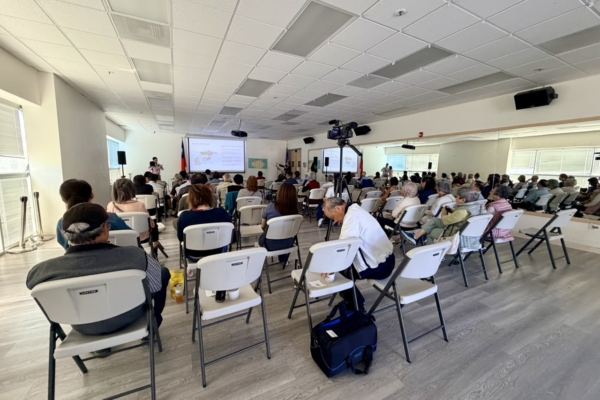
The Southern Bay Area Overseas Chinese Education Center held a “California Earthquake Emergency Crisis Management Seminar” on May 9th (last Saturday), inviting geological and earthquake expert Kevin Gill to speak and share insights on Bay Area earthquake risks, disaster preparedness, and emergency response strategies. Approximately fifty people attended the event.
Co-organized by the Northern California Taiwan Schools Association and the Taiwan-American Community Support Group for Emergencies, the seminar covered topics such as potential disasters from different earthquake magnitudes, emergency response and first aid knowledge, as well as earthquake emergency kit preparation. Interactive Q&A sessions and earthquake drills were conducted on-site to help participants enhance their disaster awareness and practical response capabilities.
In her address, Li Hanwen, President of the Northern California Taiwan Schools Association, emphasized California’s long-standing earthquake threats, highlighting that a major earthquake could strike without warning at any moment. She stressed the importance of individuals understanding how to respond in various scenarios, whether in an office, a vehicle, hiking, or in public areas.
Interviewed by the media, she mentioned that similar seminars were held several years ago, and the decision to organize one this year was to remind the public to prioritize earthquake preparedness and update their disaster prevention mindset.
As the main speaker, Kevin Gill is currently serving as a mining geologist. He holds a master’s degree in Geology, Geophysics, and Exploration from the Missouri University of Science and Technology, as well as a bachelor’s degree in Geological Engineering from the Colorado School of Mines. With around 11 years of experience in the mining field, he frequently deals with faults and geological environments. Through the seminar, he aims to share earthquake and geological knowledge with the community.
During the seminar, Kevin Gill pointed out that California experiences frequent earthquakes, largely due to the San Andreas Fault, which runs through the entire state. The fault is a strike-slip fault where two plates slide past each other, releasing energy, leading to California facing higher earthquake risks.
Regarding earthquake preparedness, Kevin stressed the importance of proactive planning, such as ensuring buildings have earthquake resistance, individuals have predetermined actions in case of an earthquake, and undergoing relevant training to understand how to react correctly during and after the disaster.
In the event of an earthquake, remaining calm is crucial, along with following the three-step protective measures: Drop, Cover, and Hold On. Individuals should immediately drop to the ground, cover their heads and neck with arms, and seek shelter under sturdy furniture. Additionally, staying away from windows, hanging objects, and tall furniture indoors, and moving away from buildings and power lines outdoors are recommended. Post-earthquake, precautions against aftershocks and checking water, electricity, and gas supplies at home are essential.
The seminar also highlighted the key preparation points for earthquake emergency kits. Li Hanwen mentioned that these kits differ from regular first aid kits, suggesting items like water, dry food, flashlight, batteries, lighter, hand-crank emergency radio, large plastic bags, medication for elders, copies of important documents, and supplies to sustain for at least three days, with some preparing for up to ten days. She recommended placing emergency kits in easily accessible locations at home and carrying one in the car trunk to be prepared in case of earthquakes while outdoors or on the road.
In the closing sessions, the organizers facilitated Q&A sessions, showcased emergency kits, and conducted earthquake drills to help participants practice finding shelter during earthquakes. The seminar emphasized that during earthquakes, individuals should avoid panicking and rushing outside, refrain from using elevators, and follow correct evacuation procedures by seeking cover under sturdy tables, chairs, or safe corners until the shaking stops before evacuating through designated escape routes.
In conclusion, the organizers introduced the training resources of the Community Emergency Response Team (CERT), assisting the public in establishing comprehensive earthquake disaster prevention and practical emergency response capabilities. ◇