
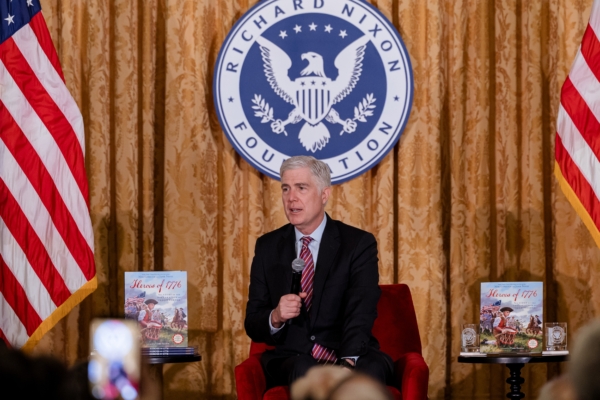
In recent days, US Supreme Court Justice Neil Gorsuch and lawyer, bestselling author Janie Nitze visited the Nixon Library along with residents to explore the courage and sacrifice of American Revolutionary War heroes, as well as the stories behind the Declaration of Independence. They also signed their new book titled “Heroes of 1776: The Story of the Declaration of Independence,” a children’s illustrated book featuring illustrations by Chris Ellison depicting the tense atmosphere, debates, and sacrifices of the founding fathers during the drafting of the Declaration of Independence in 1776.
This book is not only easy to understand but also inspiring, suitable for both children and adults to read together. Gorsuch and Nitze have previously co-authored “Over Ruled: The Human Toll of Too Much Law.”
The book signing event was part of the “America 250th Anniversary Lectures” series at the Nixon Library, hosted by Chapman University President Matthew J. Parlow.
Gorsuch mentioned that on the occasion of the 250th anniversary of the Declaration of Independence, it is an opportunity to reflect on the document and its underlying three principles: the equality of all people, the inherent unalienable rights bestowed by the creator, and the right to self-governance.
“These extraordinary principles are the foundation of our nation,” Gorsuch said. “The courage and sacrifice of the founders, such as depleting their fortunes, losing their lives, being separated from loved ones, or even facing imprisonment, with about one-third of them encountering such hardships, should be remembered.”
Nitze, being a mother of young children, expressed her struggle to find a children’s book about the Declaration of Independence that resonates with kids but lacked the human touch that makes the story vivid.
She mentioned that nothing was certain, as on July 1, 1776, there were significant divisions among the colonies, with 9 states supporting independence, 2 states against, and 1 state neutral, while New York abstained due to lack of instructions.
At a crucial moment, Delaware representative Caesar Rodney rode through the rain to cast a decisive vote on July 2; and South Carolina representative Edward Rutledge set aside personal biases to support independence, with Jefferson ultimately penning the idealism into words.
Children naturally love superheroes, and the creators of the Declaration of Independence were the superheroes of their time: ordinary people who achieved extraordinary deeds. Gorsuch highlighted the story of 18-year-old Emily Geiger, who was tasked with delivering secret messages to two patriot generals, got captured by the British but managed to deliver the information after eating the paper it was written on.
The war lasted eight years with the British occupying Philadelphia. Patriots sought the help of Baltimore printer Mary Catherine Goddard to widely distribute the Declaration of Independence. She printed the first broadside with signatories’ names on it, a document she signed at the bottom, but the Declaration was considered treasonous at the time.
Nitze noted that public opinion surveys indicate growing cynicism among Americans, with many believing people only act out of self-interest, but she admired the founding fathers for defending deeper values. She cited a soldier’s letter to his family saying, “Though uncertain of the dangers ahead, I would rather have it said to our children, ‘Your father was a coward.'”
Nathan Hale, a 20-year-old in the Continental Army, wrote in a letter to his father, “Strong sense of duty impels me to devote all I have to my country.” He was later captured, hanged, and famously stated, “I only regret that I have but one life to lose for my country.”
Nitze reiterated that virtues like courage, willingness to sacrifice for noble causes, and a sense of responsibility and honor are the core pillars of patriotism and the fundamental safeguards for the survival of a republic. She expressed hope that children could find inspiration from these figures.
The founding fathers also emphasized self-reflection and self-improvement. George Washington, at a young age, copied 110 rules of good behavior by hand, which helped shape him into a military leader and the nation’s president. His most valuable legacy, some argue, was not just leading the Continental Army to victory but voluntarily relinquishing power twice by resigning his military commission and refusing a third term as president.
Nitze stressed that the founding fathers considered virtues crucial, as the Declaration of Independence states people have the right to “pursue happiness,” not just sensory pleasure or comfort, but to strive to be virtuous individuals and live in a society of virtues.
Gorsuch mentioned 10-year-old Richard Lloyd Jones who followed the army into battle. At the time, many soldiers in the Continental Army lacked decent shoes, and Washington once described how soldiers’ footprints could be traced by their blood in the snow. Three years later, Jones, now 13, managed to trek 150 miles home alone after retiring from the army.
John Adams (the second president) and Jefferson (the third president) deliberated on who would draft the Declaration of Independence. While one might assume they’d argue over the honor, they both wanted the other to take the lead. After some back and forth, Jefferson finally asked in exasperation, “Why me?”
Adams replied, “First, you’re a Virginian, and a matter of this magnitude should be led by a Virginian, the most populous and wealthiest state. Second, I’m disliked and unpopular. Third, your writing skills are ten times better than mine.” Jefferson accepted the task, immersing himself in a rented bricklayer’s house outside Philadelphia, working without consulting any books or pamphlets, to draft the Declaration of Independence.
Gorsuch noted that through this story, we can witness invaluable virtues, humility, and an acknowledgment of the value of others – even those with differing opinions. He remarked, “We often think we live in divisive times, but compared to that era, it’s nothing.” He added, “They were once friends, parted ways for years due to differing views on the country’s direction, only to reconcile in their later years.”
They exchanged around 140 letters, each a treasure trove. Jefferson’s letter to Adams upon the loss of his wife is considered one of the most touching and uplifting condolence letters one can read. They realized the power of unity and how it’s stronger than divisions; they foresaw that there would always be those advocating for granting more power to the states in the future.
Nitze expressed her awe towards the widespread suffering and sacrifices manifested by the signatories, who made huge sacrifices for their ideals.
Richard Stockton of New Jersey was dragged out of bed by enemies in the dead of night; Abraham Clark’s two sons were captured, one nearly starved to death in prison; John Hart returned home from Philadelphia only to lose his wife shortly after.
Hart, a primary target for the British, had to flee in winter, hiding in caves and barns, never staying in the same place for more than a night, one time huddling for warmth next to a dog. Although he didn’t live to see the day of victory, his faith never wavered, even though the British promised amnesty to “rebels.”
Wealthy Virginia gentleman Thomas Nelson Jr. led state militia into battle and upon discovering British troops in his home, ordered fire. By the time of his death in 1789, he was penniless, having exhausted his fortune in support of the patriotic cause. Nelson said, “If it were to be done all over again, I would still make the same choices.”
Signatories of the Declaration faced hardships one after another, with at least five captured by the British, about a third witnessing their homes burnt, and almost all ending up destitute due to their commitment to the cause of freedom. Thomas Paine, who anonymously published the pamphlet “Common Sense” in January 1776, wrote, “These are the times that try men’s souls. The summer soldier and the sunshine patriot will, in this crisis, shrink from the service of their country.”
The war dragged on for years with Washington facing defeat after defeat. At one point, he wrote, “Unless some great and fundamental change takes place, the army will starve, dissolve, or disband.” In 1781, Washington seized the opportunity he had been waiting for, launching an attack on the British forces at Yorktown, with French allies blockading the sea, leading to British General Charles Cornwallis surrendering.
Gorsuch mentioned that only 13% of 8th-grade students in America reach proficiency in American history, and only 18% of colleges require students to take at least one American history course. Additionally, 6 out of 10 adults fail the citizenship test, which is not considered difficult.
How can this situation be turned around? Gorsuch said, “I can offer what I see, hear, think, and feel to everyone. Ultimately, the responsibility of solving the problem still rests on the people; the preamble of the US Constitution starts with ‘We the People,’ not ‘We the Judges,’ nor ‘We the Elite,’ as the power for change lies within the people themselves.”
At the time, about 15-20% of colonial residents were loyalists to Britain, 40% supported independence, and 40-45% were neutral. Nitze commented that in any era, it’s always easiest to pass on the daunting task of fighting for ideals to others, but “our writing aims to show that history is often driven forward by a few, like Samuel Adams, who dared to inspire the people and incite resistance.”
The British Empire then had the strongest army and navy with 200 warships and 30,000 well-trained professional soldiers crossing the Atlantic. They were well-equipped, not only with firearms and ammunition but also carrying blankets and clothing in their backpacks. In contrast, Washington led a newly formed Continental Army, mostly comprising farmers and laborers who had never seen battle and lacked essential supplies. By European standards, Washington was deemed unfit to command troops, and those signatories of the Declaration of Independence could have faced hanging.
Nitze emphasized that this reminds us that the freedom we enjoy today came with a significant cost, needing each generation to safeguard and pass it on to future descendants.
The book recounts the spring of 1776 in Philadelphia, echoing with the cries for independence. Patriots had enough of British rule, strongly opposing providing shelter and food to British troops, allowing random searches of homes by British spies, facing trial before royal judges rather than local juries, and imposed taxes. They yearned to establish a new nation where people could govern themselves, with laws guaranteeing individuals rights to speech, belief, and freedom to live autonomously. ◇