
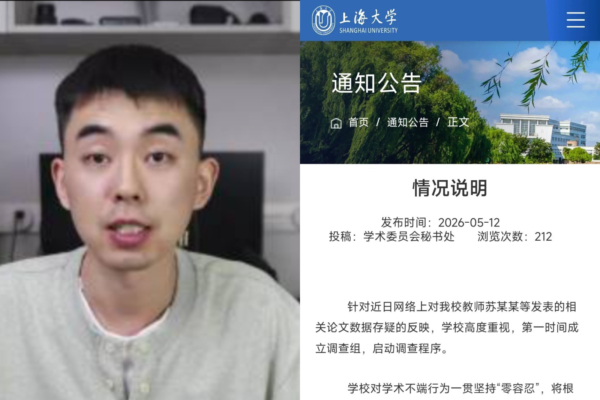
On May 12th, the well-known anti-counterfeiting blogger “Geng Xue” in mainland China posted a video on social media, publicly reporting suspicions of data fraud in a new paper published this year by Director Su of the Translational Medical College of Shanghai University. Prior to this, he had been continuously reporting on multiple individuals and admitted facing significant resistance recently.
The video titled “Geng Xue’s Storytelling” displayed evidence of data fraud in the representative first paper published on the official website of Su Jiacan, Dean of the Translational Medical College at Shanghai University, in the international top academic journal “Nature.”
“Geng Xue” detailed the evidence of fraud, such as highlighting in a chart the blue data column where “out of 13 data, 8 are the same, and the other 5 share similarities”; the green column where “out of 13 data, 11 have the same two decimal places, with 5 being identical”; the yellow column where “out of 13 data, 11 have the same two decimal places, with 6 being identical,” and so on.
He pointed out that it is evident that these data were fabricated out of thin air by the authors, mentioning that “there are always some people in this world who willfully engage in academic fraud, which ultimately only brings laughter to their peers.”
Following the release of the video, Shanghai University promptly issued a notification stating that the university had formed an investigation team and would handle the matter seriously based on the investigation findings.
Previously known as Geng Hongwei, “Geng Xue” was a doctoral student at the School of Biomedical Engineering of Beihang University in Beijing. He dropped out in 2025 to become a full-time anti-counterfeiting blogger and now has over 1.8 million fans. This is the fifth anti-counterfeiting action “Geng Xue” has taken in over a month.
On April 9th, “Geng Xue” reported data fraud in a paper published by Wang Ping, Dean of the School of Life Science and Technology at Tongji University, on “Nature.” On May 6th, Tongji University announced the removal of Wang Ping from the position of Dean of the School of Life Science and Technology, reduction of professional technical position level by two grades, and the cancellation of qualifications for position hiring, salary promotion, job promotion, research project application, award evaluation, and commendation for 24 months. Additionally, the paper’s author Jing Jiali was dismissed.
On April 25th, “Geng Xue” made another report concerning abnormal data in a paper regarding cancer cell drug resistance published by Chen Quan, Dean of the School of Life Sciences at Nankai University, in a sub-journal of “Nature Cancer” in January 2024. Nankai University responded on May 1st, stating that an investigation had been initiated.
On May 4th, “Geng Xue” reported image manipulation and data fabrication in a representative paper of the Experimental Research Department of the Tumor Prevention and Treatment Center at Sun Yat-sen University published in the sub-journal “Nature Cell Biology.” The university also initiated an investigation on May 5th.
On May 6th, “Geng Xue” released a video reporting on the paper published by Kuang Dongming, Vice Dean of the School of Life Sciences at Sun Yat-sen University and recipient of the National Distinguished Youth Science Fund, in “Nature Cell Biology” on February 12, 2026, pointing out numerous perplexing data and extremely unnatural statistical figures.
According to a report by Hong Kong’s “Ming Pao,” “Geng Xue’s” anti-counterfeiting actions have targeted top young scholars and leading academic journals in mainland China. The five individuals reported are all prominent figures in the field of biochemical medicine at prestigious universities. Behind these academic scandals lies the pressure of research being quantitatively assessed.
The report states that “under the pressure of ‘publishing papers is an absolute criterion,’ some scholars resort to plagiarism and fabrication, while the universities turn a blind eye.”
In the video on May 12th, “Geng Xue” mentioned that exposing several fraudulent papers is not their primary goal. Rather, they aim to raise awareness among more people that academic fraud in mainland China is severe and that relevant authorities should at least strengthen supervision over laboratories with large research funding.
However, he also admitted facing significant resistance. Despite working in the media industry for several years, the recent obstacles have proven to be the most challenging.