
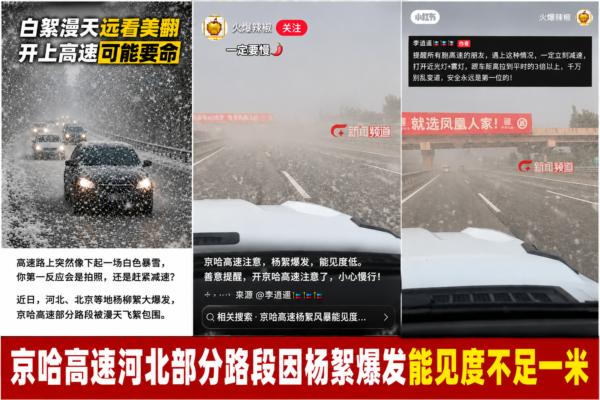
Recently, the cotton-like seeds of Beijing’s poplar trees have started to get out of control again, with citizens’ videos looking like a heavy snowfall in the city. In some sections of the Jingha Expressway, the visibility was less than 1 meter due to the flying seeds, leaving drivers feeling like they were in a disaster movie. Beijing residents describe the current environment as a hell for allergy sufferers.
Videos circulating on mainland social media recently showed a massive outbreak of cotton-like seeds in some sections of the Jingha Expressway in Hebei, appearing to enter a white fog with visibility of less than 1 meter. The fluttering poplar seeds densely covered the windshields, scaring the drivers and passengers, forcing them to slow down. At one point, the traffic police even closed a section of the road, leaving drivers stranded in their vehicles for three hours, staring blankly at the white fluff.
A video from the Tangshan section of the Jingha Expressway on May 9 was particularly shocking and made waves on the internet. The video quoted a driver with thirty years of experience saying, “The scene is like walking with your eyes closed, you can’t even see the road signs, and the wipers can’t clear the seeds on the windshield, scarier than a downpour.”
Netizens commented that the scene shrouded in white poplar seeds was like a disaster movie, frightening passing drivers. This year’s seed dispersion is doubly dense due to the impact of drought, significantly affecting road safety.
A local from Hebei explained to reporters that some sections of the Jingha Expressway are lined with a large number of poplar trees, causing the seeds to be lifted into the air at the slightest breeze, making this year particularly severe.
According to the Shandong Business Daily, aside from the Jingha Expressway, numerous highways in the entire Beijing-Tianjin-Hebei region have also experienced “cotton seed snowstorms,” leading to low visibility and urging vehicles to slow down.
Netizens outlined three major hazards of such road conditions: first, the risk of driving, as flying seeds obstruct visibility and block windscreens, easily leading to rear-end collisions and engine overheating from clogged radiators. The second is the risk of fire, as poplar seeds swiftly ignite upon encountering an open flame, acting like a mobile powder keg. The third is health hazards, as the seeds can trap pollen and dust, triggering allergies such as asthma and rhinitis.
Compared to the poplar seeds in Hebei, the cotton-like seeds from willow and poplar trees in Beijing persist for a longer time and are more severe. On May 8, a Beijing resident posted a plea for help, asking what was in the city’s air, as they had just ended the vacation and their urticaria had reappeared, their face had begun peeling, and rhinitis had resurfaced.
A netizen in the comments offered an explanation, “Because we have the nation’s highest pollen index.”
Videos captured by Beijing residents showed the air filled with drifting seeds, with one resident expressing, “At this moment, I’m about to collapse: this is too frightening.”
Another resident stated, “I am allergic to cypress, and I finally got better after more than a month, but these past two days, I don’t know why, I started sneezing again.”
A citizen exclaimed, “After being outside for a few minutes, my whole face is itchy and numb; Beijing is truly a hell for allergy sufferers.”
A young white-collar worker in Beijing informed a reporter from Dajiyuan that for about three weeks to a month each year, Beijing is like experiencing a snowstorm. They emphasized the importance of wearing masks when going out to prevent inhaling the problematic seeds, which can lead to lung problems if not addressed.
Apart from the pollen from cypresses causing allergies in Beijing, there are also the fluffy poplar seeds flying everywhere. On May 8, a citizen noted, “The number of seeds tonight is unusually high, and as soon as I step out, my nose starts running. It’s the first time in my years in Beijing that I have been so distinctly aware of my allergies.”
Another resident confirmed, “I live near Guanyuan Bridge in Xizhimen, and these past two days, I’ve avoided walking by that area, fearing being caught in a tearful, runny nose situation.”
According to the Southern Metropolis Daily, the outdoor concert of the band “Mayday” and Ashin at the Bird’s Nest in Beijing on May 8 was significantly affected by the flying seeds, causing them to cough continuously while performing.
There were residents in Beijing who couldn’t help but complain, “How come Beijing’s poplar seeds are acting up again? When will it end?”
A video captured by a Beijing resident on May 1 showed the air filled with drifting willow seeds, reminiscent of a heavy snowfall in winter. Comments in the online community expressed how frightening the situation was.
One Beijing resident lamented that this seed issue had been going on for two and a half months, settling down for a bit a few days ago but now had worsened again. They emphasized the need to be fully prepared when going out during this period, as both the poplar and willow seeds needed more than ten more days to completely disperse.
Residents shared their experiences, noting that a while ago, there were only a few flying seeds, and the windows were okay, but now they were completely covered. Some mentioned that their home windows were entirely blocked by the fluffy seeds.
One Beijing citizen expressed concerns for the future, foreseeing that the situation would worsen next year as the trees continued to grow, which frightened them. Residents living in traditional Beijing alleys commented on the overwhelming amount of poplar seeds in those areas.
An allergy-stricken Beijing resident painfully shared that they had to take medication every day and were constantly drowsy due to the allergy symptoms.
Another resident noted that the dermatology department at hospitals was overcrowded, sharing their personal experience of visiting a Beijing hospital and finding it frighteningly crowded, indicating the severity of the situation.
A Beijing resident told a reporter from Dajiyuan that a large portion of the population in Beijing was affected during this period each year, leading to crowded respiratory, eye, nose, and throat departments at hospitals. They described how almost everyone ends up coughing, reflecting how widespread the issue is.
The same citizen explained, “It seems pretty severe recently; we play sports regularly, but there always seem to be a few people out sick, saying they are unwell.”
A netizen who had fled Beijing and was currently living in Guangzhou suggested that allergic people in Beijing should leave as the situation would only worsen, indicating their own experience of significant improvements after leaving Beijing due to severe allergies.
They shared their struggles, saying, “I endured it for nine years but couldn’t take it anymore and had to leave. I had to give up a lot, but without good health, nothing else matters.”
A woman named Wang, who had also left Beijing for Guangzhou, revealed her experience of developing allergies after working in Beijing, leading to severe swelling every year, which automatically improved upon returning to Guangzhou.
Another netizen mentioned how they had no idea what allergies felt like until they spent two years in Beijing and developed allergic conjunctivitis.
A Beijing resident in distress shared, “I almost suffocated from allergies last year. The doctor suggested I have desensitization shots for two years. I asked about non-pharmacological treatments, and the doctor told me to keep wearing a mask.”
A white-collar worker in Beijing interviewed by Dajiyuan mentioned that the situation had worsened over the years and lasted longer each time. They explained the service offered in Beijing each year where auto repair shops clean cars of flying seeds for a fee, dismantling and cleaning the windshields and air intakes to avoid engine damage during the high seed season.
They stressed the high sales of imported air purifiers in Beijing due to the worsening air quality, highlighting how Chinese citizens had become accustomed to the situation, prioritizing survival over other concerns.
The individual also criticized the ineffective high fees for environmental management, noting the lack of clarity on actual improvements for ordinary citizens, as various methods employed may not yield significant results, leading to frustration among the populace.