
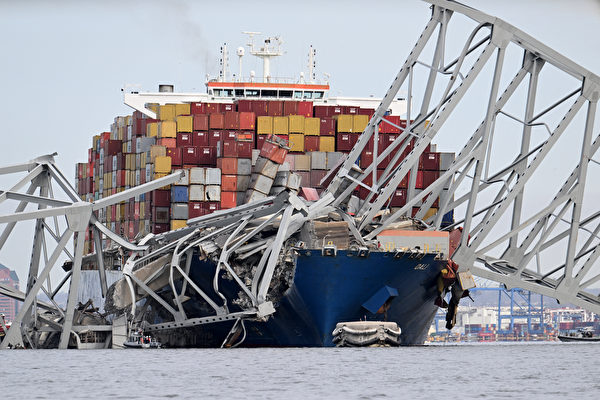
On Tuesday, the federal prosecutors in the United States announced that they have filed criminal charges against two foreign companies and a shore-based supervisor in connection with a cargo ship colliding with the Francis Scott Key Bridge in Maryland.
The incident occurred on March 26, 2024, when the 900-foot container ship named “Dali,” flying the flag of Singapore, crashed into the bridge in Maryland.
This accident resulted in the death of six construction workers who were working to repair holes on the bridge.
The ship was operated by Synergy Marine Pte Ltd., headquartered in Singapore, and Synergy Maritime Pte Ltd., headquartered in Chennai, India. These two companies are now charged with conspiracy, willfully failing to report known dangerous conditions to the U.S. Coast Guard promptly, obstructing justice, and providing false statements.
Radhakrishnan Karthik Nair, a 47-year-old Indian national, who served as the technical director for both companies, is also facing charges.
Acting U.S. Attorney General Todd Blanche stated in a press release, “The collapse of the Francis Scott Key Bridge was a tragedy that could have been avoided with extremely severe consequences.”
“This prosecution is a crucial step in holding those responsible for this disaster accountable for their disregard of maritime safety regulations. Six construction workers lost their lives, critical infrastructure was damaged, pollutants leaked into the Patapsco River and Chesapeake Bay, and economic losses have exceeded $5 billion. Our department is committed to seeking justice for the victims and ensuring that the perpetrators are held accountable.”
On March 26, 2024, the “Dali” experienced two power failures shortly after leaving the port of Baltimore, leading to the collision with the Francis Scott Key Bridge.
According to previous investigations, the shortcomings of the two Synergy companies (shared responsibility) include: First, long-term use of unsafe fuel supply practices. Since 2020, to save costs, changes were made to the vessel configuration, relying on a flushing pump not originally designed for the main generator fuel supply, providing oil for some of the generators. The pump failed to automatically restart after a power failure, causing the vessel to be unable to quickly restore power.
Second, failure to maintain the vessel’s seaworthiness and properly maintain electrical and mechanical systems (including high-voltage distribution boards), violating international maritime safety standards. When the “Dali” first experienced a power failure (possibly caused by a loose wire), it failed to restore power promptly to maneuver away from the bridge piers.
Third, the failure to immediately report known dangerous conditions. Relevant entities and individuals were aware of the dangerous fuel supply configuration on the vessel but did not promptly notify the U.S. Coast Guard.
Fourth, obstructing the investigation and providing false statements. The relevant entities provided false information and documents to the National Transportation Safety Board (NTSB) responsible for the investigation.