
New York has always been known as a city with a distinct flair, but in 2026, it seems to be particularly foul-smelling. As of now, the city’s non-emergency hotline, 311, has received a whopping 5,332 complaints about unusual odors, and the numbers continue to climb, with the peak of summer complaints yet to come.
According to data cited from the New York Post, from May to July last year, the city received a total of 4,093 odor complaints, higher than the 3,756 complaints during the same period in 2024. Throughout 2025, there were a total of 15,322 odor-related complaints, ranging from sewer smells, pigeon odors, chemical smells from nail salons, and street vendors’ cooking fumes.
The top five sources of odor complaints are vehicle idle emissions with 5,381 complaints, chemical gases and vapors with 2,812 complaints, sewage stench with 1,487 complaints, chemical odors with 1,357 complaints, and sewer smells with 1,202 complaints.
The Department of Environmental Protection (DEP) in New York City stated that the term “chemical odor” typically refers to scents like cleaning agents, gasoline, asphalt, or paint, rather than the usual garbage, exhaust, or animal waste smells.
In addition, New York City was ranked as the third smelliest city in America in 2025 by Prilla, following Houston and Los Angeles. However, according to the lifestyle website “Secret NYC,” the number of sewer smell complaints in New York City even surpassed the top-ranked Houston.
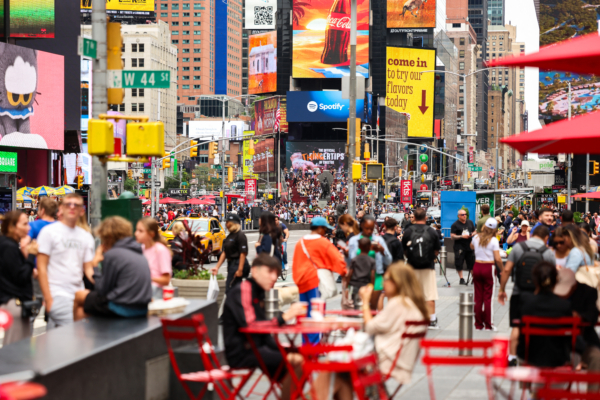
Among all zip codes, the 10036 area in Manhattan is considered the “stinkiest,” covering Times Square, the Theater District, and parts of Hell’s Kitchen.
In 2025, this area had a total of 1,648 odor complaints, with a significant 1,378 related to vehicle idle emissions.
Many complaints in this area are concentrated near 680 Eighth Avenue, close to the Port Authority Bus Terminal, where traffic volume is exceptionally high.
In recent years, the “Idle Vehicle Reporting Program” in New York City has contributed to the increasing number of related complaints. This program encourages people to report trucks idling illegally for more than 3 minutes, with successful reports potentially earning up to a 50% share of fines.
Greenpoint in Brooklyn also made the list. There were 267 odor complaints in the area last year, with 110 related to “animal smells.”
Residents have long complained about some dog owners not cleaning up after their pets, leading to the streets appearing like a “minefield.”
Furthermore, the Green Asphalt asphalt recycling plant has been a source of nuisance in the area for years. However, in December last year, the plant was temporarily closed for failing to meet state government requirements to increase the height of its chimneys, providing residents with some relief.
The 11235 zip code in Brooklyn, including Brighton Beach, Sheepshead Bay, and Manhattan Beach, accumulated 243 odor complaints last year, with 96 related to chemical vapors.
The DEP acknowledges that tracing the source of chemical odors is often challenging because gases are intermittent and tend to dissipate rapidly.
In the 11364 zip code where Bayside and Little Neck in Queens are located, there were 220 odor complaints last year, with 182 related to chemical odors.
To address the city’s “overwhelming stench” problem, the city government has been implementing ongoing measures to alleviate it.
In addition to the vehicle idling reporting system and closing odor-emitting factories, Mayor Mamdani announced last month the expansion of the “Trash Canization Program” initiated by former Mayor Adams. Starting in June this year, all residential buildings with 1 to 9 units will be required to use designated trash bins provided by the city.
According to city data, since the launch of the program in 2024, New York residents have ordered over a million trash bins, leading to a reduction in rodent infestations and garbage odors.