
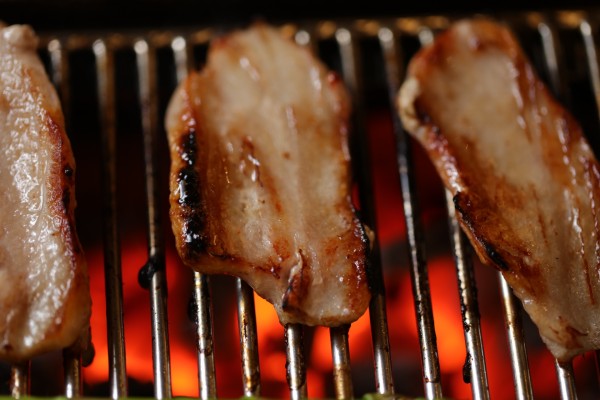
In China’s current economic downturn and high unemployment rate, there is a significant number of people signing up to learn “barbecue skills,” yet the acceptance rate at schools is extremely low.
According to a report by “Tide News,” the first barbecue industry college in China, the “Yueyang Barbecue Academy,” established in July last year, started enrolling students for its “Advanced Talent Training Class” from March 9 this year. The academy offers a one-month barbecue skills training program with a tuition fee of 5,800 yuan (RMB). Graduates will receive an official “Barbecue Chef” certificate upon completion.
The enrollment at the barbecue academy is open nationwide. By the deadline of April 9 for applications, over 4,000 people had applied, far exceeding expectations. However, the school only accepted 30 students, resulting in an acceptance rate of less than 0.75%.
Vice President Jiang Zongfu of Yueyang Open University, the driving force behind the establishment of the Yueyang Barbecue Academy, stated that the decision to accept only 30 students was to ensure teaching quality, allowing each student to receive practical guidance. Another reason for the limited acceptance was the ongoing renovation of student dormitories at the barbecue academy, which forced students to stay in hotels at a cost of 50 yuan per person per night, with the rest of the expenses subsidized by the school.
Jiang Zongfu previously expressed surprise at the source of applicants, stating, “I thought they were all locals, but as it turns out, 80% are from out of town. They come from all over the country, while the locals are not as many.”
Moreover, applicants include university graduates. Jiang Zongfu mentioned graduates from Wuhan University of Technology and Shu Da College of Hunan Normal University, both of whom have bachelor’s degrees. The Yueyang Barbecue Academy targets vocational education only.
American economist Huang Dawei, interviewed by Da Ji Yuan on May 10, stated that the trend of highly educated individuals engaging in low-end labor indicates that China’s high-end industries cannot absorb university graduates anymore. Knowledge-based individuals are forced to transition to lower-tier service sectors, reflecting a conservative societal expectation where entering the affluent class is no longer a viable fantasy, but rather seeking a survival mode.
The news has sparked discussions on social media. Some perceive the 5,800 yuan tuition fee for a one-month course as potentially exploitative, while barbecue practitioners highlight the significant regional differences in barbecue styles across China, indicating that establishing a single barbecue academy may not represent the entire industry culture effectively.
Located in Yueyang City, Hunan Province, the Yueyang Barbecue Academy is a collaboration between Yueyang Open University and the Yueyang Barbecue Association. It is reported that Yueyang City alone has over 2,000 barbecue establishments and 50,000 industry practitioners.
In addition to the barbecue academy, there are various other specialized colleges in China. In December 2025, the Guangdong Provincial Education Department and JD.com founded the first “Modern Delivery Rider Academy” in China, focusing on training full-time food delivery riders and couriers. In September 2025, Shenyang Vocational and Technical College in Liaoning Province established the “Bathing, Leisure, and Health Management Industry Academy,” playfully dubbed as China’s first “Bathing Academy” by netizens.
Previously, there were the “Orange Navel Academy” in Ganzhou, Jiangxi, the “Lobster Academy” in Qianjiang, Hubei, the “Grilled Fish Academy” in Wanzhou, Chongqing, and the “Snail Noodle Academy” in Liuzhou, Guangxi.
Huang Dawei commented that presenting relatively low-end service sectors as industries with high technical and knowledge content, as part of a grand narrative extension, implies that the government aims to profit from these fundamentally low-end services, akin to selling shovels rather than mining for gold.
The report mentions that students in the barbecue class have to head to the local farmer’s market as early as 3:30 a.m. daily to observe the beef cutting process, with industry professionals personally tutoring them on beef cuts, butter quality, and ingredient selection techniques to establish standardized operating procedures.