
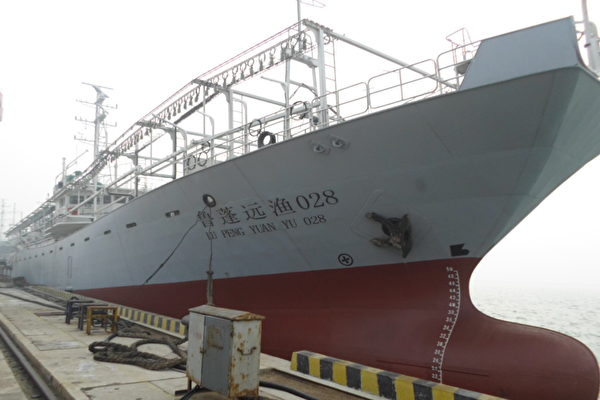
In recent years, the resources of Japanese flying squid have significantly declined, with China’s overfishing by its distant-water fishing vessels being one of the reasons contributing to the sharp drop in the squid population, according to Japan. The World Wide Fund for Nature (WWF) Japan reiterates once again that “one of the reasons is China’s illegal, unreported, and unregulated fishing activities.”
According to the latest statistics from the Food and Agriculture Organization of the United Nations (FAO), the catch of Japanese flying squid in Japan was 33,502 tons in 2024, a decrease of about 26% from 45,290 tons in 2023, and about 53% from 70,711 tons in 2022. The current catch is only one-twentieth of the peak catch in 1996 when it was 715,900 tons. In 2024, Japan caught 19,800 tons, while Korea caught 13,500 tons, and Russia caught 150 tons. China did not report its catch to the FAO, so it appears as zero in FAO records.
According to a report in the Nikkei newspaper, Shuhei Uematsu from WWF Japan’s Marine and Seafood team stated, “The resources of Japanese flying squid in the Sea of Japan are significantly decreasing. One of the reasons is China’s illegal, unreported, and unregulated fishing activities.”
The “2026 National Trade Estimate Report on Foreign Trade Barriers” published by the United States on February 28 describes China’s distant-water fishing industry as having one of the world’s largest fishing fleets, estimated at 486,530 vessels. Their catch represents over one-third of the global catch of distant-water fishing. The Chinese government provides substantial subsidies, especially for distant-water fishing, allowing its fishing fleets to operate legally or illegally in waters belonging to other countries and on the high seas.
It is estimated that China’s annual subsidy amount ranges between $4 billion and $6 billion, with over half going to the distant-water fishing fleets. These subsidies are estimated to be equivalent to 20% to 40% of the value of China’s distant-water fishing hauls, indicating that without significant government support, China’s distant-water fishing industry would not be viable.
China is the world’s largest producer of marine fishing, and since joining the World Trade Organization, it has been supporting its fishing fleets through subsidies and other market-distorting mechanisms. In terms of marine catch volume, China’s annual fishing catch is nearly twice that of the world’s second and third largest fishing nations and three times that of other major fishing nations such as the United States.
Simultaneously, reports continue to suggest that Chinese-flagged distant-water fishing vessels engage in illegal, unreported, and unregulated (IUU) fishing activities, including in waters under the jurisdiction of other WTO member countries. Despite making some progress in reducing subsidies to domestic fisheries, China continues to transfer its surplus fishing resources beyond its jurisdiction by providing higher proportions of subsidies to its distant-water fishing enterprises.
IUU fishing refers to illegal, unreported, and unregulated fishing activities. In a 2020 report by Japan’s Ministry of Agriculture, Forestry and Fisheries, China’s catch volume was first considered, attributing the sharp decline in Japanese flying squid resources in the Sea of Japan to rising sea temperatures and China’s overfishing.
Japanese media reported that while the fishing activities of Chinese vessels were previously unclear, estimates based on research papers and other statistical data suggest that China caught 150,000 tons of Japanese flying squid in the Sea of Japan in the 2019 fiscal year. In comparison, Japan’s catch at that time was approximately 14,000 tons, less than one-tenth of China’s catch and the lowest level in nearly 30 years.
In 2019, the FAO estimated the global catch of Japanese flying squid to be 101,800 tons. Based on Japanese estimates, China’s catch that year was approximately 1.5 times the global catch volume.
Japanese flying squid is a species found in both offshore and nearshore waters, distributed in water temperatures ranging from 5°C to 27°C, typically inhabiting the surface to 100 meters deep, occasionally reaching depths of 500 meters. With a lifespan of only about one year, it migrates northward and then southward, typically closely associated with major surface ocean currents.
As China does not have an exclusive economic zone (EEZ) in the Sea of Japan, it should not be fishing in that area. However, it is believed that China has acquired fishing rights from North Korea, allowing them to operate within North Korea’s EEZ. Chinese fishing vessels also illegally enter Japan’s EEZ for fishing.
A Japanese government official stated, “The squids caught (by China) were likely mostly a result of illegal fishing within Japan’s exclusive economic zone.”
Chinese fishing vessels primarily target the waters near the Oyashio Current off the Noto Peninsula, located along the coast of Ishikawa Prefecture in central Japan, a rich fishing ground within Japan’s EEZ. From January to September 2020, Japan’s Fisheries Agency issued warnings to 2,586 Chinese fishing vessels, three times the number during the same period the previous year, urging them to leave the area.
In February this year, Japan detained a Chinese fishing vessel, marking the first detention of a Chinese vessel since 2022. Prime Minister Sanae Takashii of Japan stated on social media, “On February 12th, a patrol vessel of the Fisheries Agency discovered a Chinese fishing vessel in the Exclusive Economic Zone (EEZ) west of Yakushima and requested it to stop for a fisheries inspection. However, the vessel did not comply with the instructions and fled, leading to the arrest of the vessel’s captain under Article 15, Paragraph 2, Item 1, and Article 18 of the Exclusive Economic Zone Fisheries and Other Sovereign Rights Enforcement Act.”
According to reports, shortly after the arrest of the vessel’s captain, Japan released him at the request of the Chinese Consulate in Japan.
Chinese fishing activities along the coasts of South America have also increased, with fishing of the Humboldt squid outside Peru’s exclusive economic zone becoming more frequent, causing concern for the Peruvian government.
In response to China’s IUU-style fishing activities, Japan, Peru, and other countries are calling for international management.
In 2022, Japan enacted a law requiring imported mackerel, saury, sardines, and squid to provide proof of legal fishing.