
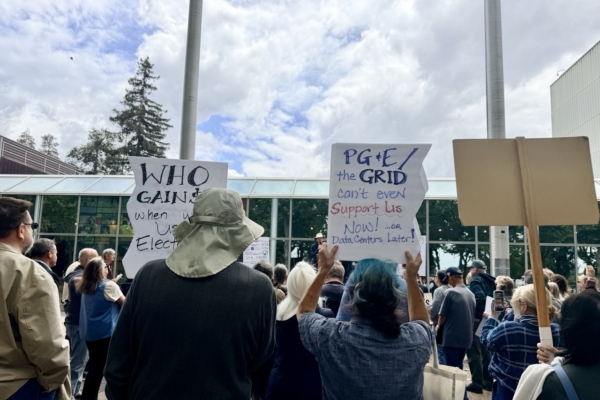
Business leaders and residents in the South Bay gathered in front of the Santa Clara County Government on May 4th to urge a halt to the gas water heater ban set to take effect in 2027. They called on relevant departments to reconsider the impact of the policy on families, small landlords, and small businesses.
The Bay Area Air Quality Management District (BAAQMD) passed regulations in 2023 that will limit the replacement of gas water heaters starting in 2027. The ban will extend to gas furnaces in 2029 and larger commercial heating equipment in 2031, covering nine counties in the Bay Area.
The gathering was organized by the Silicon Valley Business Alliance. Johnny Khamis, the chairman of the alliance, stated that this regulation will affect every household, yet most people are still unaware. He said, “When they realize the law has been passed, they will feel angry.”
Khamis pointed out that starting in 2027, residents who need to replace water heaters will no longer be able to do so as easily as before, where the cost was only $2,000 to replace gas equipment.
Instead, people may be forced to switch to electric water heaters and upgrade their electrical panels, or even upgrade the main electrical cable to the house. In extreme cases, if permission is needed from PG&E to upgrade the main cable, the entire power upgrade process could take up to a year and cost as much as $100,000.
Khamis advocated that policies should follow the promotion methods of electric vehicles and solar panels by providing tax refunds, subsidies, or tax credits instead of using bans to force people to bear high costs.
Industry insiders noted that full electrification involves more than just replacing appliances; it requires upgrading the entire house’s electrical system. Many old houses in the Bay Area built from the 1950s to the 1970s have electrical capacities of 60 to 100 amperes, which may require upgrading electrical panels to at least 200 amperes and adding dedicated circuits, along with permit applications.
If PG&E is involved in upgrading service lines or underground cables, wait times could extend from 6 weeks to 6 months. Even for residences built after the late 1990s with a 200 ampere capacity, replacement equipment could take around 5 days and cost approximately $10,000. If multiple homeowners upgrade simultaneously, PG&E may also face pressure to upgrade street transformers, as the existing public power infrastructure may struggle to cope.
Dan Pan, a director at the Business and Housing Network (BAHN), warned that small family landlords are among the most severely affected groups, and without financial support, mandatory upgrades to the electrical system could leave small landlords and tenants in distress.
Chair of the Silicon Valley Business Political Action Committee (PAC), Tracey Enfantino, spoke on behalf of small businesses. She pointed out that establishments like restaurants, laundromats, gyms, salons, small manufacturers, and auto repair shops have different hot water needs compared to residential homes. Being compelled to switch to electric heating equipment that meets zero nitrogen oxide emission standards could lead to panel upgrades, construction delays, and high costs.
Several residents also expressed their concerns at the event. Homeowner Joseph Weinstein said that inquiring with electricians, the city, and PG&E revealed that complying with the new regulations could involve permit applications, electrical upgrades, road excavation, and long wait times. He mentioned that city permits could take 30 to 60 days, and PG&E could not clearly communicate specific requirements, leaving people to search through a 1,200-page manual online themselves.
Chinese resident Alice Gao stated that the gas equipment ban is highly unreasonable, and if fully implemented, she would even consider moving. She questioned whether full electrification truly benefits the environment, as much of the electricity still comes from natural gas generation. For homeowners, however, replacing equipment and upgrading panels could cost tens of thousands of dollars, if not more. The burden is particularly heavy for old houses, leaving them “with no hot water in the end.”
Another Chinese resident, Jenny Zhao, expressed concerns about the high cost of retrofitting older homes with electric systems, and the fact that the cost of heating water with electricity is much higher than with gas, potentially leading to the issue of affordability in the long run.
Founder of Asians Unite, Tuan Ngo, traveled from Berkeley to show support that day. He warned that the current electrical grid and infrastructure are not ready for full electrification, and many homeowners and housing providers are unable to afford upgrade costs reaching tens of thousands of dollars.
The gathering called on the public to contact elected officials from the South Bay who serve on the BAAQMD board to listen to the concerns of residents and businesses and to repeal the ban. The board is scheduled to convene on the 6th to discuss whether to grant exemptions to some families who find it difficult to afford equipment replacements.