
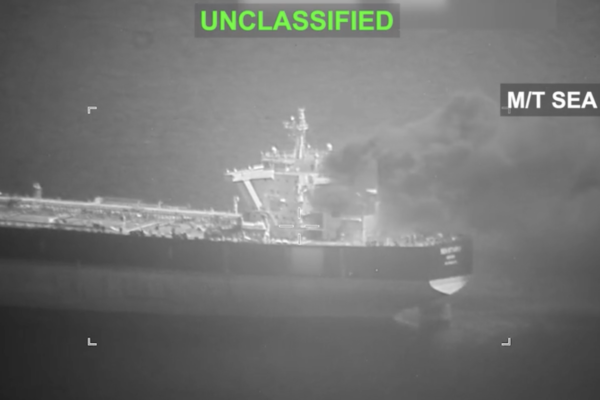
The U.S. Central Command said on Friday that an F/A-18 “Super Hornet” fighter jet launched from the USS George H.W. Bush aircraft carrier carried out precise strikes on two Iranian-flagged oil tankers in the Gulf of Oman, rendering them “paralyzed.” According to the Central Command, these two tankers violated the U.S. blockade on Iranian ports.
The airstrike on the tankers occurred on Friday as they attempted to enter an Iranian port in the Gulf of Oman. The U.S. military took action before the Iranian vessels, the M/T Sea Star III and M/T Sevda, could reach the Iranian port, rendering them ineffective.
The Central Command detailed the sequence of events, stating that the U.S. imposed a blockade on the two empty oil tankers as they attempted to enter an Iranian port in the Gulf of Oman. An F/A-18 “Super Hornet” fighter jet from the USS Bush aircraft carrier fired precision munitions at the smokestacks of the tankers, causing them to be incapacitated and preventing the non-compliant vessels from entering Iranian territory.
On May 6th, the U.S. also fired at the Iranian oil tanker, the M/T Hasna, while it was trying to sail to an Iranian port, leading to its immobilization. These actions were taken against vessels violating the U.S. blockade directive, preventing their entry into Iranian ports.
The Central Command confirmed that these three tankers are no longer able to reach Iran. The U.S. military in the Middle East will continue to enforce the blockade on vessels entering and exiting Iran. “Our highly trained military personnel are executing incredible missions,” said Central Command Commander Brad Cooper.
A U.S. official told Fox News that on Friday, airstrikes were launched against several oil tankers attempting to break through the U.S. blockade. These tankers were described as Very Large Crude Carriers (VLCC), massive empty vessels attempting to return to Iran and break the blockade.
The official added that multiple tankers were targeted in the airstrikes. On social media platform X, the Central Command stated that it has prevented more than 70 oil tankers from entering Iranian ports, capable of transporting over 166 million barrels of Iranian oil valued at over $13 billion.
Due to the blockade imposed by the U.S., Iran’s oil exports are under pressure, and Iran faces the closure of oil wells. These empty tankers may be attempting to return to Iran as temporary storage space to help alleviate the oil storage pressure.
Miad Maleki, a senior researcher at the Foundation for Defense of Democracies, earlier informed Fox News that Iran’s traditional oil storage capacity only lasts for 13 days, and they have been using empty tankers to store oil to buy themselves more time.
Maleki stated that their onshore storage capacity is running out, and they still have a batch of tankers that can be used to store oil. On Friday, the Iranian Foreign Ministry condemned the U.S. attacks on two Iranian oil tankers in the Strait of Hormuz.